

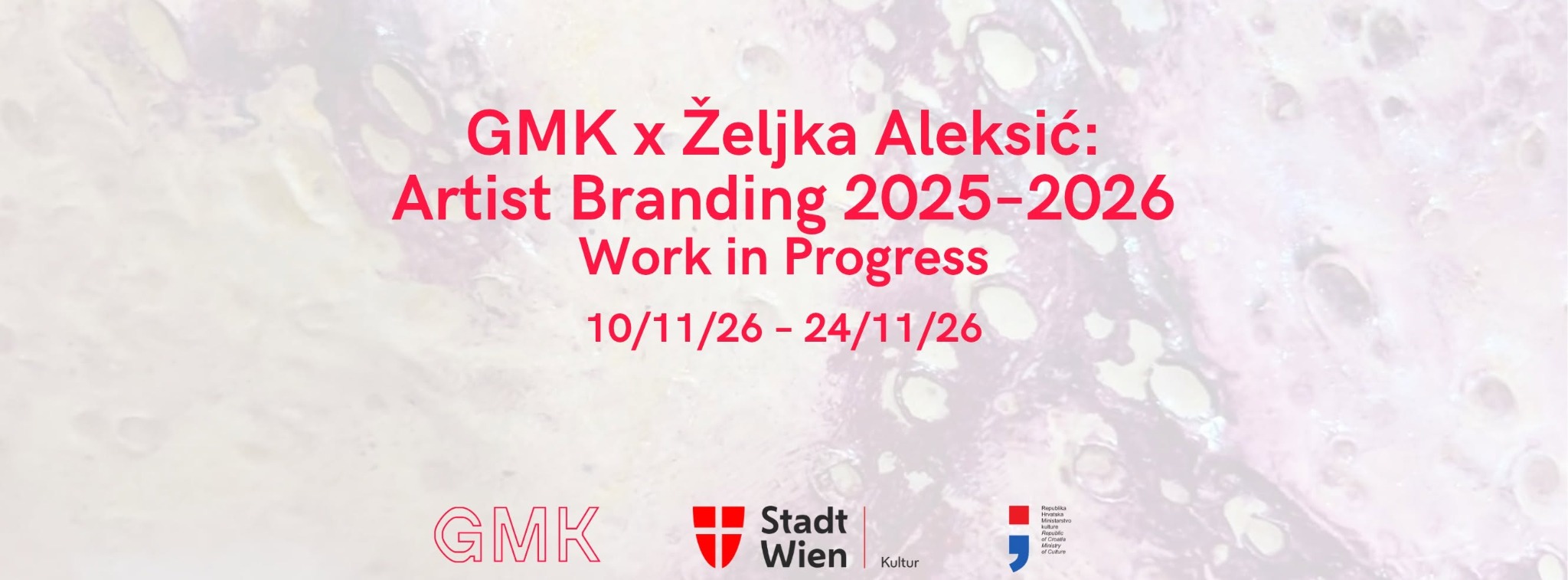
New exhibition
10ka, GMK, 29 Pavla Šubića Street, Zagreb
Opening: Tuesday, 10 November 2026, 7 pm
Exhibition dates: 10–24 November 2026
Gallery hours: Tue–Fri 4–7 pm / Sat 10 am–1 pm
Free admission
We warmly invite you to the opening of Željka Aleksić’s solo exhibition, “Artist Branding 2025–2026 – Work in Progress.”
What does it mean to work on oneself today, and how much is that work worth? In Artist Branding 2025–2026 – Work in Progress, Željka Aleksić explores how personal and artistic identities are shaped under the pressure of the market, social expectations and institutional systems. Drawing on her own body and lived experience, the artist questions the imperative of constant self-improvement, self-presentation and the production of one’s own visibility.
Working across a range of media, from photography to installation, Aleksić connects the shaping of the body with the construction of a personal artistic brand. From clothing-size restrictions and gym workouts to skin, bruises, earrings inspired by household bathroom scales and the digital tracking of everyday movement, the works raise questions of embodiment, belonging, class position and market value. The body becomes a project in need of constant improvement, while the artist simultaneously takes on the roles of author, performer and worker, investing her own time, energy and resources in the production of an artistic and personal identity.
By using and subverting the mechanisms of self-promotion, Željka Aleksić exposes the absurdity of a system in which individuals are expected to constantly increase their own value. But who actually benefits from this labour? Are we paid to work on ourselves, or are we expected to do this work for free, at the expense of our own bodies, time and resources? Artist Branding 2025–2026 – Work in Progress opens up a space to reconsider the boundary between the personal desire for change and the social pressure placed on us, as artists and cultural workers, to become ever better, more visible and more desirable versions of ourselves.
Foreword
What must women artists become in order to be recognised as artists? Must they be healthy, beautiful, disciplined, socially active, digitally present and capable of continuously producing their own visibility? How much labour does the production of one’s own image require, and who can afford that labour?
Artistic work today no longer ends with the production of an artwork. It also entails the continuous presentation of oneself, the maintenance of one’s visibility and adaptation to the expectations of markets and institutions. In Artist Branding 2025–2026: Work in Progress, Željka Aleksić examines the construction of her own identity within a system that ties value to the capacity for self-presentation. The artist is simultaneously the author of the project and a project in her own right: someone perpetually working to improve her own image.
The body is one of the principal sites where this process unfolds: a surface upon which social expectations are inscribed, a space of belonging, but also a place where personal limits are negotiated. Like a brand, the body is shaped through constant evaluation, correction and the promise that it could become better, more desirable and more successful. In this process, the boundary between a personal desire for change and social pressure becomes increasingly blurred.
The photographic works produced during visits to clothing stores along Vienna’s Mariahilfer Straße begin with a simple procedure: the artist asks for the largest clothing size available in each shop. Confronting the limits of standard sizing raises questions about normative representations of the body and the bodies excluded from them. Installed in the gallery windows, the photographs simulate shop displays and fitting rooms. While some are visible from the street, drawing back a curtain reveals a more intimate layer of the work: photographs of the artist’s body from the period when she was at her highest weight. This establishes a relationship between public image and personal experience, visibility and concealment.
In the video work Curatorial Support, the shaping of the body is directly connected to the construction of artistic identity. The video documents a gym workout involving the artist and a curator, who assumes the role of personal trainer and guides Aleksić through exercises aimed at defining her body. The training becomes a performative situation in which physical discipline intersects with institutional power relations. Curatorial support acquires both literal and symbolic meaning: who determines what must be shaped and improved for an artist to become more desirable within the art system?
The work also addresses the artist’s class position and the relationship between artistic and physical labour. Drawing on her own experience, Aleksić regards the workout not merely as a means of reshaping her body but as a job to be performed. The grant awarded for the realisation of the work further emphasises the economic dimension of artistic production. The artist is simultaneously author, performer and worker, investing time, energy and physical effort in carrying out a paid assignment. The logic of the work ethic enters the gym: if you are paid well for a job, you are expected to do it well. The body thus becomes an instrument of labour that must be disciplined, while art emerges as a form of work conditioned by economic circumstances, the need to earn a living and the demand for productivity.
The examination of the body as an object of transformation continues in works investigating the skin and its materiality. Stains and pigmentation in the paintings evoke bruises and contusions, while a wall installation resembling fragments of skin emphasises its organic and tactile qualities. Skin appears as a sensitive surface upon which traces of injury, touch and time remain.
A work in which a household bathroom scale is transformed into a pair of earrings, subsequently offered for sale, reverses the conventional system through which bodies are assigned value. The price of the earrings increases in proportion to the artist’s weight loss: the fewer kilograms, the greater their value. Through this procedure, Aleksić ironises the economic logic of the beauty industry, which turns thinness into a commodity and bodily insecurity into an incentive for continuous consumption. An object designed to measure the body becomes a fashion accessory whose market value rises precisely as body weight decreases. The work questions the ways in which the female body is transformed into a project of perpetual optimisation, discipline and market valuation.
In Pređeni put (Distance Travelled), Aleksić extends the question of self-presentation into the digital sphere and the social strategies of belonging. Using data collected by a smartwatch — step counts, distances travelled and calories burned — the artist documents her daily movements and publishes them on Instagram. Tracking physical activity thus becomes both an archive of everyday life and a means of building an audience and social visibility. Underlying the work is the experience of migration and the difficulties of professional and administrative integration in Vienna. Physical movement also becomes a metaphor for social mobility, while digital self-presentation takes on the function of a strategy for integration and the accumulation of social capital.
Visibility, therefore, concerns not only appearance and artistic recognition but also the possibility of social and professional belonging. The body becomes a site where the personal desire to belong encounters the pressure to change something about oneself in order to achieve that belonging. Branding is thus not limited to physical appearance and self-promotion. It also concerns the need to make one’s identity recognisable within various social, economic and institutional systems.
The project addresses not only the imperative of self-improvement but also the conditions under which such improvement is expected. The artist works simultaneously on herself and for others, producing an artwork as well as her own value. Self-presentation becomes a form of self-discipline, while the personal desire for change reflects a market imperative. This raises the question of how much room there is to refuse such demands for those whose artistic and personal survival is already conditioned by economic insecurity and social exclusion.
Aleksić does not reject the system of self-promotion. Instead, she employs its mechanisms while simultaneously exposing their absurdity. The question remains whether the artist is genuinely attempting to adapt to the rules of the game or whether, by playing according to those rules, she pushes the entire process to the point of absurdity. Perhaps the inability to distinguish one from the other with any certainty is part of the project’s very point. In any case, working on oneself appears to be a job that never ends. As we continuously invest in our visibility, appearance and market value, who actually profits from the work we do on ourselves?
Antonela Solenički
About the artist
Željka Aleksić (1989, Knjaževac, Serbia) is a visual artist and poet based in Vienna. She graduated in Contextual Painting from the Academy of Fine Arts Vienna in 2023, where she studied in the class of Despina Stokou.
Her artistic practice encompasses painting, photography, performance, installation, sculpture and text. Drawing on autobiographical experience, she explores the position of women and the working class, precarious working conditions, migration, economic inequality and the construction of personal identity. Her work is particularly concerned with the relationships between labour, class, gender and economic power, as well as the conditions that determine the possibility of establishing a professional career in the arts.
Her long-term project Das Kapital (2017–2023) examines the economic conditions of art education in Vienna and her experience of financing her studies through various forms of work. In 2023, she received the First Prize for her diploma project from the Academy of Fine Arts Vienna and participated in the exhibition of the year’s best diploma projects at Kunsthalle Wien. She was a finalist for the “Dimitrije Bašičević Mangelos” Award and received the Akademie Studio Programm and the Austrian Startstipendium for Visual Arts. In 2025, she received the Erste Bank Anerkennungskunstpreis.
She has been writing poetry since 2012. Her poetry manuscript Žena koja ima tremu (A Woman with Stage Fright) won the “Prva knjiga” (First Book) competition organised by the Banat Cultural Centre in 2025.
She is currently working on Artist Branding 2025–2026: Work in Progress, a project exploring the construction of artistic identity, self-presentation and the mechanisms of the contemporary cultural market.
Exhibition credits
Artist: Željka Aleksić
Exhibition title: Artist Branding 2025–2026 – Work in Progress
Dates: 10–24 November 2026
Venue: Miroslav Kraljević Gallery (GMK), 29 Pavla Šubića Street, Zagreb
Foreword: Antonela Solenički
Gallery Directors: Tea Matanović, Antonela Solenički
Production: Generator of Multidisciplinary Co-productions (GMK)
Supported by: Ministry of Culture and Media of the Republic of Croatia and the City of Vienna (Stadt Wien Kultur), through the 2026 Working Grant for Visual and Media Arts (Arbeitsstipendium Bildende Kunst und Medienkunst 2026).
