

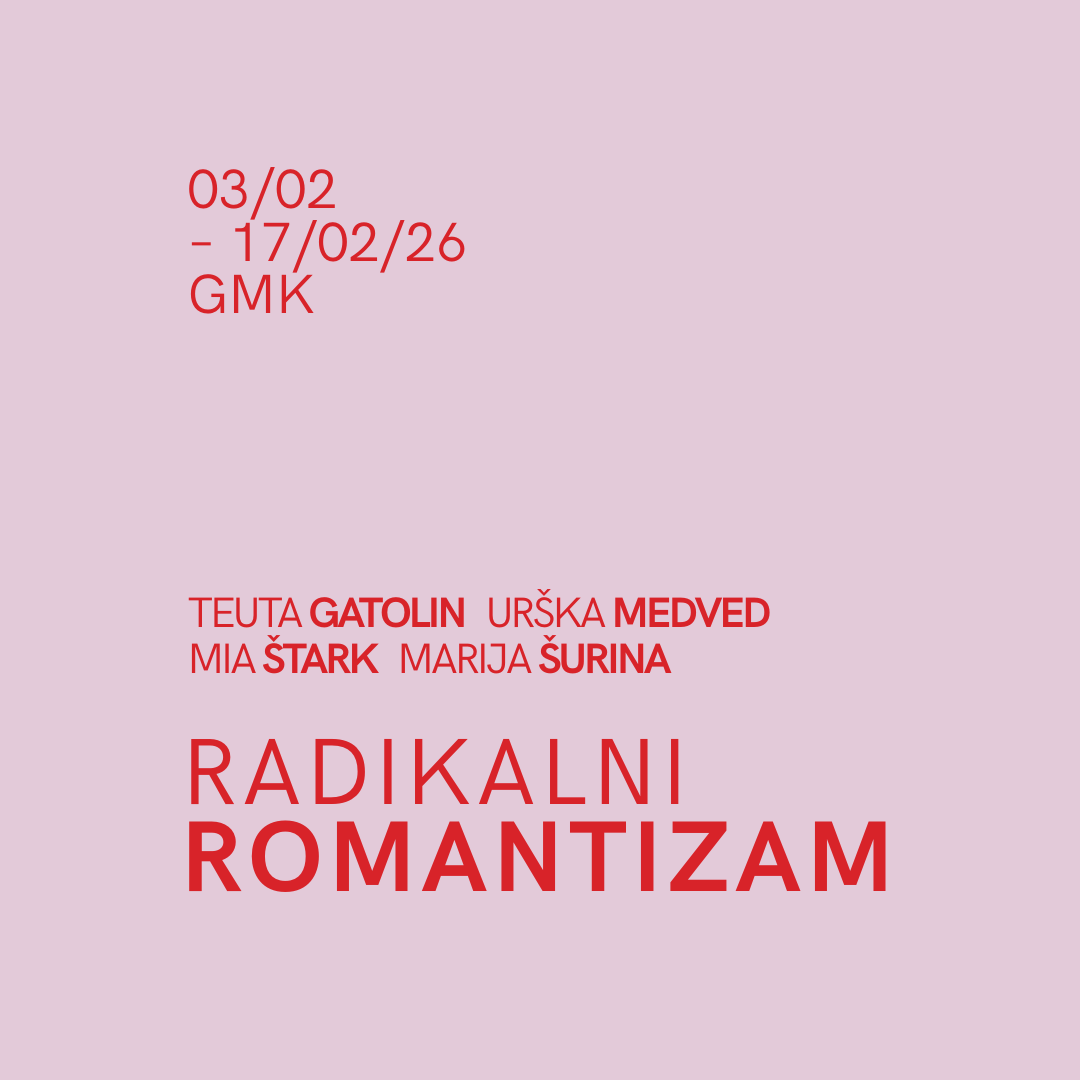
new solo exhibition
spaces 10ka and 8ica, GMK, Šubićeva 29
opening: Tuesday, 3 February 2026, 7:00 PM
duration: until 17 February 2026
gallery opening hours: Tue–Fri: 4–7 PM / Sat: 10 AM–1 PM
free admission
Galerija Miroslav Kraljević invites you to the opening of the exhibition Radical Romanticism, bringing together works by Teuta Gatolin, Marija Šurina, Mia Štark, and Urška Medved, curated by Maja Pavlinić.
The exhibition departs from the question of how to think rest, slowness, and tenderness under conditions of constant acceleration, hyperproduction, and pressures of efficiency. Radical Romanticism does not call for nostalgia; rather, it understands romanticism as a conscious decision for vulnerability, one’s own rhythm, and resistance to the instrumentalisation of the body, time, and attention. Through interdisciplinary artistic practices, the exhibition constructs an atmosphere of pause and deceleration, in which the works function as sensory situations rather than illustrations of theory.
The curator’s text follows below.
Foreword
Radical Romanticism is an exhibition by four artists who, through closely related approaches, question the idea of the radical as that which steps outside the norm. Guided by this premise, they explore radical romanticism as an idealistic distortion of reality—a reality saturated with a cacophony of information, constant haste, bureaucracy, superficial communication, a lack of genuine closeness and tenderness, and the capitalist imperative of continuous, quantified production. The exhibition opens a heterogeneous contemporary commentary that echoes Nietzsche’s warning about the danger of the individual losing their own rhythm of living and becoming a mere extension of the machine.
In contrast, the artists position their own practices, encompassing a spectrum of media—textiles, photography, printmaking, painting, text, archives, and ambient elements—which oppose socially dominant demands of action, labour, and being. Drawing on avant-garde models, artists Urška Medved and Mia Štark jointly write a synopsis of the Manifesto of Radical Romanticism, laying the foundation for further work: genuine and authentic connection and communication; learning through practice and making; opposition to instant art (and instant life); advocacy for rest and for work that includes rest as an equal component; tenderness toward oneself and others; a return to nature; and the fostering of togetherness. In clear language, they embrace Aristotle’s premise that without rest there is no freedom of thought nor truly human action, expanding it through Hannah Arendt’s critique of the logic of productivity. They draw on critiques of the burnout society (after Byung-Chul Han) and practically translate ideas from Zen Buddhism.
One step toward embodying the manifesto was carried out through a short-term research stay in Sweden, where the artists, in the solitude of wild and impressive nature—far from the rush of urban life—deepened the project’s philosophical foundation and dedicated themselves to creation within the calm rhythm of the environment.
The residency-based work is presented in a joint series of silkscreen prints. The next step is this exhibition, in which the concept leaves the safety of intimate exchange among the artists and enters into communication with the public. Teuta Gatolin creates an environment of multiple viewpoints through fragmented series of objects and videos, questioning the diversity of perspectives—of people, objects, animals, plants, and spaces—and the possibilities of their distortion through minimal shifts from the “ordinary.” Štark returns to the landscape through Polaroid photography, which cannot be manipulated, and through her fundamental medium of multi-original printmaking. Her new series of landscapes, titled All My Slavonian Landscapes, uses sequences of Polaroids and silkscreen prints as an alternative diary, conveying the need of body, eye, and soul for grounding in landscapes where the earth becomes home. Urška Medved skillfully overturns learned conventions: in her installation, tangible materials compel a return to the physical body, while the abstraction of text, image, and thought dissolves into simple clarity. Marija Šurina concludes this version of Radical Romanticism with illusion—photographing impressions in the manner of a recognisable impressionist signature, shifting the boundaries of perception by deceiving both eye and mind.
Through this group exhibition, the artists dismantle the dominant demand for hyperproduction and the constant search for what is new, faster, and more efficient, questioning the fetishisation of futurism and the rigid separation of humans from nature. They transform the exhibition space into a space of slowing down, rest, closeness, and subjective attention toward oneself and the viewer. In doing so, they point to the limitations of life in a world of infinite possibilities and information, offering approaches that minimise the risks of burnout, anxiety, and identity destabilisation caused by constant and violent changes, trends, and market demands. Radical Romanticism thus transcends a single concept, a single research process, and an exhibition, becoming a free guideline for soft resistance to existing conditions and for collective, constructive growth.
Maja Pavlinić
Artists’ Biographies
TEUTA GATOLIN (1993) is an intermedia artist based in Zagreb. Her current artistic practice focuses on exploring text and language, nostalgia and narrative, as well as technology and archives. Her work is grounded in process-based and interdisciplinary approaches and involves a wide range of media. She holds an MA in Animated Film and New Media from the Academy of Fine Arts in Zagreb. She is a former participant of the WHW Academy programme. Her work has been exhibited in numerous galleries and museums in Croatia, Bosnia and Herzegovina, and Austria, including Pogon Jedinstvo; Galleries Nova, Prozori, Greta, ZILIK, and Kamba; HDLU Galleries Karas and Prsten; the Lipa Memorial Centre; the Museum of Contemporary Art in Zagreb; the National Museum of Bosnia and Herzegovina in Sarajevo; and the Rotor Centre for Contemporary Art in Graz.
MARIJA ŠURINA (1992) graduated in Painting from the Academy of Arts and Culture in Osijek in 2020. She has exhibited in group exhibitions and participated in art projects including Analog Mania in Timișoara (2017), Instant Cologne at The Stage Gallery in Cologne (2023), Monochromes in Rome (2023), and the Sarajevo Photography Festival.
MIA ŠTARK (1992) is an interdisciplinary artist working across drawing, printmaking, dance, performance, and video. She graduated from the Academy of Arts and Culture in Osijek in 2017 and completed a BA in Contemporary Dance at the Academy of Dramatic Art in Zagreb in 2019. Her work Not Everything That Hurts Is an Illness received the Jury Award in 2021 at the exhibition One su tu in Vinkovci and a Special Mention at the juried group exhibition GRISIAyouth. During 2022/2023, as one of the selected artists of the Forecast Festival in Berlin, she developed An Anthology of Glancesunder the mentorship of Ana Prvački. She participated as a performer in Untitled by Tome Savić-Gecan at the 2022 Venice Biennale. She is currently completing the BMC education programme at the Moveus Centre and is active on the art scene in Croatia and internationally.
URŠKA MEDVED (1996) is an interdisciplinary artist working in the fields of textile art, installation, and performance, focusing on themes of rest, productivity, and transience. She earned a BA in Textile and Fashion Design from the Faculty of Natural Sciences and Engineering at the University of Ljubljana (2021) and an MA in Contemporary Performative Arts from the University of Gothenburg (2025). She won first prize at the Olga Birkefeldt Young Artists’ Competition (2018) for her work Home Sweet Home. Her first solo exhibition, Traces, was presented at Medprostor in Kranj (2020), as well as at the Lotny Biennale in Lithuania and the 4th Triennial of Young Textile Art in Łódź, Poland (2022). She has participated in the international RICF festival in Delhi (2019) and the BIEN21 Textile Biennale in Kranj (2021). Since 2023, she has been a member of the performance trio Gentle Pain. She currently lives in Gothenburg and works actively in Sweden, Slovenia, and Croatia.
Programme Information
Title: Radical Romanticism
Artists: Teuta Gatolin, Marija Šurina, Mia Štark, Urška Medved
Gallery Directors: Tea Matanović, Antonela Solenički
Curator: Maja Pavlinić
Duration: 03/02/2026 – 17/02/2026
Venue: Galerija Miroslav Kraljević (GMK), Ulica Pavla Šubića 29, Zagreb
Organisation and Production: Generator multidisciplinarnih koprodukcija (GMK) in collaboration with Gallery Kortil
Programme supported by: Ministry of Culture and Media of the Republic of Croatia, City of Rijeka, Primorje–Gorski Kotar County
