

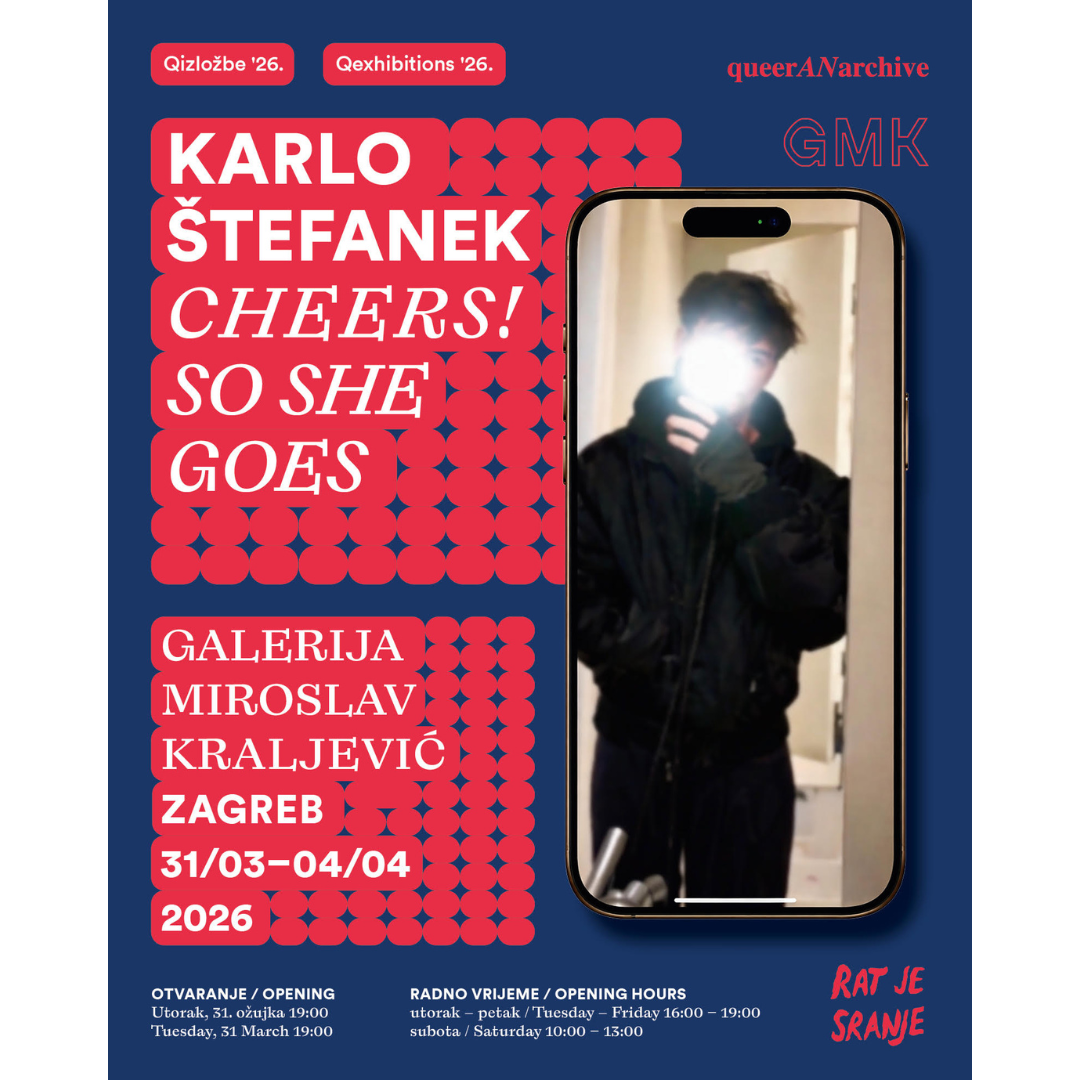
A new exhibition produced by queerANarchive
10ka, GMK, Šubićeva 2
Opening: Tuesday, March 31, 2026, at 7:00 PM
Duration: until April 4, 2026
Gallery opening hours > Tue–Fri: 4–7 PM / Sat: 10 AM–1 PM
Free admission
We invite you to the opening of Karlo Štefanek’s exhibition at the Miroslav Kraljević Gallery, produced by queerANarchive. Through an ambient installation that transforms the gallery into a café-like setting, Štefanek explores the feeling of shallow and exhausting digital communication, drawing on Marc Augé’s concept of the non-place. Through video works, an audio installation, and spatial interventions, the exhibition addresses alienation, loneliness, and the illusion of connection on social media, while from a queer perspective it critically examines the conditions of identity and togetherness in contemporary digital environments.
Curatorial introduction by Leopold Rupnik
The sense of continuous, superficial communication—one that takes on a Sisyphean futility—forms the thematic core of Karlo Štefanek’s exhibition Cheers! So she goes. Drawing on French anthropologist Marc Augé’s concept of the non-place, Štefanek transforms the gallery into a café, while stripping it of its anthropological function as a site of social exchange. In doing so, the space begins to operate as a kind of Augéan non-place. Within it, the artist evokes feelings of alienation, exclusion, and solitude through his digital presence. This presence materializes across several interconnected works: video pieces arranged on tables throughout the gallery, a video installation located in the restroom, and an accompanying audio work that reverberates through the space. Such affective states are often articulated by other non-places—airports, subways, and supermarkets—through their architecture and their hauntological qualities of timelessness and identity void. This framework is key to understanding the first segment of the exhibition, in which the gallery is transformed into a café-like interior: tables and chairs are arranged into an ambient whole, and each table is paired with a TV screen displaying a video of the artist seated in an identical position, gazing directly at the viewer. Although the locations of the individual videos vary, the affect they convey—and the interaction the artist invites through these digital works—remains marked by an elusive, muted sense of distance. The interaction between artist and viewer never fully materializes; his gestures and responses to the environment feel like shots fired into the void. Even during the artist’s TikTok Live performance, staged for the exhibition opening, Štefanek appears in the same bodily position from his Amsterdam studio, allowing the audience to communicate via chat. Despite this possibility, the communication feels impersonal and one-directional. In this way, the critical edge of Štefanek’s work toward digital platforms as non-places of connection becomes even more pronounced. Extending this motif of alienation, the second segment of the exhibition consists of a video installation situated in an intimate, selfie-familiar setting—the restroom. Generated in part with the help of artificial intelligence, the video produces multiple looping variations of the artist’s mirror self-portrait. These iterations are accompanied by a textual layer that simultaneously reproduces empty phrases and internet slang, as well as isolated words and exclamations reminiscent of the murmur of café conversations. Through its looping repetition, the installation simulates the compulsive refreshing of social media notifications, intensifying the anxiety that permeates the exhibition’s atmosphere—one that mimics the mechanisms of alienation characteristic of social networks in everyday life.
The restroom thus becomes a space no longer reserved solely for privacy, but a liminal site where the conditions of digital space—sharing, confessionality, and (self-)surveillance—spill over into the physical world. The sense of overwhelm produced by digital interactions is further evoked in the accompanying audio work that echoes throughout the gallery. Composed of random audio fragments sourced from TikTok, the piece weaves together disjointed words into a narrative whole, depicting a breakup from the perspective of one interlocutor. Through attentive listening, it becomes apparent that the speaker is an artificial intelligence, personified under the nickname Archie, with whom the artist is ending a relationship. The dissociative quality of breaking up with a non-living digital entity satirically points to another dimension of post-capitalist digital production, in which, amid a sea of failed interactions, the only attentive listener and source of support may be a carefully engineered corporate system.
When discussing Štefanek’s artistic practice, the queer dimension is inseparable from it, and the artist sustains it in this exhibition as well. In his approach, this dimension is most strongly expressed in the way he engages with digitality. The creation of online personas, the redefinition of identity, and the uncensored freedom to be oneself have long been embedded in the fabric of the internet as a kind of rite of passage for young people attempting to form themselves outside heteronormative impositions and their temporalities. As the internet expands—gradually becoming fertile ground for profit extraction—queer individuals increasingly find themselves on online battlegrounds, fighting for their share of digital wilderness: spaces where corporations will not coerce them through shameless data extraction, product placement, and censorship wrapped in the guise of protecting marginalized identities. By creating performative alter egos, Štefanek exposes the illusion of togetherness promoted by social media, revealing it instead as an inherently artificial digital complex in which even queer individuals struggle to find the sense of safety once promised by the internet. Queer authenticity is replaced by cunning corporate strategies: in a curatorial gesture of sorts, online personas are selected and commodified as aspirational models for queer users. Much like the various inert queer characters embodied by Štefanek, corporations promote those queer subjects who fit neatly into a heteropatriarchal template of compliant, politically subdued, and homogeneous consumers—subjects who must continuously adapt to the capitalist agenda imposed upon them. Through his use of irony, the exhibition critically interrogates the conditions of queer existence not only within digital environments but also in the real world. At the same time, Štefanek grapples with the question of how contemporary social shifts and attitudes toward queer individuals are reflected across the surfaces of our social media feeds. What further situates the exhibition within a queer register are numerous carefully considered artistic choices that function as tributes to queer culture. For instance, Štefanek pays homage through the use of internet slang actively employed by queer communities, selfies reminiscent of typical “thirst traps” found on gay dating apps, a highly camp staging of a breakup with artificial intelligence, and even the detail of multicolored IKEA tables and chairs. Thanks to memes surrounding IKEA’s inclusive marketing strategies, these have become niche symbols within segments of queer internet culture. Štefanek’s immersion in queer pop culture, coupled with his awareness of the broader issues surrounding toxic online environments, succeeds in bringing together audiences from different vantage points—allowing viewers, regardless of their own level of engagement with digital worlds, to find themselves reflected in his work.
Leopold Rupnik
Biography
Karlo Štefanek is a multidisciplinary artist whose practice explores how identity is constructed, deconstructed, and reconstructed through the mediums of self-portraiture and performance. At eighteen, Štefanek moves to Amsterdam, where he begins laying the groundwork for his artistic methodology. The series Self-titled (2022-), which integrates both visual and performative elements, has become a cornerstone of his practice, challenging evolving notions of selfhood and perception.
Štefanek has been showcased at CC Amstel, Amsterdam, Netherlands (2022); Stedelijk Museum, Rietveld Uncut, Amsterdam, Netherlands (2023); Treehouse, Amsterdam, Netherlands (2024); 2nd Floor, Groningen, Netherlands (2024); La Biennale, Venice, Italy (2024); Museum of Contemporary Art, Sounded Bodies, Zagreb, Croatia (2024); The Holy Art Gallery, London, United Kingdom (2024); SerformanceP Festival, São Paulo, Brazil (2024); Echo Studio, Amsterdam, Netherlands (2024); KIC, Zagreb, Croatia (2025); Vagon Gallery, Banja Luka, Bosnia and Herzegovina (2025); Multimedia Institute MaMa, Zagreb, Croatia (2025); ARL, Dubrovnik, Croatia (2025); HDLU Istok, Osijek, Croatia (2025); HDLU, 60th Zagreb Salon, Zagreb, Croatia (2025); EMAD, Perforations, Buenos Aires, Argentina (2025); Performance in Flux, Immerse, Orlando, USA (2025); Youth Biennial, Belgrade, Serbia (2025); Biennale del Vesuvio, Naples, Italy (2025), amongst others. The artist lives and works between Zagreb, Amsterdam and New York.
Programme Information
qEXHIBITIONS is a program run by collective queerANarchive that opens queer discourse in the town of Split. Since 2010 queerANarchive works as a collective that develops, researches and questions queer culture. Its curatorial and educational programs deal with particularities of queer culture at the time of LGBT normalisation and re-traditionalization of society.
At the international level the collective participated at Queer Art Lab Space ID Madrid, Madrid (2013), Activist in Residence at Baltic Art Center, Visby (2014), Young Queer Europe (2015 – 2016), What’s masc, Berlin (2022), W/ri/gh/ting Archives through Artistic Research, Vienna (2023), Doing history – methods of artistic historiography, Bauhaus University, Weimar (2023) and conferences Unstraight Museum Conference, Stockholm (2016), Organ Vida, Zagreb (2017) and Queering Memory ALMS Conference, Berlin (2019). The collective is a member of Youth Center Platform, Clubture Network and LGBT center Split platform.
Exhibition title: Cheers! So She Goes
Artist: Karlo Štefanek
Exhibition curator: Leopold Rupnik
Duration: 31/03/2026 – 04/04/2026
Design: Nikola Križanac
Translation: Leopold Rupnik
Acknowledgements: Vedran Grladinović (technical installation), Val Mačukatin (technical installation), Mia Laura Jurčić (producer), Luka Pešun (photographer), Noa Lončarić, Tomislav Paviša, Rada Iva Sibila, Kruno Štefanek, Noa Štefanek, Snježana Štefanek
Programme under which the exhibition was realised: qEXHIBITIONS
Programme curators: Tonči Kranjčević Batalić, Leopold Rupnik
Production: queerANarchive 2026
Donors: Ministry of Culture and Media of the Republic of Croatia, City of Split, City of Zagreb, Kultura nova Foundation
Partners: Miroslav Kraljević Gallery (curators Tea Matanović and Antonela Solenički)
