

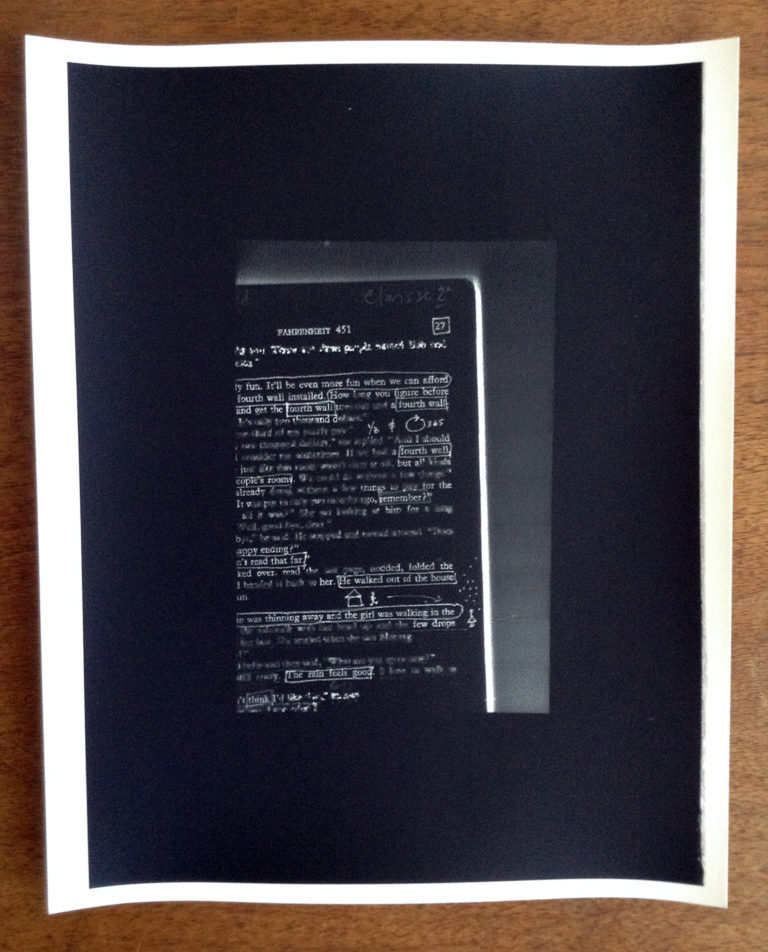
18/11/2014.
rnEKTBF451/EKTFF451: Notes and Confessionsrn rna solo exhibition by Ève K. Tremblayrn rncurated by Zeljka Himbelern rnExhibition will open on 5th of December 2014 at 8 pm.rn rn rnEve K. Tremblay’s multimedia project Becoming Fahrenheit 451 started in 2007. Similar to many of her other works, it was triggered by an accidental event from the artist’s former nomadic life and sharp observations of her close surroundings; in this particular case, the encounter with a video-rental store in Berlin, in the neighborhood Tremblay was living at the time. The store’s name, Filmgalerie 451, was indeed symbolic; it referred to the name of a famous Sci-Fi novel by Ray Bradbury (in the 1960s loosely adapted into film by François Truffaut) that describes not that distant future in which books and reading are treated as a threat to society’s peacefulness; as a disturbance that supposedly leads to uneasiness, doubt, criticality and consequently misfortune. Therefore, the books needed to be destroyed by specialized squads of firemen; only small groups of dissidents, the so- called “Book People,” had the mission to preserve the books from obsolescence in immaterial form- in their minds, through the specially developed photographic memorization method- in spite of being prosecuted.rn rnThe event of running across this store in

20/10/2014.
Residential lab by G-MK and Radiona titled ‘Alternating current’ will take place in lab’s usual working hours, Tuesdays, 20h and Saturdays, 18h onwards within the following groups: Robotics and hacking, advanced audio section, Processing (interaction design), BIOsection, 3D printing, wearable technology and eTextiles, Balkan rocketry and flying objects, microcontrollers and hands-on electronics, DIY print and design, FPGA, advanced programming, DIY prosthetic, and a variety of educational programs specifically designed for beginners, kids, youth and seniors.
The curatorial teams of G-MK and Radiona will also work on special programs which are connecting fields of contemporary art, intermedia and innovative technological practices.
Radiona.org is currently conducting a research phase of the project Amplitude of Image and Sound supported by Kultura nova Foundation, and will soon go in public with their first DIY kit – open source synthesizer / theremin powered by the ATmega microcontroller which is jointly designed by artists, designers and technologists, and as a part of the research the lab will organize a workshop for the wider audience. In addition, Radiona.org is also in the middle of the lab’s yearly educational program with domestic and international master class workshops, and is taking preparations for the exhibition Sound Hybrids – Creative

10/09/2014.
When not precious or semi-precious, how valuable is a stone? Can it have any value in itself, or is the value (for example, historical value) bestowed by the context in which the stone finds itself? Because it is not irrelevant whether a stone is used for skipping or is part of the structure of a medieval church. The skipping stone remains insignificant enough so that, as soon as it sinks, we can replace it with another one without feeling any loss, but what about losing a stone that is part of a church? Historians and archaeologists are certainly not indifferent about material remains because one stone, even a damaged one, can help build a narrative of the entire history. rn rnStarting from an interest in the value that is produced by the creation of narratives, Emilio Moreno is particularly intrigued by material remains, that is, cultural heritage that gets dislocated from its own temporality through relocation or the process of anastylosis. He is interested in what happens to the value of cultural heritage during such a procedure. Does the new building remain the "old one"? His first film Stone Acrobatics (2014) seeks to consider these issues, and the film narrative is built
02/09/2014.
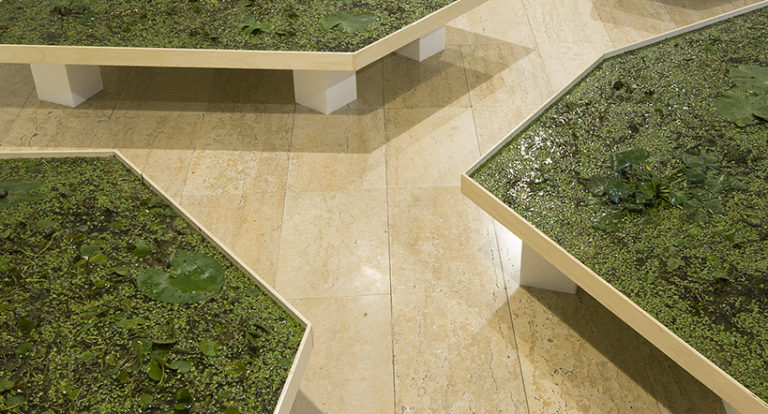
[stag-ney-shun n] the state or condition of stagnation, or having stopped, as by ceasing to run or flow:rna foulness or staleness, as one emanating from a standing pool of water.rna failure to develop, progress, or advancern rn rnWhen a river develops one or more alternative channels, one channel is considered primary and is used as a navigational route, while other channels are called backwaters and are often shallow and in stagnation. In this case, the term backwater can be applied to the physical and social areas that have been isolated—systematically neglected in their cultural and economical development—in the process of shifting from the periphery to the margin. Although these places are stagnant, they posses a far greater richness and diversity of life than the main stream.rn rnThrough displacement of these natural forms inside the gallery space, Stagnation allegorically interprets states of neglect and diversity, as well as the disconnect between individual formations. The disconnect of the margins and their gravitation towards the center, as well as the relation of the center towards the margins, disables them to achieve any true change, regardless of the individual potential they posses.rn rnAlthough the work reflects upon the dynamics of margin-center, and can be interchangeably applied to all

31/05/2014.
Wave Drawings (orange and green)rnField Drawing (Brisbane, a film)rnLandscape Paintings (Lake Bolac and Zagreb) rn rn"These works are concerned with ‘difference’, an aspect of connectivity between things in the world that is often disconnected by notions such as ‘natural’ and ‘manufactured’. Everything in this world, both natural and manufactured, is a part of nature and interrelated. Each thing in the world is innately unique and constantly in a state of flux. The nature of nature is such that a small shift within very tight parameters can produce quite different outcomes. The less that change is allowed to occur (is repressed) the more radically change may happen when it does occur, because it will occur. The physics of such processes of change helps to explain what is going on in the world around us."rn rnWave Drawings (orange and green)rn"The process of making these wave drawings is about understanding the processes of waves, and the relationship of wave dynamics to objects and ideas by ‘drawing’ relationships between waves and patterns. Waves can be used as a metaphor to describe the phases and layers of geomorphology, histories, cultures, stories, politics, art, friends and ideas; how things shift and change, merge, blend and disperse."rn rnField Drawing (Brisbane, a

