


25/04/2014.
Over the last quarter of century the countries of former Yugoslavia have seen the wholesale transfer of social ownership of the collective means of production and subsistence into the hands of the free market and private capital. Companies, banks, housing stock, higher education, health, natural resources, public space and infrastructure have been submitted to the repeated rounds of marketization, commodification and privatization. The re-alignment to full-blown liberal capitalism, which started in the late 80s with the structural adjustment programs that were supposed to end the enduring crisis of the Yugoslav social and economic model, and then further spurred by the vitriol of ethnic conflict and war in the 90s, had been legitimated by a promise of progress that the integration into the capitalist world-system would bring to everyone. It was a promise of normalized trickle-down capitalist progress that would paradoxically ensue after the end of history. But now that the crisis of 2008 has shown that the emperor is naked, that the capital cannot expand and reproduce without deepening social divisions across the global capitalist territory and that under this regime of supposed equal opportunities some face lasting prospects of poverty and destitution, the continuous accumulation by privatization is showing
19/03/2014.
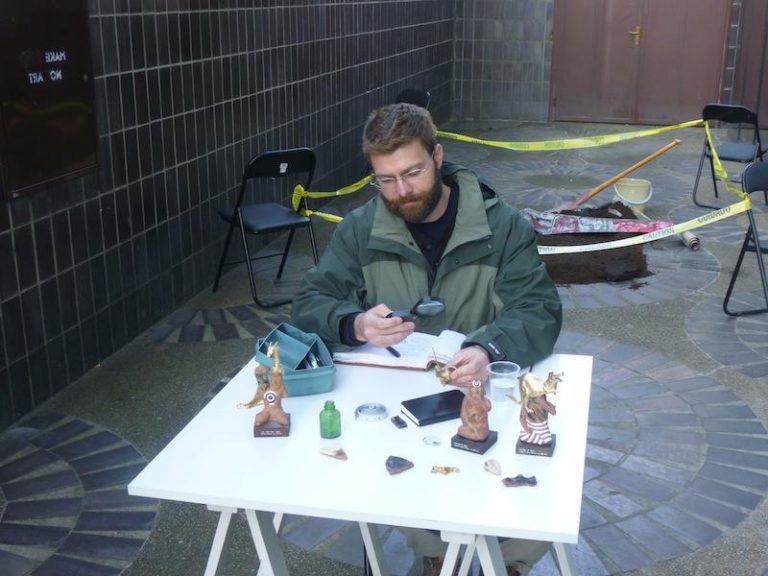
In the exhibition, The Lost City, American artist Joshua Goode will showcase the remnants of an underground city, a part of an imaginary ancient civilization. These ruins were found during an archeological research of multiple locations near the Miroslav Kraljević Gallery from March 11th to 14th. Posing as an archaeologist, Goode has publicly carried out an archaeological dig and discovered amazing lost treasures.
During the excavation, the passersby have witnessed the discovery of objects of the lost city and contemplated the boundaries between reality and fiction.
Joshua Goode will exhibit these found objects within the gallery space, temporarily transforming G-MK into a small archeological museum where reality and fiction become one.
Joshua Goode was born in 1981 in Fort Worth, Texas. He received his BFA from SMU in Dallas, Texas and his MFA from Boston University in Boston, Massachusetts. He has had solo exhibitions in international venues such as the Zendai Museum of Modern Art, Shanghai, China; Darb 1718 in Cairo, Egypt; LaSala Gallery in Zaragoza, Spain, and Shanghai University in Shanghai, China; in addition to group exhibitions at the Museum of the National Library in Madrid. Spain; National Library of Argentina, Buenos Aires, Argentina; Zentral Bibliothek, Zurich, Switzerland; University

10/01/2014.
Exhibition will open on 10th of January 2014 at 8 pm.rn rnThrough his films and installations, Duncan Campbell investigates how meaning and history are constructed and mediated. The artist’s work examines historical events and their interpretation, and tests the boundaries between the factual and fictive. The captivating power of Campbell’s films is derived from their specific collage structures and fragmentary narratives, unusual sound editing, montage of black and white and color footage, dazzling animated excerpts and quotes from the history of experimental film. The films re-contextualize the authentic archival film material by combining it with the newly shot scenes—re-enacted episodes filmed in 16mm by Campbell himself—and challenge the viewer to navigate through their open-ended fables.rnrnIn Zagreb, the artist will present his acclaimed film Bernadette (2008, 37’). While giving a portrayal of Bernadette Devlin, the controversial Irish republican member of parliament and civil rights activist from the late 1960s, the film also captures wider political, social and cultural struggles, civil unrest and political leaders during Northern Ireland’s The Troubles era. However, rather than giving a simplified overview of the struggle between Republicans/the IRA and the British government and loyalists, or the common heroic presentation of Bernadette Devlin’s fiery character, Campbell focuses on

14/11/2013.
Monday, Nov 18, 2013rn19:00 exhibition openingrn19:30 discussion as part of the program Micropolitics rnparticipants: Rena Rädle and Vladan Jeremić, artists, Iva Marčetić, architect and member of the Young Anti-Fascists of Zagreb, Nikola Vukobratović, member of the editorial board of the Croatian edition of Le Monde Diplomatique and [BLOK]rn rn“A girl asks a monkey at the ZOO: Why do you live here? Isn’t it nicer where you come from?” This text opens Dušan Makavejev’s “Montenegro,” a film in which he shows the encounter of a wealthy American housewife, brought to Sweden by her businessman husband, with Yugoslav immigrants, who come to Sweden to look for work. The separation of the worlds, which leads the protagonist Montenegro (who gets a job at the ZOO) to his tragic end, is primarily class-based, but is also the product of a specific production of otherness, and his suicide is the final consequence of the clash between the imagined idea of the constructed “other” (the wild Balcan, attractive and intimidating at the same time) and his actual appearance – the man whose position is clearly determined by concrete economic and political processes, whose origins reveal nothing exotic, and whose workers’ nomadism contains nothing romantic.rnThe exhibition Between Worlds II


13/10/2013.
I am not sure where exactly I heard or read that neoliberalism had been the last effective revolution in history. It might have been in a conference of Franco Bifo Berardi in documenta 13 since it makes sense with the text he published for the occasion. In this text he develops an argument that the complexity of social life and flow of information has rendered acts of total transformation- a revolution- impossible since there is no longer a single identifiable power to subvert. At the same time this saturation overflows our capacity for processing information pushing us to a state of automated decision making and shared behavior that longs for machines of complexity-reduction. Politicians and economist´ s goal becomes then the monopolization of the role of interpreters of this density in order to lead us to believe that we live in a state of symbiosis with the financial apparatus and that our lives must be aligned with its expectations of infinite growth. The premise is that life and capitalism are so intertwined that the end of capitalism would be in fact the end of the world. For Bifo it is foremost a question of form, money is the form, the
