

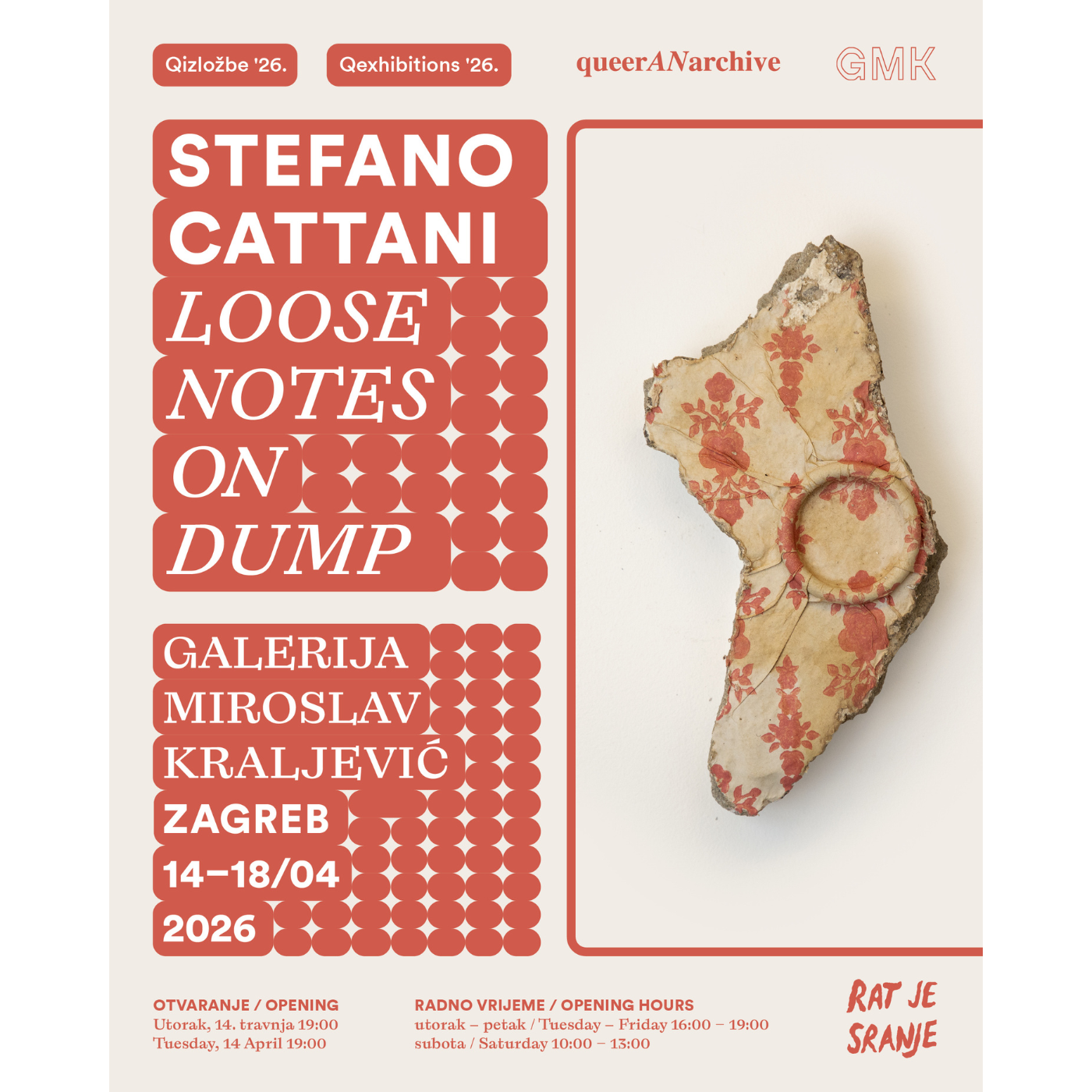
A new exhibition produced by queerANarchive
prostor 10ka, GMK, Šubićeva 2
Opening: Tuesday, 14 April 2026, 7:00 PM
On view until: 18 April 2026
Gallery hours: Tue–Fri: 4–7 PM / Sat: 10 AM–1 PM
Free admission
On Tuesday, April 14 at 7 PM, Stefano Cattani’s exhibition Loose Notes on DUMP opens—an immersive installation that, through sculpture, installation, video, and found objects, explores the act of “dumping” as a process of queer self-discovery, self-reflection, and reconciliation with one’s own past. Drawing on personal memories of the family farm, the artist reclaims this space as a liminal site where desire, shame, loss, and emancipation intertwine. Through motifs of grain sacks, discarded objects, fragments of family videos, and wheat sprouts, the exhibition approaches identity as a process of constant negotiation. In doing so, it moves beyond the autobiographical framework and opens up space for a broader experience of queer self-acceptance, showing how the self is built precisely through fragments of what was once discarded. The exhibition will be on view until Friday from 4 to 7 PM and on Saturday from 10 AM to 1 PM, through April 18.
To dump is an act of freedom. It aims at liberating, at making space. To DUMP is to immerse oneself in the other. DUMPing/to DUMP is an active action. A movement simultaneously and indissolubly directed outwards and inwards. A conversational act to reach deeper. To DUMP is to stay in it, with it, within it. To DUMP is to understand. DUMP is an impulse to dig into the unwanted: a posture of openness and permeability towards the rejected. It is a willingness to find resolution to a crushing silence. To DUMP is moving with the duality of what is in and what is out: inside and outside, taken and given, hidden and in plain sight. DUMP is an unsolved tension, a continuous attempt at getting closer. Perhaps a failing, impossible, attempt.
Stefano Cattani about his concept of DUMPing
Curatorial foreword by Leopold Rupnik
In Loose Notes on DUMP, Stefano Cattani builds the exhibition around notes and observations that emerged from his artistic research and were later translated into visual form. If dumping itself is an emotional dissection, a stripping bare of the soul and an excavation of every psychic wound, then Loose Notes on DUMP becomes a confrontation with that event: a moment of self-reflection that, through distance, allows both the artist and his audience to rationalize his initial responses to his own inner fractures. Loose Notes on DUMP emerged organically as the artist’s most compelling interpretive tool for processing those reactions.
Through this exhibition, Cattani retrospectively returns to his younger years spent on the family farm. From the present perspective of an openly queer person living outside his homeland, he reclaims the site of the farm as a place of reconciliation with the self and as an important catalyst in his queer self-discovery. In this body of work, the family farm becomes a site of self-empathy: rather than confining him to a fixed identity, it transforms into a kind of cocoon from which the artist is able to redefine himself. The farm functions as a liminal space that unpacks his desires. In one work, presented as a triptych, Cattani displays rubble into which he places objects symbolizing everything he once idealized as queer and gay. Covered in wallpaper, the work hovers on the edge of the visible and the concealed, suggesting that these objects exist in a perpetual paradox—between the desire to become who he is and the part of himself that still unconsciously represses what at times continues to feel forbidden. Following this sense of inaccessibility and distance from the self, Cattani also reworks grain sacks found on the farm. Hanging from hand forged nails in a sterile, almost hermetic white form, the sacks are filled with objects whose outlines only hint at what they might contain. Because such sacks on the farm were once also used to store objects no longer wanted, the artist plays with this association to rethink the rejection of unwanted things in relation to himself and all that he no longer is. DUMPing thus becomes a radical act of refusing what is imposed upon us and of articulating the self more authentically. What is discarded fades into memory, becoming, like the sacks themselves, only a contour. At the same time, there are objects from the farm that evoke more complex emotions and memories, and through their display the artist searches for a way to position himself in relation to them. He places these objects onto strips of waterproof film attached to the wall, arranging them in formations that seem almost in tension with the tape holding them from collapse. Visually and conceptually, this gesture marks his unresolved conflict with objects that still resist finding a stable place within the order of his life. The wheat sprouts piece, which most clearly synthesizes the exhibition’s emotional and symbolic threads, distills the warmth of self-acceptance. Growing over printed video stills of his family and the farm, the sprouts crown the artist’s experience of growth. Through the symbolism of wheat, they testify to the resilience required to keep growing even in less-than-favorable conditions. By merging this image with the family printed video stills, Cattani closes the circle of his exhibition, marking fragile traces of new hope and life paths no longer bound to old threads of existence.
Loose Notes on DUMP is not only a gesture of personal reconciliation, but also a story that resonates with many queer people still searching for a bearable point of self-definition while moving through intertwined processes of mourning and making of the self. The works on view reveal the artist’s mature awareness that self-acceptance is never linear, but rather made up of repeated returns, negotiations, and new readings of one’s own past. This is precisely why Cattani’s exhibition moves beyond autobiography and opens a space of collective affect. Every object, contour, and trace of the farm becomes a site onto which others can easily project their own experiences of shame, loss, desire, and emancipation. In this sense, the exhibition functions as a tender yet precise study of how identity is never found all at once, but gradually built through discarded and repressed fragments of the self, alongside the courage to revisit one’s history from a different point of view.
Leopold Rupnik
Artist biography
Stefano Cattani (b. 2000, he/she) is a research-based visual and performance artist. His work, rooted in queerness, investigates the intersection of body, identity and space. His practice questions the hierarchical structure of contemporary Western society, departing from personal experiences and observation, looking for relationality in conversations and critical theory. His work aims to unveil the hegemony and power dynamics of the structure object of his interest, employing storytelling through movement, spoken words, sound, photography and video, materialising in performances, sculptures and installations, stills and moving images. Since 2025, Stefano is the founder and part of the research-based artistic collective TogetherTogether.
Information about the exhibition and programme
qEXHIBITIONS is a program run by collective queerANarchive that opens queer discourse in the town of Split. Since 2010 queerANarchive works as a collective that develops, researches and questions queer culture. Its curatorial and educational programs deal with particularities of queer culture at the time of LGBT normalisation and re-traditionalization of society. At the international level the collective participated at Queer Art Lab Space ID Madrid, Madrid (2013), Activist in Residence at Baltic Art Center, Visby (2014), Young Queer Europe (2015 – 2016), What’s masc, Berlin (2022), W/ri/gh/ting Archives through Artistic Research, Vienna (2023), Doing history – methods of artistic historiography, Bauhaus University, Weimar (2023) and conferences Unstraight Museum Conference, Stockholm (2016), Organ Vida, Zagreb (2017) and Queering Memory ALMS Conference, Berlin (2019). The collective is a member of Youth Center Platform, Clubture Network and LGBT center Split platform.
Exhibition title: Loose Notes on DUMP
Artist: Stefano Cattani
Exhibition curator: Leopold Rupnik
Duration: 14/04/2026 – 18/04/2026
Translation: Leopold Rupnik
Programme under which the exhibition was realised: qEXHIBITIONS
Programme curators: Tonči Kranjčević Batalić, Leopold Rupnik
Production: queerANarchive 2026
Donors: Ministry of Culture and Media of the Republic of Croatia, City of Split, City of Zagreb, Kultura Nova Foundation
Partners: Miroslav Kraljević Gallery (curators Tea Matanović and Antonela Solenički)
