


17/10/2006.
/ interactive movement animation
Gifoskop is an experiment that manifests the relations between what is perceived as the basic elements of dance: locomotion, composition and its visuality. It is also an analytic means for communicating dance procedures between dancers and non-dancers. Gifoskop enables the non-dancing body to animate its creative and performative mechanisms in dancing.
Gifoskop is an interactive animation-motoric installation which reanimates movement/dance and returns it to its space-time/performative medium. As a trace/excerpt of a movement, gif signifies the interupted body-space position which is, in a way, the origin of movement that is animated in order to create an illusion of movement/dance. Gif also communicates information that the dancer uses in creating and performing a movement / dance, which the visitor adopts and performs in the act of reanimating movement. concept and performance:| Maja Marjancic| Nikolina Pristas | Nenad Romic

17/10/2006.
‘Work in Progress’ was inspired by artists personal situation, but also the general problem of contemporary artists, who make art in their free time, after they have finished with the jobs that secure their material existence. The project was moreover triggered by the fact that in Croatia it is extremely hard to get financial support for research based projects; it’s rarely possible to even cover the production costs, not to mention taking care of the author’s existential problems while working on the project. Unlike artists working in the field of performance art or music, visual artist in most cases do not get any fee for their work and their presentation. Budgets donated by the state are usually too small and the money usually comes late, so the process of producing a new work is always prolonged, which is additionally complicated by the obligation to realize the financed projects by the end of the same year. At the same time, the market for this kind of production is still undeveloped. For the reasons above, it is not unusual that, with time, even affirmed artists become frustrated and give up on making art. Lara Badurina’s research deals with this dichotomy: how big

17/10/2006.
Exhibition of Radoslav Putar Award Winner 2005 - - - - - - - - - - - - - - - - - The solo exhibition of the awarded artist is the final stage of the Radoslav Putar Award initiated by the Institute for Contemporary Art from Zagreb. As one of the programatic orientations of g-mk is also the focus on the promotion of the perspective young artists and their integration into the international art context, g-mk is the regular partner of the Radoslav Putar Award where it takes part in conceptualization, organization and production of the winning artist’s final exhibition.
Antun Bozicevic's exhibition closes the fourth cycle of the Radoslav Putar Award. At the same time, the new, fifth cycle is opened by launching of the new Call for Applications for the 2006 Radoslav Putar Award. Since 2002 four artists have received the Radoslav Putar Award: Tanja Dabo (2002), Nika Radic (2003), Igor Eškinja (2004) and Antun Bozicevic (2005). - - - - - - - - - - - - - - - - - - - Badel Station is an audio-video installation which consists of sound recordings of the New York subway and the live sound
17/10/2006.
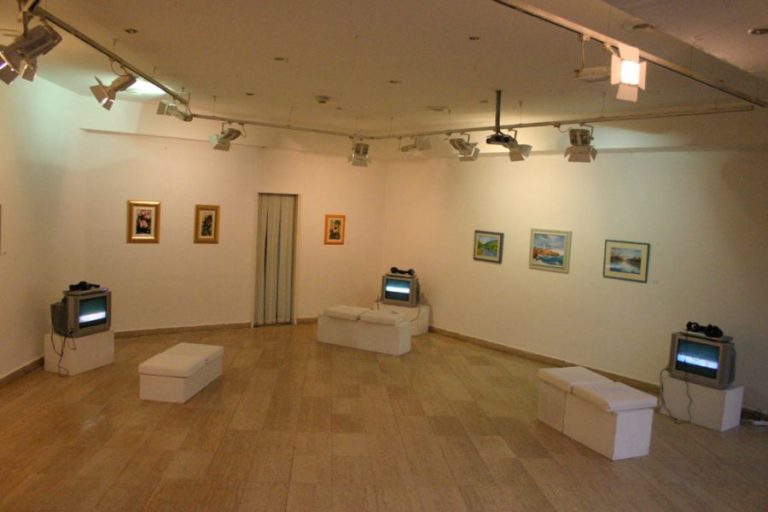
It is difficult today to bring into connection amateurism in art and culture, organized in the form of arts clubs, with an image of a progressive and prestigious 21st century corporation. In the overall acceleration, under the impact of information technologies in the society of late capitalism, the remnants of arts clubs in Croatia seem to be a sort of survived archaic form, even a simplistic way of workers’collective organization of their free time but also a form of self-initiatiated uniting of workers in big companies through cultural and artistic activities. Today, when free time is becoming a luxury, they are being replaced by various forms of «team building» and carefully formulated models of «active and strategically conceived collective activities». In the local context of the old «complex organizations of united work» (SOUR), the form of arts club was, surely, strongly encouraged, which is witnessed today by various monographs and overviews of cultural initiatives and artistic organizations of united workers. The 20 years of KUD-Ina monograph, for example, states that «passive participation in already finished cultural projects (theater shows, concerts, exhibitions, libraries) did not satisfy a part of employees. They wanted to use their own creativity to produce art programs,

17/10/2006.
www.g-mk.hr/online/setnje 'Walks' by Edita Schubert takes you to 4 virtual walks through the rural landscape of the Northwest Croatia. Each walk goes forth and backwards automatically (with the option of repose), due to the simple animation based on the photographs artist took while strolling up and down the path. The banal, yet beautiful landscapes underline feeling of intimacy with artist while instead of walking with her we watch through her eyes, creating our vision by the images she has selected. Walks are to be continued.- - - - - - - - - - - - - - - - - - - -
Edita Schubert (1947,Virovitica). Attended the Applied Arts School in Zagreb, 1967 - 1971 studied painting at the Academy of Fine Arts in Zagreb, from 1973 employed at the Institute of Anatomy, Faculty of Medicine, Zagreb. She lives and works in Zagreb.

17/10/2006.
The discussion deals with issues of selection from the perspective of communication / mediation of art to the public and the significance of selection and methodology in the context of writing / creating art history.Participants:Eva Brunovic (Ministry of Culture, Republic of Croatia)Kresimir Purgar (art critic, editor of Kontura magazine) Andreja Kuluncic (artist)Enes Quien (art critic) Vladimir Gudac (art critic)KONTEJNER /Olga Majcen & Suncica Ostoic/ (curators)Marko Golub (art critic)Nevena Tudor (art historian)Nicole Hewitt (arist and teacher at the Academy of Fine Arts, ZagrebSilva Kalcic (art historian, curator) Tihomir Milovac (art historian, curator)Moderated by:Gordan Karabogdan and Tomislav Soban (artists) and Nikica Klobucar (art historian)consultation (g-mk): /Ivana Mance, Antonia Majaca, Evelina Turkovic/The discussion is concerned with issues such as the significance of selection from the perspective of communication/mediation between art and the public; the meaning of selection and methodology in the context of writing/creating art history; consequences of selection as curatorial activity; consequences of selection as activity of jounalists and art critics; the issues of responsibility in selection; methodologies and selection of information in education about contemporary art; relation of art and theory in contemporary art education; key factors in deciding upon financing contemporary art projects etc.
