

13/02/2017.
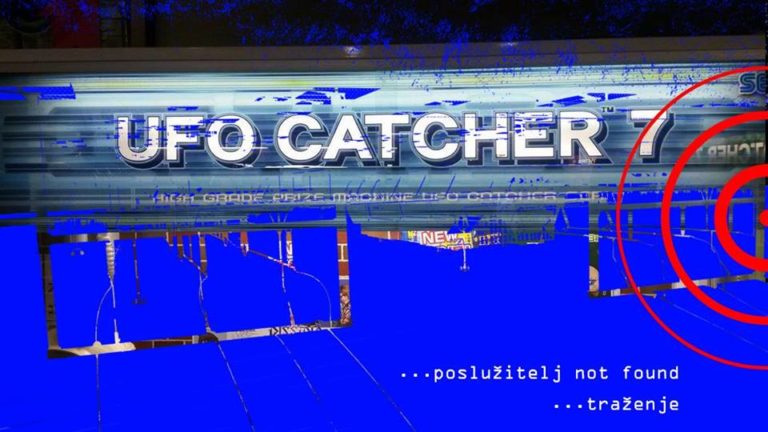
U.F.O., 2017 unknown flying object unknown fantasy object unknown female object unknown facebook object unknown fragmented object unknown futuristic object THE FIRST STEP: #000f-chan and The Nameless One The Nameless One is a construct and a fantasy by Ana Vuzdarić created specifically for the project My Sweet Little Lamb (Everything we see could also be otherwise). The Nameless One is a collection of fragmented information that is accessed through a text-based game, the so-called text adventure. The Nameless One exists in a dystopian near future – more precisely in 2020 – where mankind has destroyed itself. The Nameless One is a manifestation of the author who finds it easier to imagine the end of the world than the end of capitalism. #000f-chan came about as a result of Marko Gutić Mižimakov’s need to leave Facebook and relinquish the care of his nine-year-old profile to someone else. Functioning as a bot and a fraud image, #000f-chan (or simply f-chan) had appeared in different stages of computer generated imagery even before Vuzdarić contacted Mižimakov. THE SECOND STEP: Contact As two not entirely formed characters, f-chan and The Nameless One inhabit the space of the gallery for the duration of the exhibition. By
25/01/2017.
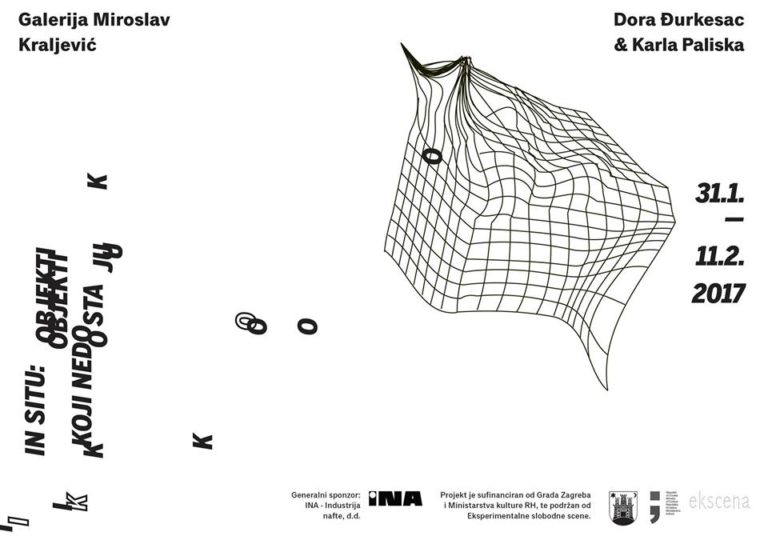
Third year in a row GMK is organizing “Tvornica” project as one of our core programs. In this project young artists chosen through an open call are given the opportunity to have their own exhibition with the institutional support provided by the Gallery. Nowadays, when state funding for independent culture is miserable, GMK tries to act as a catalyst and a development platform offering artists advisory and financial support much needed in the production of the new work. Once a year we have an open call for the production of new work open to artists up to 35 years that are willing to apply with works in their initial phase. After exhibitions by Iva Cepanec Masters in September 2014 and Ana Kuzmanić in December 2015, this year we have chosen the proposal titled “In Situ – missing objects” by Dora Đurkesac and Karla Paliska.
“In Situ – missing objects” is an artistic research primarily focused on processes and ways of perceiving our environment with further aim of creating new methodologies in researching space. Originating from sociological, cognitive and physical points of view, artists are interested in relations between existing concepts of space, but also their potentials and limits in describing
01/12/2016.
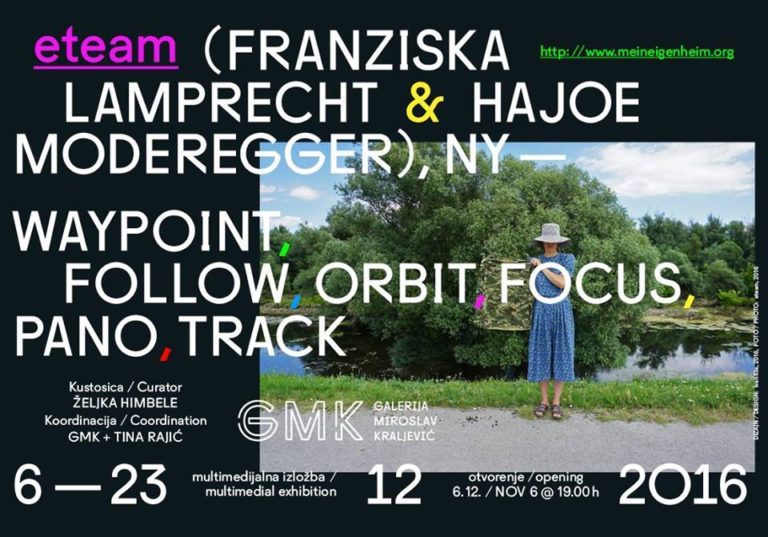
For their most recent exhibition at Miroslav Kraljevic Gallery, eteam (the New York-based duo Franziska Lamprecht and Hajoe Moderegger) engaged in a multimedia project titled Waypoint, Follow, Orbit, Focus, Pano, Track. The whole endeavor started with the artists visiting Croatia last summer, in an effort to research a peculiar camouflage design of Croatian military uniform which, in order to render a person concealed, incorporates the geographical mapping shape of Croatia itself. This intriguing issue, found by the artists through their initial online research, is in fact very much along the lines of eteam’s constant interest in disappearance, (in)visibility, land and its numerous uses in public and private contexts. In this newest project, the topics of disguise, appearance, absence and surveillance were further researched through eteam’s travel through Croatia and finally implemented through the exhibition featuring the video Waypoint, Follow, Orbit, Focus, Pano, Track, several paper mâché sculptures, a photograph and a novel The Case of Distance Disengaged. The visited locations, extensively presented in the book form as well as captured in the video, included a factory that makes military uniforms, then Liberland (a territory of the self- proclaimed nation on a small terrain between Croatian and Serbian border, which appears
29/11/2016.
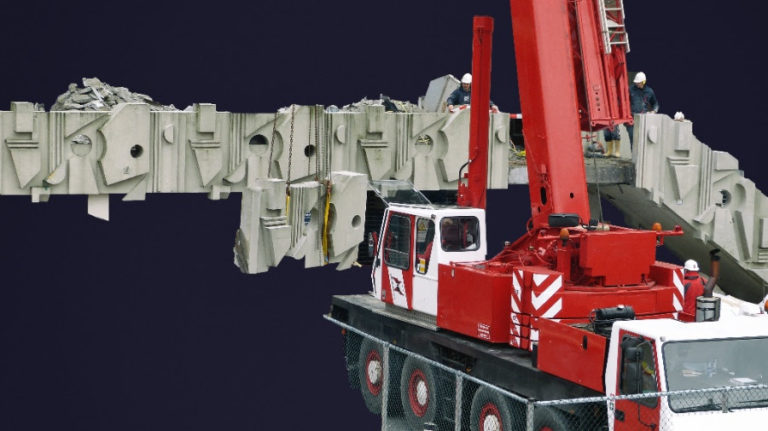
Project Monuments of the Future by Petra Milički and Anika Schwarzlose is a study of monumental places and objects in the light of increasing digitalization and networked communication. Project is a combination of theoretical research with a praxis based approach and an opportunity to establish collaborations with artists, theorists, researchers and scientists in different countries, such as Croatia, Netherlands and Germany.
Our environment is changing radically. Debate and expressions of nostalgia or violence have partly migrated into the digital realm, where they form a new memory culture. At the same time material substance of monumental objects is in the process of disappearing – by active destruction, weathering, decay or obsolescence – and is subsequently replaced by different digital representational techniques.
How exactly the recent expansion of digitalization and archiving techniques has affected our perception of monumental places and objects. How did it change their symbolic value? How will it affect the way we commemorate and process historic events?
Petra Milički and Anika Schwarzlose will present a work in progress: a web platform which collects sculptures that have been removed from public space for different reasons. This collection will be used as source material to build a virtual sculpture garden. A

28/11/2016.
Topic: Precarity in Art
Dates: April 1-30, 2017
Location: Budapest (Hungary) and Zagreb (Croatia)
The first East Calls Curatorial Residency is jointly organized by Easttopics (Hungary) and G-MK (Croatia) in Spring 2017, on the topic of Precarity in Art.
The topic of Precarity in Art mirrors the actual situation in both countries: Hungary has endured a severe shift in cultural policies since 2011, resulting in the desertification of the contemporary art scene and generating new artistic reflexes, independent and alternative ways to operate. Croatia is presently undergoing the same kind of restructuration, foreshadowing an oppressing cultural political climate and situation for the years to come and already witnessing the unprecedented solidarity of the art scenes in a need to act.
The residency lasts one month and is divided in two time blocks,the first one in Budapest (Hungary) between April 3-15 and the second one in Zagreb between April 17-30. The purpose of this residency program is to engage with the thematic of Precarity in Art by connecting international curators with those protagonists of the Hungarian and Croatian cultural scenes who were/are working with minimal financial, spatial or temporal resources, and to map the answers they give to such situation.
The
05/11/2016.
In the dramaturgical intervention "A Multilogue for Later" Nina Gojić examines the possibility of creating new systems in the art scene and models of cooperation and solidarity among cultural workers. Her research is based on the thesis about the continuity of self-management and self-organizing practices in the Yugoslav cultural space resulting from non-alignment, which today function as a tangible alternative to the neoliberal logic which is increasingly shaping the management of culture. The idea of non-alignment is extended to the development of the discourse on still unformed collectives, unfinished or not yet started processes which, on the level of cultural production, become a potential basis for imagining new communities. The work consists of two events and a soundmap that the author created through conversations with her previous collaborators. Starting from the reflection on the idea of cooperatives in culture, the work also questions the collaborative models and the sharing of resources in the art scene. The dramaturgy of the multilogue is realized on three levels: through the spoken text, through the way the text is edited, and through the minimally choreographed gallery space. Sound design: Iva Ivan Set up design: Tea Truta The audio installation is on view until November
