


19/12/2007.
is a project dealing with the status quo of the human rights in Europe seen from the perspective of visual art. Starting by the end of 2007, over a period of three years analyses and visions of human rights issues in Europe will be developed and disseminated in the general public with the means of art. The planned activities - exhibitions inside and outside the gallery space, poster campaigns, media projects, film programmes, theoretical discourse etc – are supposed to reach a broad audience and shall make us aware of the following fact: In many respects the observance of human rights is not guaranteed in front of our doors too!
Land of Human Rights is a joint project of rotor association for contemporary art, Graz http://rotor.mur.at, University of J.E. Purkynì, www.fuud.ujep.cz riesa efau | Motorenhalle, Dresden http://www.motorenhalle.de, www.motorenhalle.de, Trafoacute; Gallery, Budapest www.trafo.hu, Galerija Škuc, Ljubljana www.galerija.skuc-drustvo.si ,g - mk | galerija miroslav kraljević, Zagreb, www.g-mk.hr. These six art institutions have jointly developed the 'Land of Human Rights'. The different parts of the program - exhibitions inside and outside the gallery space, poster campaigns, media projects, film programmes, residency programmes, theoretical discourse etc, are conceived and carried out on the institutions own authority. In terms of content a knowledge transfer takes place regarding questions of arts and human rights as well as an interchange of experts: artists who deal with aspects of the human rights discourse will present their work resp. develop new works in communication with human rights activists and researchers.
http://www.landofhumanrights.eu/index.html

19/12/2007.
At this year’s Documenta 12 exhibition in Kassel, Germany, Sanja Iveković realized an intervention in public space titled Mohnfeld “Poppy Field”. On the lawn in front of the Fridericianum, the central building of the exhibition, the artist planted, with the help of experts, a poppy field made up of two species – the red, field poppy (Papaver Rhoeas) and the purple, opium poppy (Papaver Somniferum). A constituent part of the installation was an audio recording of 9 revolutionary songs sung by the Zagreb activist/lesbian choir Le Zbor and the choir of the women’s group RAWA from Afghanistan, which was played twice daily through large loudspeakers placed on the square. The Friedrichsplatz thus became, throughout the duration of the Documenta, a red square uniting various symbolic connotations, but also a favorite location for visitors of the exhibition and for the locals of Kassel. During the Documenta, visitors were also offered, via the internet site of the exhibition, to send their photographs to the artist.
In May this year, one month before the opening of the Documenta, Sanja Iveković participated in the exhibition Memorial to the Iraq War at the Institute of Contemporary Art in London. For this exhibition, which presented artistic concepts of a memorial, with a focus on the Iraq war, Sanja Iveković conceived a proposal of the project White Poppy Field Guarded by Women in Black: the artist proposed the planting of white poppies on a surface of minimally 20 x 10 m in a public urban space, which would be “guarded” by members of the British branch of the “Women in Black” organization. The guarding would be continuous – 24 hours a day during the harvest season of the opium poppy and during the rest of the year the members of the organization would arrange the guarding according to their resources, while the field itself would be maintained by the British organization “White Poppy”, which promotes education for peace and non-violent conflict resolution.

12/12/2007.
At this year’s Documenta 12 exhibition in Kassel, Germany, Sanja Iveković realized an intervention in public space titled Mohnfeld / “Poppy Field”. On the lawn in front of the Fridericianum, the central building of the exhibition, the artist planted, with the help of experts, a poppy field made up of two species – the red, field poppy (Papaver Rhoeas) and the purple, opium poppy (Papaver Somniferum). A constituent part of the installation was an audio recording of 9 revolutionary songs sung by the Zagreb activist/lesbian choir Le Zbor and the choir of the women’s group RAWA from Afghanistan, which was played twice daily through large loudspeakers placed on the square. The Friedrichsplatz thus became, throughout the duration of the Documenta, a red square uniting various symbolic connotations, but also a favorite location for visitors of the exhibition and for the locals of Kassel. During the Documenta, visitors were also offered, via the internet site of the exhibition, to send their photographs to the artist.
In May this year, one month before the opening of the Documenta, Sanja Iveković participated in the exhibition Memorial to the Iraq War at the Institute of Contemporary Art in London. For this exhibition, which presented artistic concepts of a memorial, with a focus on the Iraq war, Sanja Iveković conceived a proposal of the project White Poppy Field Guarded by Women in Black: the artist proposed the planting of white poppies on a surface of minimally 20 x 10 m in a public urban space, which would be “guarded” by members of the British branch of the “Women in Black” organization. The guarding would be continuous – 24 hours a day during the harvest season of the opium poppy and during the rest of the year the members of the organization would arrange the guarding according to their resources, while the field itself would be maintained by the British organization “White Poppy”, which promotes education for peace and non-violent conflict resolution. The exhibition Poppy Fields – from the research archive and project documentation at the Miroslav Kraljević Gallery presents these two projects as complementary segments of the artist’s research and dealing with the subject. The exhibition will therefore include a collage – the proposal of the project White Poppy Field Guarded by Women in Black - which was exhibited at the ICA, a new video, “Poppy Field”, filmed during the Documenta, as well as a selection of photographs of the Kassel project. Among the other exhibits are materials gathered by the artist during the research process, photographs by visitors during the exhibition, and media coverage of the project. In Anglo-Saxon countries the red poppy has become a symbol of remembrance of soldiers killed in the war, while in socialist countries it is accepted as a symbol of political struggle, resistance, and revolution. Planting opium poppy along with the field poppy on the Friedrichsplatz (which has played different roles in history, among others as a place for military ceremonies), Sanja Iveković refers to the problem of
22/11/2007.
On November 22, Damir Očko will present his work 'The End of The World' in the framework of the VIDEOJAMIT program at HIAP-u together with a finnish artist Kari Yli-Annala. During his residency Očko will also have the opportunity to present his developing new work in the framework of the OPEN STUDIO program together with Michael Dans and French artist group Nuage Vert.
www.hiap.fi
Finish artist Pilvi Takala will be a G-MK resident artist from 1.12.2007 - 17.1.2008.

21/11/2007.
In the framework of the artist exchange program coorganised by G-MK and HIAP, Helsinki, Croatian artist Damir Očko is currently an artist in residence at HIAP.
On November 22, Damir Očko will present his work 'The End of The World' in the framework of the VIDEOJAMIT program at HIAP-u together with a finnish artist Kari Yli-Annala. During his residency Očko will also have the opportunity to present his developing new work in the framework of the OPEN STUDIO program together with Michael Dans and French artist group Nuage Vert.
More: http://www.hiap.fi, Damir Očko: The End of the World
19/11/2007.
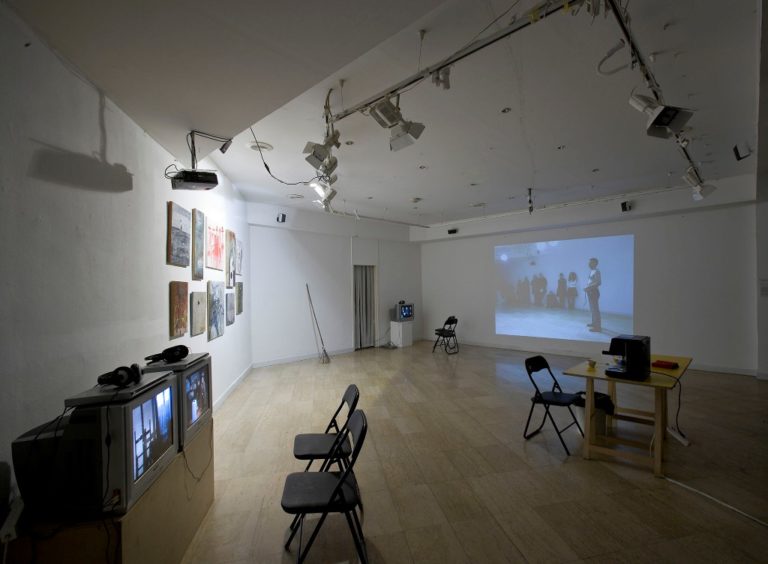
The work of art as seduction asks to be superceded and seduced in turn by the brilliance of each and all - it demands reciprocity. (Hakim Bey) Each work is thus an intervention, not only into the gallery space, but also into the very institution of the exhibition as the manifestation of the artistic and curatorial undertaking at the moment of its completion and perfection and its public presentation at the point when it reaches the peak of representability. \'Exhibiting\' involves a more or less stable economy of exchange, and here it is based exactly on the unstable dynamics of giving and loss, constant negotiation among the protagonists in the process, as well as the encounter or clash of expectations of everyone involved towards one another and towards themselves, along with the possible frustrations resulting from their unsuccessful realization. Everyone is visibly dependent on each other and are in a constant process of negotiating, role exchange, transfer of responsibility and reciprocities. Institutions and curators have expectations from the artists, the artists expect something in return from curators and institutions, donators, sponsors and the audience (which is, again, expected not to be merely a \'passive\' audience) have their own expectations regarding the institutions and the content they are presenting etc. In this space of intertwined expectations, a field of multiplied mutualities is being established, allowing occasionally for an absurd play of positions, which could also be interpreted as an institutionalization of power during which the play is legitimized by placing and confronting the protagonists in a dialogue. In the context of the independant, non profit art scene, however, clear delineations between positions are often missing - critics, curators, artists etc. are all in the position of freelance cultural workers. Lacking stable forms of organization and institutionalization (primarily on the levels of cultural policy and economy), all cultural workers are often, in one way or the other, simultaneously exposed to the pressures of expectations of highly professional execution and the relentless exploitation of its labor. The artist/cultural worker is thus always ready for action, always enthusiastic enough, energetic and, above all, a flexible social entrepreneur who, despite the fact that he/she often covers several different segments of creative production, he/she nonetheless keeps gathering strength from his/her infatuation with the mere possibilities of participation in the processes of production of symbolic values. . . . In the performance PUNISHMENT, Sinisa Labrovic is playing with the fragile dynamics of expectation and desire, primarily in the relation between artist and audience. As an artist-cultural worker, he is also ready to take action, ready to satisfy the audience\'s desire for content and spectacle, which is here inseparable from the artist\'s own desire for audience and fulfilling of their expectations. Just as he states in his descriptive CV summarizing his work, Labrovic is also here exhibiting \'a little bit of himself, a little bit of others and other\'. The other that is being exhibited in PUNISHMENT is exactly the unresolved interdependency of self and other. Following on
15/11/2007.
Alti Aylik will open its doors in a new space with a project titled A and B is almost equal showing the work of the two artists Alina Viola Grumiller and Benguml; Karaduman from November 16th to December 15th, 2007.
A and B is almost equal
16 November-15 December
Opening: 16 November / at 7pm
Visiting Hours: Thursday-Friday-Saturday 7pm-9:30pm
A and B is almost equal is a mathematical parameter. Though two units are different from each other, the contrast between them is almost invisible, so they are close enough to name as almost equal. This mathematical phenomenon could be taken as a reference point to our daily lives, even though we all come from different social and econominal backgrounds, we still face the changing realities of our time without any exception: We are bombarded by the media, the flow of information, speed of the city, consuming society and many other aspects every day. These changes cause a schizophrenic society which is not able to recognize its manifold of identities. It creates the situation similar to walking on fluid ground. The show aims to create a dialogue between two artists that is formed as an exhibition regarding the problematics of daily life. How do these two artists formulate the problems? How do they build up resisting strategies? How do we find ways to cope with this situation? About Alti Aylik: Alti Aylik will open in a new location in Cukurcuma, time-sharing the space with the t-shirt shop WASP and the record shop Deform. The nature of Alti Aylik is a form of co-existence, not only with the shop, but also as a mediator for collective intelligence. We are questioning various ways of co-existence and offer room for verbalizing and materializing ideas. We understand ourselves to be part of a process rather than focusing on concrete results. We are not relying on a fixed body of people, instead we are taking the risk of shifting roles. Alti Aylik is organised by Benguuml; Karaduman, Kristina Kramer..
www.altiaylik.blogspot.com

