


11/08/2008.
Galerija Miroslav Kraljević is proud to present Pilvi Takala's solo show Outshiners. Besides a selection of the artist's earlier work, the exhibition presents a new piece The Messengers, produced during the artist's research and residency at G-MK in Winter 2007.
In her work, Pilvi Takala often uses narrative forms such as video or artist books, which are based on interventions or actions in specific social settings. With subtle interventions the artist creates situations where the unwritten rules and shared truths are revealed, questioned and eventually reinvented. Takala\'s projects often use the visual language of documentation or evidence such as candid camera aesthetics. The situations and settings we encounter in her works are always banal and everyday, something that could easily be experienced by any of us. Even if the work has elements suggesting fiction, the border of fact and fiction often tends to stay blurred and finally, unimportant. By bringing the work very close to real life, Takala tries to make the small miracles more visible, those that seem unreal, but actually are possible. She is interested in looking at the social rules we follow in different situations and finding ways of pushing the limits of our toler ance to create openings, exceptions in everyday life that allow us to see something in a place we thought was empty. The video Easy Rider brings the short story of a young man in a tram who is asking a bit too much from a stranger. In Wallflower an overdressed girl tries her luck at a dance party for elderly Finnish tourists in Pärnu, a small Estonian health resort town. In The Announcer an elderly lady pushes the limits of customer service at an up-market department store by continuously requesting announcements for interesting-looking men while The Angels is based on a performance in a department store, where an \'angel\' dressed in the clerk\'s uniform is taking care of the feeling of safety in a suspicious way. Takala\'s artist book Bag Lady is based on a performance which took place again in a mall - Arkaden in Potsdamer Platz, Berlin, where the artist went shopping carrying a transparent plastic bag full of money for one week. Behaving like a perfect customer while doing something totally wrong, Bag Lady is both a security threat and a subje ct of protection. Existing in both roles but fitting in neither of them she challenges the pleasant and secure shopping atmosphere of the mall, especially the people responsible for maintaining it. This slight intervention sheds controversial light on the fragility of the social order, where private property in the form of money or product is such a holy cow, that it is under constant intuitive public control. The Messengers is a new project developed during Pilvi Takala\'s residency at G-MK in Zagreb in Winter 2007 that presents a series of mysterious phonecalls to a local newspaper that deliver positive stories about a local celeb. The project deals with the celebrities phenomenon and the the role of the

11/08/2008.
During the 1990s, especially on the so-called Western art scene, a „curatorial boom“ happened, but the lack of clearly defined methodologies, curatorial theory discourse as well as the unfinished and fragmented history of curatorial practices provoked critical introspection, and the need of re-questioning and re-definition of the same curatorial and exhibition practices, primarily so in the form of seminars, conferences and discussions.
There is something especially stimulating and fascinating about the art of the late 1960s and 1970s. Something incredibly vibrant was happening in the art world in many places at the same time; the radical rethinking of the art object led to wide ranging experiments in all media, to artistic practices, which, at times, literally moved out from the studio, in an attempt to be more responsive to the world. The political engagement and the critical position of art introduced radical changes in artistic expressions and behaviours, fostering innovations and challenges to traditional categories of art making, particularly in the exhibition and curatorial practices. The curator’s activity becomes separated from the museum collections and art institutions, more oriented to the close cooperation with artists, and with time the curator becomes one of the main protagonists in the production, presentation and distribution of artworks, and generally in the field of visual art.
One of such events was the “Curating Degree Zero. An international Curating Symposium”, organised by curators Dorothea Richter and Barnaby Drabble, in Nürnberg in 1998. Analogously with the Roland Barthes’ “writing degree zero”, the goal of the symposium was not the definition of curatorial practices, but the research and pointing out of the “experimental and critical curatorial practices“ in the contemporary art. This was at the same time the beginning of the project, itinerant archive and exhibition “Curating Degree Zero Archive”, composed of variety of materials: catalogues, magazines, books, articles, audiovisual records and different exhibiting ephemeris, and testifying the activities of a hundred international “curators, artist curators, curators of new media and curatorial collectives” Thus, in the very focus of the archives are exhibition and curatorial strategies alternative to the standardised models, and following the lead from the 1970s, a special role is occupied by the “free-lance”, independent curator, operating outside institutions, whose activities are perceived as a form of cultural practice. The exhibition, one of the primary curatorial activities, has primarily become a social, active space dealing with meanings, narratives, history and functions of cultural material, as well as with the political aspects and discourse dimensions of cultural production; a large portion of the material in the archive consists of catalogues and literature about exhibition models. The itinerant archive ‘Curating Degree Zero…’, is primarily an open narrative and un-hierarchical structure, enriched on its every geographical stop by local contributions and displayed by new curators, offering an excellent insight into local networks, and enabling multiple critical and auto-reflexive considerations of the curatorial profession and activities, helped by the webpage of the project www.curatingdegreezero.org, and the newer web-project www.curating.org. Taking into consideration the place of creation and the ’travelled

22/07/2008.
16 November - 09 December, 2007/exhibition in progress/ŽELJKO BADURINAPASKO BURÐELEZSINIšA LABROVIĆIVICA MALČIĆCurated by: Ivana Bago i Antonia Majača- - - - - - - - - - - - - - - - - - - - - - -The work of art as seduction asks to be superseded and seduced in turn by the brilliance of each and all - it demands reciprocity. (Hakim Bey) In the exhibition MUTUALITIES: Shown & Found, the works of participating artists are not presented simultaneously, by a single act of opening of a group exhibition. Instead, each work is a new intervention into the physical and symbolic space of the gallery, both building the exhibition and deconstructing the very process of its making, as well as destabilizing the positions and relations within the networks created between the protagonists of the process.Each work is in the show thus becomes an intervention, not only into the gallery space, but also into the very institution of the exhibition as the manifestation of the artistic and curatorial undertaking at the moment of its completion and perfection and its public presentation at the point when it reaches the peak of representability. 'Exhibiting' involves a more or less stable economy of exchange, and here it is based exactly on the unstable dynamics of giving and loss, constant negotiation among the protagonists in the process, as well as the encounter or clash of expectations of everyone involved towards one another and towards themselves, along with the possible frustrations resulting from their unsuccessful realization. Everyone is visibly dependent on each other and are in a constant process of negotiating, role exchange, transfer of responsibility and reciprocities.Institutions and curators have expectations from the artists, the artists expect something in return from curators and institutions, donators, sponsors and the audience (which is, again, expected not to be merely a 'passive' audience) have their own expectations regarding the institutions and the content they are presenting etc. In this space of intertwined expectations, a field of multiplied mutualities is being established, allowing occasionally for an absurd play of positions, which could also be interpreted as an institutionalization of power during which the play is legitimized by placing and confronting the protagonists in a dialogue. In the context of the (local) independent, non-profit art scene, however, clear delineations between positions are often missing. Critics, curators, artists etc. are all in the position of freelance cultural workers. Lacking stable forms of organization and institutionalization (primarily on the levels of cultural policy and economy), all cultural workers are often, in one way or the other, simultaneously exposed to the pressures of expectations of highly professional execution and the relentless exploitation of its labor.The artist/cultural worker is thus always ready for action, always enthusiastic enough, energetic and, above all, a flexible social entrepreneur who, despite the fact that he/she often covers several different segments of creative production, he/she nonetheless keeps gathering strength from his/her infatuation with the mere possibilities of participation in the processes of production of symbolic values.-

15/07/2008.
- gesture/happening/installation05 November - 09 December, 2007- - - - - - - - - - - - - - - - - - - - - - -Badurina formulates a game of which a working title could be 'The artist gives a functional and welcome ready-made to his dear gallery'. By offering an espresso coffee maker as a gift to the gallery, the artist willingly eliminates the process of creative production beyond the model of the goods-exchange economy but also inverts the usual positions in which the artist expects something from a gallery - an exhibition fee, promotion, documentation etc. Instead, the artist here calls for reciprocity and gift economy, appropriating the principle of giving and returning the gift on which the society was based prior to the institution of \'money\' and \'contract\'. Moreover, the artist points to the equality of the positions of 'cultural workers', reminding of the concept of mutuality and the times before the existence of 'surplus' and 'lack'. Ivana Bago & Antonia Majača- - - - - - - - - - - - - - - - - - - - - - -At G-MK openings I often wanted to have coffee because I don't drink alcohol or soda drinks. I was able to do this only at the neighbouring coffee place which closed at 11 PM. I was frustrated by this so I wanted to give the G-MK gallery a coffee-machine so that I would always be able to have coffee at the openings. Besides, this gesture might contribute to G-MK to become an even more comfortable gathering place, a place of exchange of opinions among colleagues and friends.Therefore I invite you for a meeting with coffee and cakes on the solemn occasion of inauguration of the coffee-machine.Željko Badurina- - - - - - - - - - - - - - - - - - - - - - -ŽELJKO BADURINA was born in 1966 in Zagreb. He graduated in 1996 at the Zagreb Academy of Fine Arts, Department of Graphic Art, class of prof. Miroslav šutej. He's a member of Association of Croatian Artists and Asscociation of Independent Artists. Exhibited widely in Croatia, but not abroad. He's a winner of the Zagreb City Office for Culture Award at the 3rd Graphic Arts Triennial in 2003. Participated at the Baranja Art COlony in 2006. In 2005 he initiated the Post-Art project which he continues until today.- - - - - - - - - - - - - - - - - - - - X Mutualites - IntroductionI SINIšA LABROVIĆ: 'Punishment'II IVICA MALČIĆ: '10 new paintings'III PASKO BURÐELEZ: 'Untitled'
15/07/2008.
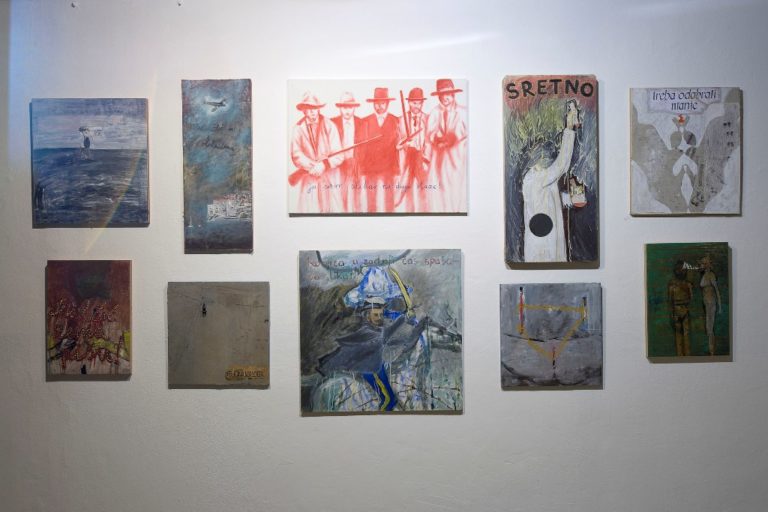
29 November - 09 December, 2007- paintings- 2-channel video-installation (in collaboration with Ivana Bago, Antonia Majača and Ivana Mance)- - - - - - - - - - - - - - - - - - - - - - -Ivica Malčić, 'the long distance painter', as he wittily dubs himself in one of his paintings, has been showing 100 new paintings on solo exhibitions over the course of almost ten years now. These exhibitions have been manifestations of the artist\'s commitment to creation and daily studio work, as well as documents of the very process of creation, the moments of exhilaration and crisis which this process entails. Malčić's painting also involves is a constant, and always also self-ironic, questioning of his own identity as an artist, the feeling of power and powerlessness, euphoria and doubt in front of the painting canvas but also in relation to the world of art and his position within it. Up to the present, Malčić has always held the function of both author and selector of his shows, retaining complete control over what would be presented to the public as his new painting cycle. In a way and by a the very concept of regular, seasonal presentations of his work - which are always at the same time a new exhibition but also a necessary precondition for the continuation of the unique life-long artistic project - Malčić poses an ultimatum and enters into a negotiation and dialogue with the world of art, in order to ensure his continuous presence inside it. Presumably speaking, if the exhibition fails to be realizes within a certain year, the whole project is put to question, which is a risk that the artist faces continuously and by which the responsibility is not only his, but that of the entire system of art institutions. At the exhibition 'MUTUALITIES: Shown & Found', it is exactly this dialogue (with himself and with the world of art) that comes to the fore after so far being only implicit in such an approach. Renouncing control of the space within the artwork and its public presentation, Malčić 'submits' himself to a jury, the space of curatorial intervention and a radical selection which reduces the presentation of 100 paintings as results of the year long work (of 1762! paintings made altogether) to presenting the work done over the course of two years by merely 10 paintings, selected by curators who, as Malčić notices, painting is not a primary area of interest and competence.Ivana Bago, Antonia Majača & Ivana Mance- - - - - - - - - - - - - - - - - - - - - - -10 NEW PAINTINGSSince 1998 I have been presenting 100 paintings every year at solo exhibitions in Zagreb. In 2003 I didn't have a solo exhibition but in 2005 I therefore showed 200 paintings. In 2007 I didn't show paintings but instead, I presented 365 diary-based drawings made during the previous year. This is how the paintings

15/07/2008.
20 November - 09 December, 2007 - performance - performance documentation (photo-documentation: Marko F. Ercegović; video-documentation: Saša Ban & Miroslav Sikavica)- - - - - - - - - - - - - - - - - - - - - - -In the performance 'Punishment', Siniša Labrović is playing with the fragile dynamics of expectation and desire, primarily in the relation between the artist and audience. As an artist/cultural worker, he is ready to take action, ready to satisfy the audience's desire for content and spectacle, which is here inseparable from the artist's own desire for audience and fulfilling of their expectations. As he himself states in the short CV to summarize his artistic practice, in this particular performance Labrović is also exhibiting 'a little bit of himself, a little bit of others, and other'. The 'other' that is being exhibited in 'Punishment' is exactly the unresolved interdependency of self and other. Following on the track of performance artists from the 1960s and 70s, Labrović subverts the idea of artist as autonomous creator and subject, intertwining the positions of performer and viewer, as well as the subject and object of the punishment invoked by the title.Ivana Bago & Antonia Majača- - - - - - - - - - - - - - - - - - - - - - -So far I have performed 'Punishment' twice, once in the O.K. Gallery in Rijeka, once in Belgrade during The Last East European Show, in a space whose name I can't recall. Due partly to my own ignorance, and partly to the inadequacies of the above mentioned spaces, I have never succeeded to properly perform this piece - the piece that I hold very dearly because, regardless of everything, it is still mine. Furthermore, I possess no documentation of it, and nowadays without documentation - I realized in the meantime, you aren't worth a plug nickel, or you're like a stray dog in the rain.Besides, I wanted to get hold of the Galerija Miroslav Kraljević as such.Then it occurred to me that the gallery's layout would be perfect for this work and that here, by doing one performance, I could satisfy all the three above mentioned ambitions.'Punishment' was made when I started wondering why everyone had started beating and terrorizing themselves like crazy. I realized it was something that attracted attention, so I decided to do such a piece myself and get some attention. Being, at the same time, somewhat timid, I thought it might be good if it wasn't entirely such. So, I put together these two opposite inclinations into one.And the audience is very important here as well. God helps out the third time. I hope.Siniša Labrović- - - - - - - - - - - - - - - - - - - - - - -Siniša Labrović was born on 12 February, 1965 in Sinj, Croatia. Baptized. Finished the 'Frano Masnić' elementary school, received the sacraments of holy communion and confirmation, then went on


29/05/2008.
The exhibition is the result of a weekly workshop that brought together students of Academy of Fine Arts, Zagreb and London Metropolitan University, London. The project has also included each group of students preparing packs of written material, images, articles, quotes, sketches, etc. that have informed their own practice. These packs of information were then sent to the other side prior to the meeting in Zagreb.The themes of the project are not specifically set, although they develop around the relations of the city to its known and hidden ‘stories’, the relation of fact and fiction in the construction of its narrative and the articulation of its wider social meaning. The project Britacia is a continuation of the collaborative project initiated in 2005. with the intention of developing a long-term exchange. Coordinators and menthors of the project: Ben Cain i Nicole Hewitt.Tara Versey, Ivana Radenovic, Sam Kettel, Nick Bates, Alex Pugh, Agnieszka Orzel, Sanja Djakovic, Marica Vitas, Margareta Dragicevic, Nikolina Knezevic, Luka Hrgovic, Nenad Kurcubic. . . . . . . . . . . . . . . . . . . . . . . ++++ I am a hard workerMe too++ The show must go onConnecting+++++ BritaciaI like Britacia tooCrotain++ More awkward mix++ ALUMETWhy are we not cooperating+ Perception & Thoughts. Brief encountersFlags & Time pressure+++++ Red Black White BlueI am not quite sureSomething revolutionaryWith two flags. . . . . . . . . . . . . . . . . . . . . . .The exhibition is open until Friday, June 6, 2008.. . . . . . . . . . . . . . . . . . . . . . . The project was realized with the support of London Metropolitan University, ALU Zagreb, Galerija Miroslav Kraljevic, Student Center, Zagreb
