


02/11/2006.
Recitativo: Of Divas and Dishes Emotion can erupt in strange places--from the kitchen sink to the calm woods. When created through a mechanical apparatus this evocation raises questions about where the generative force lies. Is genius God-given, or does it gather force in the process or the product of art-making? Is it only found in nature, or can it be formed in labor, thought, or culture? Or rather, is genius found in the transformation, the relations and friction of spheres and identities? Long Pond is ostensibly a tune for player piano that follows the pattern of the bark on a birch tree that Fritzie Brown collected at Long Pond in upstate New York. The melody is not a Romantic rhapsody that conjures walks in the forest and crisp blue skies and water. Long Pond resonates with the tradition of the American transcendental poets like Whitman and Thoreau but comments on our complicated relationship to nature. The tune produced from the birch bark is nature singing. However, we can only hear this mechanically through man-made systems. Mediated through the artist’s hand and broken down into a pattern of code that can be further translated electronically to sound, the birch’s music is a serial pattern of tones that sounds systematic in the tradition of minimal music. Although the perforations on the piano roll are a direct, even literal, transcription of the natural pattern of the tree bark, it does not mimic the tree precisely. Through her direct connection to the tactility of the tree, Brown’s process portrays the opposite of verisimilitude, instead presenting the elusiveness of nature and of approaching the original. Fritzie Brown highlights an aspect of the artist that is a machine for transforming nature into culture. Brown xeroxed the bark and manually transferred the markings to a twenty four feet graphite drawing. Her artistic hand does not remain in the final work and neither do the idiosyncrasies of the slice of bark. The pattern that is created is random and predetermined by the natural wood. In the translation from visual to sound, a poesie concrete emerges; these marks, like musical notes, can be read as music. In order to transfer the drawings to player piano, Brown searched the internet and found experimental composer Wolfgang Heisig. Heisig understood immediately Brown’s need. Their ensuing collaboration spanned several months of active email correspondence, faxes, and explanations from Long Pond to New York City to Leipzig, Germany, where coincidentally there is also a Long Pond nearby. The creative question sparks communication, transformation, connection. Every artwork tells a story of production, often collaboration, as well as individual creative impulse. Finally Long Pond was played and recorded electronically, the last step to date in the many phases in the process of the piece. Not yet played on a piano, on the occasion of this exhibition at Miroslav Kraljevic Gallery, Fritzie Brown and Branko Franceschi began another email correspondence and journey in a valiant attempt to rescue a pianola (player piano). This search led in zigzags

02/11/2006.
The perception of the transformation of visible reality is one of the elements that directly touch upon POKRIVENO/COVERED, a cycle of photographs by Jasenko Rasol. The photographs have been taken in the past six years; they are a statement on the modern society, the process whereby an author notes and expresses an idea and observation as the central topic of modern culture. Structuring the process of viewing from the macro-world towards the micro-situation, Jasenko Rasol photographs objects in public places – objects whose contents are concealed, covered in tarpaulin and plastic sheets, hidden from the view for one reason or another. Construction materials, items left behind after a temporary urban intervention, all kinds of makeshift work areas and other unknown contents in a way threaten the organisation of the space as a whole, pointing to the reading of its other givenesses. Covering them is a legitimate reaction to the found contents of the space which one does not want to encumber any further. Simple mimicry does not function according to an ideal conceived model, and Rasol’s photographs seem therefore as a process in which the transience of the form is brought to awareness – the assemblage of futility threatened by weather and time. The associativeness related to the photographed interventions is inevitable because both the author and most of the viewers are interested in the unrecognisable contents and in the reasons why it is considered unnecessary or even undesirable for others to look at them. The author himself rejects the aesthetic value of the photographs in this cycle, pointing to the temporary nature of the relations between the covered contents and the context of the space where they are located. On a symbolic level, the covered may reflect the shape of things, privately, locally and globally. Together with the author, the viewers become witnesses to those human actions and reactions in solitary environments or locations defined by the historical buildings around them and the contents therein. In Rasol’s photographs of unassuming, everyday states, the covered objects, as much as they are at the centre of his attention, do not automatically become the source of a specific content. The atmosphere of the presentation mediates the remnants of someone’s activities, creating an impression that one is entering into spaces set up exclusively for those who want to look and comprehend the whole in all its parts. Nothing is final, everyone is entitled to draw their own personal conclusions, which are just as temporary, because the covered contents have in the meantime changed places, becoming part of visible reality. Modern media culture often does not rely on authentic procedures but on stereotypes and repetitions. Doubting anything we are not in the position to see leads to the repetition of the procedure; using a camera to record things is of assistance here, as it transforms what is seen into an authorial intervention – a process which includes perception and representation. The author’s experience founded in this manner in the historical context is seen as

02/11/2006.
Album of the Non-existent Antiquities
Even when it sought the fragment “anarchy” in the structure of collage, the art of Tomislav Čeranić always expressed the need for order, regularity, harmony, subordination of the parts in a whole. When I presented the cycle of collages L’age d’or in 1996 I have noticed that this artist was always rather reconciling then confronting the fragments of reality (collage), thus expressing the pronounced affinity to order in which there is no place for material roughness and influence of raw slivers of reality. The elegant tone of classic painting was present even in his works executed in surrealist style or those that invoked ludic heritage of the avant-garde. For all that his works lacked typical modernist polemics while distanced placability prevailed. His paintings did not polemize but conversed with the past, whether it was anachronistic or avant-garde and instead of vehement gesture prevailed the “draughtman’s” silent enthusiasm that cared most about the perfect display of parts in a whole and the complete control of the harmonizing procedure. His drawings, even more than his collages, enhanced the inbred propensity for meticulousness in precise construction of details, characteristic of a careful architect aware of the need to plan everything in advance in order to assure firmness of the future construction. In distinction from those drawers who use details as devices in service of the whole that they are secretly creating, for Čeranić they are equally important for the perception as the massive contour resulting from their union. Sometimes we have the impression that our attention is captured by this meticulous detail alone, and that only by looking into the microstructure of the work we can grasp its macro-plan. Because the stability of architectural fragment seems to depend on every stone or brick that was built into its thoroughly planned volume. The cycle of pencil drawings Star City (2001-2002) is one of Čeranić’s homage to detail, which, crossing the centuries, might be placed among the works of architects and illustrators from the past who were especially concerned about the existence of their drawings as independent, thoroughly defined and to the smallest details worked out drawing creation. Čeranić is not even concealing his paragons, he uses the fragments of their architectural designs in order to fit them into his personal constructive fancy. Although it should be said that as a draughtman he does not aspire to feasibility of his project. Instead of imagining a future palace, church or residential building, his final goal is to give his projects a convincing architectural life on the paper and in the retro-imagination by which he revives the past. Namely, absorbed in built and non built projects of the 18th century architects like Etienne-Louis Boullee and Nicholas Ledoux, as well as Giovanni Battista Piranesi’s architectural illustrations and archaeological reconstructions or Atanasius Kircher’s (1) fantastic illustrations, Čeranić constructs the structure of Star City, Utopian city realistic in plastic and architectural details, but fantastic as a functional unity. But this city is not some

01/11/2006.
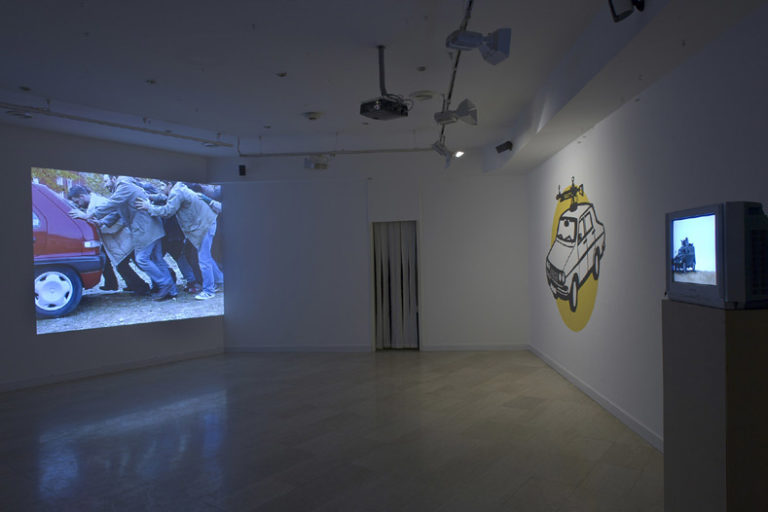
Ahmet Ögüt, one of Turkey’s influential young artists, brings the diversity of specific local determinations, which appear to take place in a particular temporal and spatial relationship, to his work. Ögüt’s art, and its patent subjectivism, is anchored in the significant role that the media plays in constructing and manipulating reality. As result, he uses the images of events that appear in the daily digestive methodologies such as newspapers and television, recapturing those images in a totally different frame.
In Somebody Else’s Car (20 pieces photo series), Ögüt transforms two found cars using readymade paper cut outs. Without requesting the owners’ permission he clads the first all in yellow and with the final addition of a boxed sign on the roof, the car adopts its new identity as a standard İstanbul taxi. On the flanks of the second car he applies graphics and on the roof a blue, white and red emergency siren and again, with remarkable dexterity and finesse, the originally plain white car is transformed into a police car. Öğüt accomplishes each makeover as if performing an act of vandalism and yet his actions result in no more damage than the owners’ confusion and likely amazement on returning to their vehicles. Light Armoured is a short animation that shows a camouflaged Land Rover being hit by small stones thrown by an unknown source. It is obvious that this vehicle belongs to the army and yet the attack is pathetic, almost comical, as the stones bounce off its armour without causing damage, or miss altogether.Played on a constant loop, the work presents a symbol of what is happening and what will, unfortunately keep on happening in the world. It is both an anti-war gesture, against all camouflaged and normalized tools, which harm humanity and world peace, as well as a comment on the futility of combat.The video Death Kit Train shows an ordinary, simple activity in an extraordinary slow manner in detail. A red car comes into the frame slowly. At first everything seems to be in order and apparently there is nothing unusual going on. However, after a few seconds of time the viewers come to be aware of the fact that the car is not moving on its own and that actually there are people pushing it strenuously. Eventually, in the last frame, viewers realize that people are pushing each other.For the wall painting the artist used the image of a vehicle with a machine gun on the top. The car in question is a white Renault 12, once widely used by civilian police officers in the rural areas back in 90s and thus represents a symptom connecting the legacy of the militarism of the 90s and the spare-parts economy. A car is once again used in Short Circuit. In this video piece,Ögüt shows as a street on the outskirts of a town that is lit only by a weak street light and occasionally by the lights of cars passing by. A viewer is able to discover what

01/11/2006.
Mario Rizzi's work develops around the notions of relation, identity and therapy. He anylyses the question of identity connected to social exclusion and reveals the commitment to giving voice to or focus on uncomfortable or forgotten truths, individual and social traumas and a therapeutic dimension. The relations occur between his own self and the others, and the others among themselves (including the public). Private stories, as a result of their universality, are transformed into paradigmatic collective events.(L. Beatrice)- - - - - - - - - - - - - - - - - - - - - G-MK’s proposal to the artist was to develop a new, site specific project in Vukovar, a town with an especially perplexed history, complex social and political constellation. Considering our constant aim to connect and collaborate with other non-profit and independent initiatives and spaces outside the capital, together with our goal to affirm the idea of decentralization of culture we decided to collaborate with Youth Peace Group Danube (YPGD) from Vukovar and Vukovar City Museum, which would act as a local partner and coordinator of the artist's residency.During his stay in Vukovar Mario Rizzi has been working on sound recordings and collecting raw sound footage, the soundscapes of the town- places of public gatherings, spontaneous conversations, urban environment, nature, historical sites etc.In it's second phase the project will involve dynamic collaboration with a number of regional musicians and bands...- - - - - - - - - - - - - - - - - - The project is ongoing at the moment. Check this web site for more information as the project develops.

01/11/2006.
The program of Resonance closes with a discussion and party with a VJ performance by the Split Academy student Marnel Tomic aka VJ Plazmatik. During June 2006, Resonance presented works by students of the University of Split Art Academy (UMAS), in the selection of Sandra Sterle, professor at the New media department of UMAS.
- - - - - - - - - - - - - - - - - -participants: Marko Golub (art critic, Radio 101) Nicole Hewitt (Academy of Fine Arts, Zagreb)Dan Oki (UMAS, Split) Dinko Peracic (Platforma 9,81) Ana Peraica (art critic and theoretician, Split)Sandra Sterle (UMAS, Split) Miranda Veljacic (Platforma 9,81) moderated by: Sandra Sterle - - - - - - - - - - - - - - - - - - -The issues the discussion will focus upon are: / uniqueness or autism of the Split art scene / development and perception of contemporary art in Split; development of local institutions / good food and even better climate / vitality, stubborness, isolation, authenticity / what does it mean to study at the Split Art Academy? / from the international art scene to Split or from Split to the international art scene? / Zagreb - Split relation/ Bologna agreement and the new department of Film and video / islands bound! - - - - - - - - - - - - - - - - - - Marnel Tomić aka VJ Plazmatik / party at g-mk, after the discussionAfter the discussion, join us for a VJ performance of VJ Plazmatik, joined by DJ Gildo.After meeting the DifferentStyle crew Marnel begins working more intensely on video-performances at concerts and other events. He\'s studying at the Spilt Art Academy, Department of Visual communications design. His VJ-ing is a form of video-performance which combines already defined video loops and clips with video outputs (camera) installed on stage or among the audience. Video flux is designed according to the physical space and all video materials are mixed on-the-fly.

01/11/2006.
The Vienna based collective monochrom works in the fields of art, technology and philosophy. It has been present in the international art scene since 1993. In its praxis, monochrom employs various media and forms of artistic work and regularly publish books and magazines and inn Zagreb they will present their work on a performance/lecture No Power for Theory And/ Or Practice- a Gala for Zagreb!
- - - - - - - - - - - - - - - - - - - - - - -
monochrom is an unpeculiar mixture of proto-aesthetic fringe work, pop attitude, subcultural science and political activism. monochrom\'s mission, its passion and quasi-ontological vocation, is primarily the collection, grouping, registration and querying (liberation?) of the scar tissues represented by everyday cultural artifacts. This mission is conducted everywhere, but first and foremost in culture-archeological digs into the seats (and pockets) of ideology and entertainment. monochrom is an open experimental ground for panel discussion service, game shows, readings, short film productions, alternative projects in space travel, do-it-yourself courses on wiretap construction, international soul trade, paper chase, tales of powerpoint, propaganda camps, epic puppet theatre, aesthetic pregnancy counselling, production and destruction of music, catering, modern dance, East German rock music, etc. monochrom’s gala medley is a tour-de-farce diversion intended to hold the attention of the transmediale audience. A joyful bucket full of good clean fanaticism, crisis, language, culture, self-content, identity, utopia, mania and despair, condensed into the well known cultural technique of a gala show. Powernapping highly welcome. monochrom is: Johannes Grenzfurthner, Anika Kronberger, Franky Ablinger, Günther Friesinger, Evelyn Fürlinger, Frank Apunkt Schneider, Harald Homolka List and Daniel Fabry. Roland Gratzer is official PR content manager. www.monochrom.at/english/
