


26/10/2006.
Vujicic is transforming the gallery space into a laboratory where, using the lab equipment, he produces perfumes from human excretions. Visitors can 'leave' any of their excretions and the perfume will be made from them. They receive one specimen, while the other is retained in my perfume repository.The time it takes to produce a perfume is ± 60 minutes. The flask filling takes place in the gallery. The perfume is named after the donor and the type of excretion it was made from. The product can be used.- - - - - - - - - - - - - - - - - --artist's notes:- gallery as laboratory - 'art' becomes functional, both approachable and inapproachable - because art might smell badly- sweat, sperm, urine, feces, menstrual blood, milk - as basis for perfume derivation, a transformation of excretions into something else in an unnatural way- perfume as social and cultural value- invisibility and strange sensuality, a potent substance- flux - importance of flow (› Deleuze)- subjective impression of smell (we like our smell no matter how it smells)expert assistence: dr.sc. Stribor Marković, Ivona Jasprica, Ana Mornar, Ivo Parać, Dean Lukićproduction: DIYARTLAB project
26/10/2006.
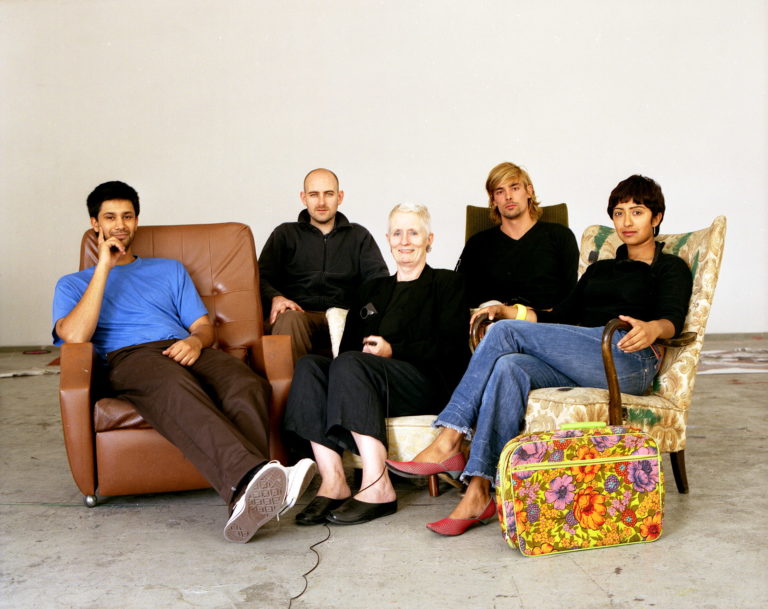
Cinema Suitcase is an international group of filmmakers pursuing projects of experimental social documentary. Coming from a diversity of fields in the visual arts, they seek to facilitate the self-narration of their subjects, always encountered on the basis of a great intimacy, rather than constructing their stories for them. This approach enhances the performative quality of filmmaking as a collective process.Nothing is Missing, 4-screen video installation, 22 to 35 min,2006Colony, digital video, 2006Mille et un jours, digital video,44 min,2004/2006Access Denied,digital video,32 min,2004The 4-screen video installation \'Nothing is Missing\' attends to the people never talked about, all but invisible, who most poignantly suffer the loss of the departure of migrants from their communities: the mothers. \'Colony\' is a tale of a lost system of production, of colonization and hierarchy and the politics surrounding the work of individuals whose lives became entwined in a global vision. The film opens but does not answer the question so crucial to the contemporary world: is the overcoming of colonialism ever able to avoid neo-colonialism? The film is political in its critical presentation of both past ideals and contemporary alternatives. Two films, made by the collective, explore the impact of the current repressive politics of migration on individual lives (\'Mille et un jours\'; \'Access Denied\'). While the former film is an experimental narrative that balances classical form with Arabic tradition, and a joyful present with recent and past trauma, the latter film also questions the ways this political climate affects the possibility to make art.

26/10/2006.
Hunger Artistrn/ performancernHunger Artist is based on Franz Kafka\'s Ein Hungerkünstler(A Hunger Artist), a story about an extinguished genre of performing arts. Applying the story to the process, the participants of the project have fasted for 20 days. This period will end on the evening of the performance. Six local dancers / choreographers have been working together with post theater, a company that worked in Zagreb twice before. post theater was part of last year\'s Dance Week Festival (with Hiroko Tanahashi\'s "skinSITEs" performance) and taught a site specific workshop as a part of Triatlon 2005 at Kino Lika (May, 2005). FEEL FREE TO MEET FREE MEAT TO FEED www.eks-scena.hr www.posttheater.com - - - - - - - - - - - - - - - - - - - - - - - - artistic directors: Hiroko Tanahshi, Max Schumacher choreographers / co-Authors / performers: Edvin Liveric Ivana Roncevic Martina Rozic Nina Sakic Gordana Svetopetric, Ljiljana Zagorac - - - - - - - - - - - - - - - - - - - - - - - coordinator of Triatlon: Sandra Banic main organizer: EkS-scena partners: / Goethe Institute, Zagreb / French Institute, Zagreb / g-mk | galerija miroslav kraljevic / CEKAO "Zagreb" / Culture of change SC. supported by: Croatian Ministry of Culture, Zagreb City Office for Education, Culture and Sport, French and German Ministry of Foreign Affairs, French Institute in Zagreb and Goethe Institute in Zagreb.

17/10/2006.
The Resonance program presents works by students at the The Art Academy from Split. The program is co-curated by g-mk and Sandra Sterle, professor at the New Media Department of the Split Academy. The program is realized during 3 weeks, from June 15 to July 8, and is comprised of a set of exhibitions, happenings in public space and a public discussion whose participants are artist, curators, architects and critics connected to the Split cultural scene.
Program of the 'Resonance': 15.6.-21.6. / Ivana Resić | Ivana Runjić 22.6.-28.6. / Sunčica Fradelić | Mitar Matić29.6.-06.7. / Nikša Rušić | Nikša Vukša7.7., 19.00 / Public Discussion: The Past And Future of the Split Cultural Scene
Participants: Marko Golub | Dan Oki | Dinko Peračić | Ana Peraica | Sandra Sterle | Miranda Veljačić7.7., 21:00 / Marnel Tomić (VJ performance)8.7. / Marko Marković, Sektart (happening in public space-at the Zrinjevac Park) - - - - - - - - - - - - - - - - - 'The places we live and work in necessarily shape not only our own work and attitude but also the perception of those who view this work. In that sense, the city of Split is an extremely defined place in our local context. It is a city that in no way suffers from lack of identity. Just the opposite, sometimes it seems overdefined. Here everything is recognizably and characteristically Split-like. Living and working in Split often surprise and transform people who come from other environments. What is astpunding is a complete lack of 'polish' in everyday life, the outbursts of sometimes unbelievable warmth, but also the inability to escape defined formats and frames. In the last several years, I've been teaching intensively at the Univerity of Split Art Academy. Keeping a close contact with students and watching their work develop, I've been amazed by the energy and lucidity od young people. I encourage them to cretae work that critically relates to the city, their own identity, authority and dominant contemporary expressions in visual arts. The works presented in the frame of Resonance in Galerija Miroslav Kraljevic are a summary of some of the student ideas that I have found most interesting in the last two years.'
Sandra Sterle - - - - - - - - - - - - - - - - - - -Ivana Runjić: Show me your hard disc and I will tell you who you are, video, Ivana Resić: My Wishes, My Dreams, installation made of 13 pillows, 'floating' in space. Mitar Matić: Slobodna Dalmacija / New York Times, 20 paintings 50x63 cm, oil and sitotisak on wood. Sunčica Fradelić: Home Theater Presents, video installation, 2006., 8:00 min Nikša Rušić: Nikša Vukša: Marko Marković: Sektart, happening in public space (the Zrinjevac park) Marnel Tomić aka VJ Plazmatik: VJ Performans

17/10/2006.
/ interactive movement animation
Gifoskop is an experiment that manifests the relations between what is perceived as the basic elements of dance: locomotion, composition and its visuality. It is also an analytic means for communicating dance procedures between dancers and non-dancers. Gifoskop enables the non-dancing body to animate its creative and performative mechanisms in dancing.
Gifoskop is an interactive animation-motoric installation which reanimates movement/dance and returns it to its space-time/performative medium. As a trace/excerpt of a movement, gif signifies the interupted body-space position which is, in a way, the origin of movement that is animated in order to create an illusion of movement/dance. Gif also communicates information that the dancer uses in creating and performing a movement / dance, which the visitor adopts and performs in the act of reanimating movement. concept and performance:| Maja Marjancic| Nikolina Pristas | Nenad Romic

17/10/2006.
‘Work in Progress’ was inspired by artists personal situation, but also the general problem of contemporary artists, who make art in their free time, after they have finished with the jobs that secure their material existence. The project was moreover triggered by the fact that in Croatia it is extremely hard to get financial support for research based projects; it’s rarely possible to even cover the production costs, not to mention taking care of the author’s existential problems while working on the project. Unlike artists working in the field of performance art or music, visual artist in most cases do not get any fee for their work and their presentation. Budgets donated by the state are usually too small and the money usually comes late, so the process of producing a new work is always prolonged, which is additionally complicated by the obligation to realize the financed projects by the end of the same year. At the same time, the market for this kind of production is still undeveloped. For the reasons above, it is not unusual that, with time, even affirmed artists become frustrated and give up on making art. Lara Badurina’s research deals with this dichotomy: how big is the gap between labour (which secures the everyday existence) and work (art practice) on the local art scene, how much is it related to the existing art chain (art practice) and the dynamic of the (non-existent) market, is there a distinction between labour and work – or has the selection, presentation, distribution of the artist’s work become just another job... In order to more easily distinguish between different aspects of the issues that interested me I talked to artists, curators, critics, gallerists, as well as representatives of the independent cultural scene. - - - - - - - - - - - -
‘Work in Progress is truly a work in progress: it’s a launching of a long-term research for me and a beginning in dealing with a more extensive issue of exploring the way the art system functions. Information resulting from the research and differing perspectives of the participants I interviewed refer to practical problems which are reflected on the whole artistic process and, finally – on the very quality of artistic production’ (Lara Badurina) - - - - - - - - - - - - - - -
Questions posed in the ½Work in Progress½: / What motivated you for the job you are doing? / Do you think that you had freedom at choosing your occupation or was it a coincidence? / Is there a difference between labour and work in what you do? / Describe the activities belonging to work and the activities belonging to labour / Describe the path from idea to realization what is, in your own case, the final phase of production (work)? / Is there a constant for you in the production process and how would you describe it? / What are the ways of financing the process of production

17/10/2006.
Exhibition of Radoslav Putar Award Winner 2005 - - - - - - - - - - - - - - - - - The solo exhibition of the awarded artist is the final stage of the Radoslav Putar Award initiated by the Institute for Contemporary Art from Zagreb. As one of the programatic orientations of g-mk is also the focus on the promotion of the perspective young artists and their integration into the international art context, g-mk is the regular partner of the Radoslav Putar Award where it takes part in conceptualization, organization and production of the winning artist’s final exhibition.
Antun Bozicevic's exhibition closes the fourth cycle of the Radoslav Putar Award. At the same time, the new, fifth cycle is opened by launching of the new Call for Applications for the 2006 Radoslav Putar Award. Since 2002 four artists have received the Radoslav Putar Award: Tanja Dabo (2002), Nika Radic (2003), Igor Eškinja (2004) and Antun Bozicevic (2005). - - - - - - - - - - - - - - - - - - - Badel Station is an audio-video installation which consists of sound recordings of the New York subway and the live sound of the street crossing in front of the gallery, which the artist mixes and broadcasts onto the street. By using a 6-channel concert sound system a new sound reality is set up on the street and in front of the gallery entrance. The sound installation is accompanied by the video projection in the gallery space and the gallery windows in which the artist uses footage from Walter Hill’s film "The Warriors", creating an audio-visual installation - an environment simulating a subway station. With Badel Station, the artist critically refers to the ‘myth’ of the construction of the subway in Zagreb which, as the artist notices, is often used as an argument justifying the lack of support for other urban and cultural projects. The exhibition title refers also to "Operation:City" a ten-day long festival of independent organizations and ‘alternative’ culture, which took place at the deserted spaces of the Badel factory, situated opposite g-mk. By using the footage from the cult film "The Warriors", the artists symbolically refers to the, very often, marginal position of artists and cultural activists. - - - - - - - - - - - - - - - / Interview with Antun Božičević The work is entitled Badel Station. Can you explain the idea behind the exhibition? I got the idea last year, before my trip to the USA, while I was reading an article in the business section of a newspaper. It was commenting on the «Operation:City», the ten-day long festival organized by independent organizations and initiatives and presenting «alternative» art, which took place in the Badel factory, a deserted building situated just opposite Galerija Miroslav Kraljević. The article that I read before leaving Zagreb conveyed the negative attitude of the city authorities towards the possibility of letting organizations involved in the project use
17/10/2006.
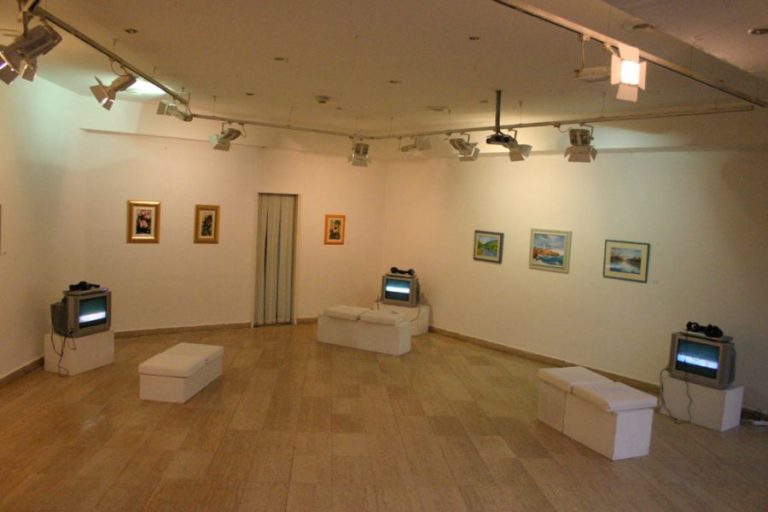
It is difficult today to bring into connection amateurism in art and culture, organized in the form of arts clubs, with an image of a progressive and prestigious 21st century corporation. In the overall acceleration, under the impact of information technologies in the society of late capitalism, the remnants of arts clubs in Croatia seem to be a sort of survived archaic form, even a simplistic way of workers’collective organization of their free time but also a form of self-initiatiated uniting of workers in big companies through cultural and artistic activities. Today, when free time is becoming a luxury, they are being replaced by various forms of «team building» and carefully formulated models of «active and strategically conceived collective activities». In the local context of the old «complex organizations of united work» (SOUR), the form of arts club was, surely, strongly encouraged, which is witnessed today by various monographs and overviews of cultural initiatives and artistic organizations of united workers. The 20 years of KUD-Ina monograph, for example, states that «passive participation in already finished cultural projects (theater shows, concerts, exhibitions, libraries) did not satisfy a part of employees. They wanted to use their own creativity to produce art programs, so they suggested cultural self-activities in their own working environment». As soon as 1973 «the first exhibition of artworks of Ina’s employees» was organized and it is stated that «the art section proved that art amateurism isn’t an unworthy weakling in relation to the more known and more commercialized academic creation; in fact, it is a real and distinguished cultural value that reveals, in the context of evereyday life, all its creative potential». What I find interesting here is also the relation to the so-called academic production, in a specific situation in which the arts club of a huge «SOUR» founded an independent gallery twenty years ago which, managed by the excellent curator , became fully independent and even transformed itself into one of the most relevant venues on the national contemporary art scene. Ana Hušman’s project deals with the very form of an arts club as a model of self-organized art amateurism, but also the relation between the artist-amateur and academic artist (of which only some are ‘professional’artists, if we use that word to designate work that also brings financial gain). At the beginning of her research Ana was regularly visiting events at the INA Arts Club in Gajeva street, researching (with the help of the manager Dubravka Vuletić) the history of the Club, spontaneously meeting amateur artists, finding out about their reasons and motivation for making art, the ways in which they work and function within the „art section“. In the second phase the artist made audio records from interviews with three artists, members of the art section, whose works she then decided to present within her project for Gallery Miroslav Kraljevic. In the well conducted, bur primarily cordial and direct interviews three clear and vivid portraits were created, showing different approaches towards their work, but also different
