


02/11/2006.
Album of the Non-existent Antiquities
Even when it sought the fragment “anarchy” in the structure of collage, the art of Tomislav Čeranić always expressed the need for order, regularity, harmony, subordination of the parts in a whole. When I presented the cycle of collages L’age d’or in 1996 I have noticed that this artist was always rather reconciling then confronting the fragments of reality (collage), thus expressing the pronounced affinity to order in which there is no place for material roughness and influence of raw slivers of reality. The elegant tone of classic painting was present even in his works executed in surrealist style or those that invoked ludic heritage of the avant-garde. For all that his works lacked typical modernist polemics while distanced placability prevailed. His paintings did not polemize but conversed with the past, whether it was anachronistic or avant-garde and instead of vehement gesture prevailed the “draughtman’s” silent enthusiasm that cared most about the perfect display of parts in a whole and the complete control of the harmonizing procedure. His drawings, even more than his collages, enhanced the inbred propensity for meticulousness in precise construction of details, characteristic of a careful architect aware of the need

01/11/2006.
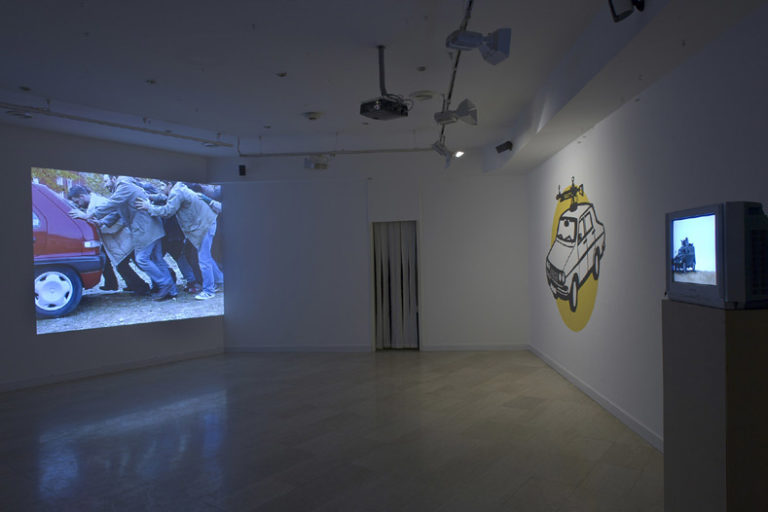
Ahmet Ögüt, one of Turkey’s influential young artists, brings the diversity of specific local determinations, which appear to take place in a particular temporal and spatial relationship, to his work. Ögüt’s art, and its patent subjectivism, is anchored in the significant role that the media plays in constructing and manipulating reality. As result, he uses the images of events that appear in the daily digestive methodologies such as newspapers and television, recapturing those images in a totally different frame.
In Somebody Else’s Car (20 pieces photo series), Ögüt transforms two found cars using readymade paper cut outs. Without requesting the owners’ permission he clads the first all in yellow and with the final addition of a boxed sign on the roof, the car adopts its new identity as a standard İstanbul taxi. On the flanks of the second car he applies graphics and on the roof a blue, white and red emergency siren and again, with remarkable dexterity and finesse, the originally plain white car is transformed into a police car. Öğüt accomplishes each makeover as if performing an act of vandalism and yet his actions result in no more damage than the owners’ confusion and likely amazement on returning to

01/11/2006.
Mario Rizzi's work develops around the notions of relation, identity and therapy. He anylyses the question of identity connected to social exclusion and reveals the commitment to giving voice to or focus on uncomfortable or forgotten truths, individual and social traumas and a therapeutic dimension. The relations occur between his own self and the others, and the others among themselves (including the public). Private stories, as a result of their universality, are transformed into paradigmatic collective events.(L. Beatrice)- - - - - - - - - - - - - - - - - - - - - G-MK’s proposal to the artist was to develop a new, site specific project in Vukovar, a town with an especially perplexed history, complex social and political constellation. Considering our constant aim to connect and collaborate with other non-profit and independent initiatives and spaces outside the capital, together with our goal to affirm the idea of decentralization of culture we decided to collaborate with Youth Peace Group Danube (YPGD) from Vukovar and Vukovar City Museum, which would act as a local partner and coordinator of the artist's residency.During his stay in Vukovar Mario Rizzi has been working on sound recordings and collecting raw

01/11/2006.
The program of Resonance closes with a discussion and party with a VJ performance by the Split Academy student Marnel Tomic aka VJ Plazmatik. During June 2006, Resonance presented works by students of the University of Split Art Academy (UMAS), in the selection of Sandra Sterle, professor at the New media department of UMAS.
- - - - - - - - - - - - - - - - - -participants: Marko Golub (art critic, Radio 101) Nicole Hewitt (Academy of Fine Arts, Zagreb)Dan Oki (UMAS, Split) Dinko Peracic (Platforma 9,81) Ana Peraica (art critic and theoretician, Split)Sandra Sterle (UMAS, Split) Miranda Veljacic (Platforma 9,81) moderated by: Sandra Sterle - - - - - - - - - - - - - - - - - - -The issues the discussion will focus upon are: / uniqueness or autism of the Split art scene / development and perception of contemporary art in Split; development of local institutions / good food and even better climate / vitality, stubborness, isolation, authenticity / what does it mean to study at the Split Art Academy? / from the international art scene to Split or from Split to the international art scene? / Zagreb - Split relation/ Bologna agreement and the new department

01/11/2006.
The Vienna based collective monochrom works in the fields of art, technology and philosophy. It has been present in the international art scene since 1993. In its praxis, monochrom employs various media and forms of artistic work and regularly publish books and magazines and inn Zagreb they will present their work on a performance/lecture No Power for Theory And/ Or Practice- a Gala for Zagreb!
- - - - - - - - - - - - - - - - - - - - - - -
monochrom is an unpeculiar mixture of proto-aesthetic fringe work, pop attitude, subcultural science and political activism. monochrom\'s mission, its passion and quasi-ontological vocation, is primarily the collection, grouping, registration and querying (liberation?) of the scar tissues represented by everyday cultural artifacts. This mission is conducted everywhere, but first and foremost in culture-archeological digs into the seats (and pockets) of ideology and entertainment. monochrom is an open experimental ground for panel discussion service, game shows, readings, short film productions, alternative projects in space travel, do-it-yourself courses on wiretap construction, international soul trade, paper chase, tales of powerpoint, propaganda camps, epic puppet theatre, aesthetic pregnancy counselling, production and destruction of music, catering, modern dance, East German rock music, etc. monochrom’s gala
