

07/03/2012.
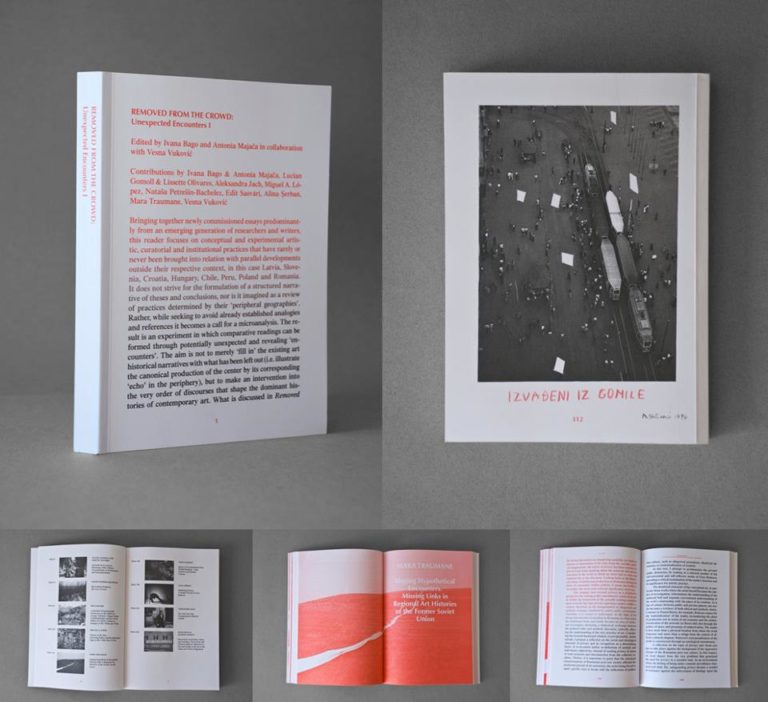
Bringing together newly commissioned essays predominantly from an emerging generation of researchers and writers, this reader focuses on conceptual and experimental artistic, curatorial and institutional practices that have rarely or never been brought into relation with parallels outside their respective context, in this case Latvia, Slovenia, Croatia, Hungary, Chile, Peru, Poland and Romania. It does not strive for the formulation of a structured narrative of theses and conclusions, nor is it imagined as a review of practices determined by their ‘peripheral geographies’. Rather, while seeking to avoid already established analogies and references it becomes a call for close reading. The result is an experiment in which comparative readings can be formed through potentially unexpected and revealing ‘encounters’.
The aim is not to merely ‘fill in’ the existing art historical narratives with what has been left out (i.e. illustrate the canonical production of the center by its corresponding ‘echo’ in the periphery), but to make an intervention into the very order of discourses that shape the dominant histories of contemporary art. What is discussed in Removed from the Crowd: Unexpected Encounters I are exactly those practices that were themselves in search of new methodologies, exploring the interstices between the collective and individual, private and public, action and escapism, art and non-art, artist and curator, urban and nature, visible and invisible. Many of them were taking place in private spaces, in solitude, in nature, or camouflaging themselves as non-art, as part of everyday life, a protest, a crowded street, radically redefining or ignoring the idea of audience. They rather counted (consciously or not) on ‘an audience to come’ and so could be said to have been meant for the future. The art historians invited to contribute are thus today their ‘delayed public’, approaching them from both historical and contemporaneous perspectives, shaped by their own preoccupations and urgencies.


07/03/2012.
In the video installation "Bogey", Bärtås and Ståhl develop parallel narratives revolving around the two neighboring areas in Blato, one of the Zagreb suburbs: the never completed building of the University hospital from the 1980s and the newly developed Golf & Country Club Zagreb. The presence of the huge building of the hospital next to the exclusive golf club points towards the dramatic changes and shifts in recent Yugoslavian and Croatian history.
The artists depart from the location of the hospital by repetitive reading of the text addressing the story of its history and its present. The last remaining guard keeps patrolling the hospital unable to prevent the continuous robbery of the building that gradually becomes stripped of all of its functioning parts and valuable metal. The gigantic skeleton of the hospital has kept resisting the influence of the weather but the nature is now invading its rooms and roofs.
And while the public hospital has been deteriorating, the private golf club has been expanding. By the 2010 court settlement, the owners of the golf club were ordered to pay 4,5 million Kunas as a compensation for the illegal digging along the Sava River, close to their premises. By that point they have excavated 300 000 cubic meters of sand and gravel, which probably caused the contamination of the groundwaters of Sava.
The reading at the hospital along with the many sounds from the building and its surrounding, form a common sound track for the two films and their two realities. The routine walk of the guard through the hospital building exposes the marks of thieves, squatters and graffiti artists, and enfolds in parallel with the movements of the golf cars of the neighboring gated community.
Magnus Bärtås is an artist, writer and professor of fine art at Konstfack in Stockholm. In his works he has been focusing on biographies, storytelling and architecture. His works is currently on view at Apex art in New York and he is developing new works for the Gwangju Biennale in South Korea, Tensta Konsthall (Stockholm) and the Art museum of Uppsala (Sweden).
Lars-Henrik Ståhl is an architect, artist and professor in Theoretical and Applied Aesthetics, Lund University. He has been the leader of arts-based research project such as Los Angeles Islands- American architectural influences in a Swedish region, and recently, Placebo-replacement strategies in hospital architecture (Zagreb project being part of it). Ståhl is also the director of ResArc, Swedish research school in Architecture.
Supported by: Ministry of Culture, Republic of Croatia, City of Zagreb – Office for Culture
The artists\' research has been made possible through the collaboration with theMuseum of Contamporary Art Zagreb.
Galerija Miroslav Kraljević Subićeva 29, Zagreb www.g-mk.hr + 385 1 45 92 696 Opened:Tue – Fri 12 – 19, Sat 11- 13




17/11/2011.
Removed From the Crowd is an on-going research and publishing project developed by Ivana Bago and Antonia Majača at the Institute for Duration, Location and Variables (DeLVe) that had its differently shaped presentations in Belgrade, Ljubljana and Prague.
Based on the initial reading of selected phenomena and concepts that informed the artistic, curatorial and intellectual practices in Yugoslavia during the 1960s and the 1970s, the project opens itself to an open process of reshifting and reshaping its scope and methodology, introducing new elements and fragments with each new iteration.
The project’s main preoccupations, revolving around the ideas of temporary communities, delayed audience, exodus, and Dionysian socialism, are offered as entry points for new chapters and ‘unexpected encounters’; testing their resonance in different geographies, through new collaborations and research contributions.
The series of seminars Removed from the Crowd: Unexpected Encounters gathers research contributions relating to artistic and intellectual practices of the 1960s and 1970s by bringing together a variety of recent research methodologies referring to different socio-political contexts, particularly exploring ‘peripheral’ geographies. The aim is not to merely \'fill in\' the existing art historical narratives with what has been left out, rather the seminar series attempts to work towards an intervention into the very order of discourses that shape the dominant histories of contemporary art.
Unexpected Encounters I seminar held in 2010 presented several on-going researches featuring practices that were themselves in search of new methodologies, exploring the interstices between the collective and individual, private and public, action and escapism, art and non-art, artist and curator, nature and urban space, the visible and the invisible.
The upcoming seminar Unexpected Encounters II edited by Klara Kemp-Welch brings together a selection of comparative methodologies for approaching international Conceptualism: mobilising affect theory to understand Hungarian and Polish artists’ responses to the Warsaw Pact Troops’ invasion of Czechoslovakia in 1968; bringing to bear parallel materials to challenge Moscow Conceptualism’s exclusivity and myths of origins; ‘reassembling the social’ in East European art in the decades preceding 1989.
This open seminar is imagined as a meeting point of researchers, research notes and material, inviting the seminar contributors and the audience to participate in open reflection on and questioning of methodologies.

