


14/07/2011.
In collaboration with Tranzitdisplay and local researchers, artists and collaborators, a new constellation of the research archive is being formed daily, based on the interaction of the existing and new material. The Prague chapter of the research is focused on projects in Czechoslovakia from the 1960s and 1970s happening outside the sphere of immediate visibility, exploring the interstices between the action and escapism, individual and collective, the urban sphere and nature, immediate and delayed audience.
The methodology of research and its presentation is likewise based on rethinking the idea of audience and the imperative of visibility: the archive takes shape through one-on-one meetings with artists, art historians, witnesses; potentially taking the form of a lecture for one where, the roles of the lecturer and audience get destabilized and interchangeable. It also questions the role of art historians and principles of formulating an interpretation. Instead of an enclosed procedure of creating an art historical interpretation, followed by the public presentation of it as a coherent and closed unit, the process of its formulation is open for interventions and contestation while in the making. The network of people involved thus becomes the immediate public of the research as well as participants in the interpretative procedure, a temporary community of individuals involved in the writing of art history, not unlike the communities around the artists of the period that is the topic of investigation. As the collection of the research notes grows, anyone interested to join the process or contribute to the research is encouraged to get in touch and schedule a meeting.
The title of the project is borrowed from a 1976 work by Mladen Stilinović.
Concept: Ivana Bago and Antonia Majača (Institute for Duration, Location and Variables | DeLVe). Research associate and coordinator: Vjera Borozan
Contact: delve@delve.hr
Supported by: Tranzitdisplay, Prague; Ministry of Education, Culture and Sports – Croatia; Zagreb City Office for Culture

04/06/2011.
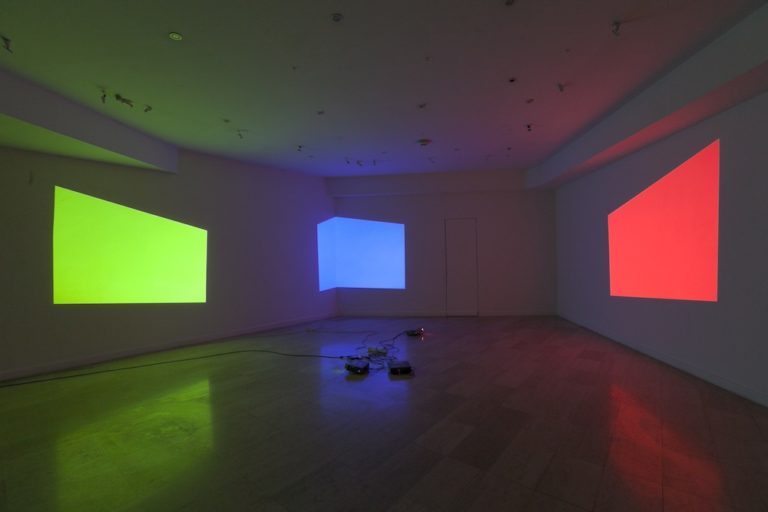
The Dystopia Files at GMK is the newest iteration of Mark Tribe's ongoing project, which recontextualizes the history of demonstrations in the US. The artist had gathered an archive of protest footage, which serves as a base for creating site specific video installations in gallery and museum spaces. The work tackles on a set of questions about power relations, spectatorship, image manipulation, participation, interaction and political engagement.The relationship between these issues and recent curatorial practices will be discussed during the workshop held by Mark Tribe. In a talk following the workshop, Mark will present his multimedia artistic practices, including his previous acknowledged projects such as Rhizome and Port Huron.
The exhibition is curated by Željka Himbele Kožul.
All interested in participating in the workshop are kindly asked to contact us at info@g-mk.hr. We are looking forward to your participation!
Mark Tribe (American, b. 1966) graduated in 1990 from Brown University, Providence, RI, and received a MFA in Visual Arts from the University of California, San Diego, CA in 1994. His acclaimed art projects often incorporate various media and technologies. They revolve around institutional critique, activism, audience participation and collaboration, and raise questions about performance, mediation and public sphere. Tribe’s art work has been exhibited at Wexner Center for the Arts, Columbus, OH; LACE (Los Angeles Contemporary Exhibitions); Ronald Feldman Gallery, New York, NY; the DeCordova Biennial at DeCordova Museum and Sculpture Park, Lincoln, MA; Aspen Art Museum, Aspen, CO; Park Avenue Armory, New York, NY; Haifa Museum of Art, Haifa, Israel; and the National Center for Contemporary Art, Moscow, Russia. He has organized curatorial projects for the New Museum of Contemporary Art, MASS MoCA, and inSite_05. Tribe is the author of two books, The Port Huron Project: Reenactments of New Left Protest Speeches (Charta, 2010) and New Media Art (Taschen, 2006), and numerous articles. He has lectured at CalArts, Goldsmiths College, the Boston Museum of Fine Arts, MIT, and UCLA. He is Assistant Professor of Modern Culture and Media Studies at Brown University, where he teaches courses on digital art, curating, open-source culture, radical media, and surveillance. In 1996, Tribe founded Rhizome, an organization that supports the creation, presentation, preservation, and critique of emerging artistic practices that engage technology.
Special thanks to: Helena Anrather, Glassbead Collective, Larry Hildes, Ariel Hudes, Zinka Ivanković, Sarah Kay, Ivan Marušić Klif, Ron Kuby, William Linn, Ines Loje, Brandon Neubauer, Nikita, Shruti Parekh, Sarah G. Sharp, Time\'s Up Video Collective, Sunčana Tuksar.
The exhibition is supported by: Ministry of Culture, Republic of Croatia; City of Zagreb - City Office for Education, Culture and Sports, Embassy of the US, Zagreb

26/04/2011.
History, understood as a category of human existence, is older than the written word, claims Hannah Arendt in her book “Between Past and Future”. Its origin - not in a historical but a poetic sense - lies in the moment when at the Phoenician court Odysseus listens the story of his own adventures and misadventures, the story of is own life which at that point becomes a “thing” in itself, separated from him, and presented to others as “an object”.1 In other words, it represents a moment in which history is for the first time symbolically objectified, turned into facts which are later confirmed and reaffirmed, repeatedly with each new act of narration, i.e. presentation. Our experience of a certain space, site, or a topos, is inseparable from our knowledge of its past. Spatial presence of a site is a product of a multitude of macro and micro histories, which can be more or less visible. However, despite the dichotomy between categories of space (the material, visible element) and time, i.e. history (or immaterial and physical elusiveness of time), both are intertwined; neither is the space static, nor the time linear. “Here” is inseparable from “now”; its past and future are elusive. Or, in words of Doreen Massey, “(...) “here” is no more (and no less) than our encounter, and what is made of it. It is, irretrievably, here and now. It won’t be the same “here” when it is no longer now.”2
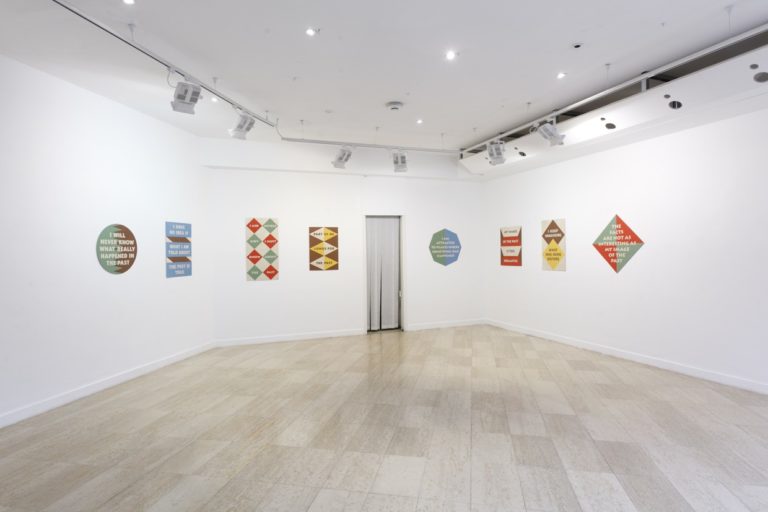
Lise Harlev’s work “What I Am Told About the Past” is a result of the art residency in Zagreb in February this year. Understanding Zagreb as a locus with its own specific history, the artist observed the ways in which the contemporary traces of this history, as well as her own expectations, have shaped the experience of getting to know the city. On wooden panels, in a very direct way, Harlev articulates a number of statements and questions concerning our perception of the history, its authenticity, nostalgia, and, finally, our universal need for history. At the same time, the background graphic elements create a number of associations – from timelessness of simple geometric shapes, through allusions to the 1950s graphic design, to a reminiscence of sign systems used on info boards at “historically significant” sites. Both elements, the textual and the graphic, thus create a completely new, ambiguous context – a very subjective experience of history, time and space is presented in visually very simple, familiar and recognizable way.
Jelena Pasic, curator of the exhibition
1 Arendt, H. Between Past and Future, London: Penguin Books, 2006: 39 2 Massey, D. For Space, London: SAGE Publications, 2007: 139
Lise Harlev (1973), a Danish artist based in Berlin, studied at Stadelschule, Frankfurt am Main, and The Royal Danish Academy of Fine Arts, Copenhagen. Harlev’s work has been included in exhibitions such as Manifesta 4 (Frankfurt am Main, 2002), Something no one else has, Liljevalchs Konsthall (Stockholm, 2003), Momenum (Moss, 2004), I don’t always agree, Galleria Maze (Turin, 2005),

22/04/2011.
The exhibition Bok Bok has been developed within the frame of an annual project of linking students of BA Animation and New Media Department at the Zagreb Academy of Art, with the Fine Art BA students based at London Metropolitan University.
The project begins with a series of meetings, readings and workshops which aim to set out some of the objectives of the project. Although the underlying themes change from year to year, they often tend to circle issues related to foreignness, the exotic, tourism, displacement/dislocation, and estrangement. During their time in each of these cities the students from each university take part in group seminars and presentations, as well as attending exhibitions, museums, talks, bars, pubs etc. The work is often developed in and for the city and gallery where the work is presented. rnThe nature of the project embraces the improvisational character of the works, developing in a climate of fluidity and spontaneity. The experience often involves the students’ preconceptions and positions being constantly challenged. Therefore works are not always completed, but rather might form the beginnings of work to be made at a later stage. This joint project and the exhibition is a continuation of a collaboration started in 2005 with the aim of developing a long-term exchange between the two art schools.
The exhibition at G-MK has been coordinated by Ana Kovačić.
Supported by: London Metropolitan University, Akademy of Visual Arts, Zagreb, Student Assembly, Zagreb
The program of G-MK is supported by City of Zagreb, Ministry of Culture RH.


10/01/2011.
Join us for the book launch of ‘Ad Hoc Project’ by Rafaela Dražić and a talk on Thursday, January 13, 2011 at 7pm. The book is a result of the artist piece developed in the framework of the 'Secret Exhibitions' - a curatorial project dealing with the mechanisms of censorship in the field of visual arts within the context of post socialist transformations. Besides 'Ad Hoc Project', the talk will address the case of censoring the exhibition '7 Zeros' at the Split City Museum and other cases of censorship dealt with through the project 'Secret Exhibitions'. With: Rafaela Dražić, Eugen Jakovčić, Irena Borić, Ivana Hanaček i Ana Kršinić Lozica.
