28/05/2010.
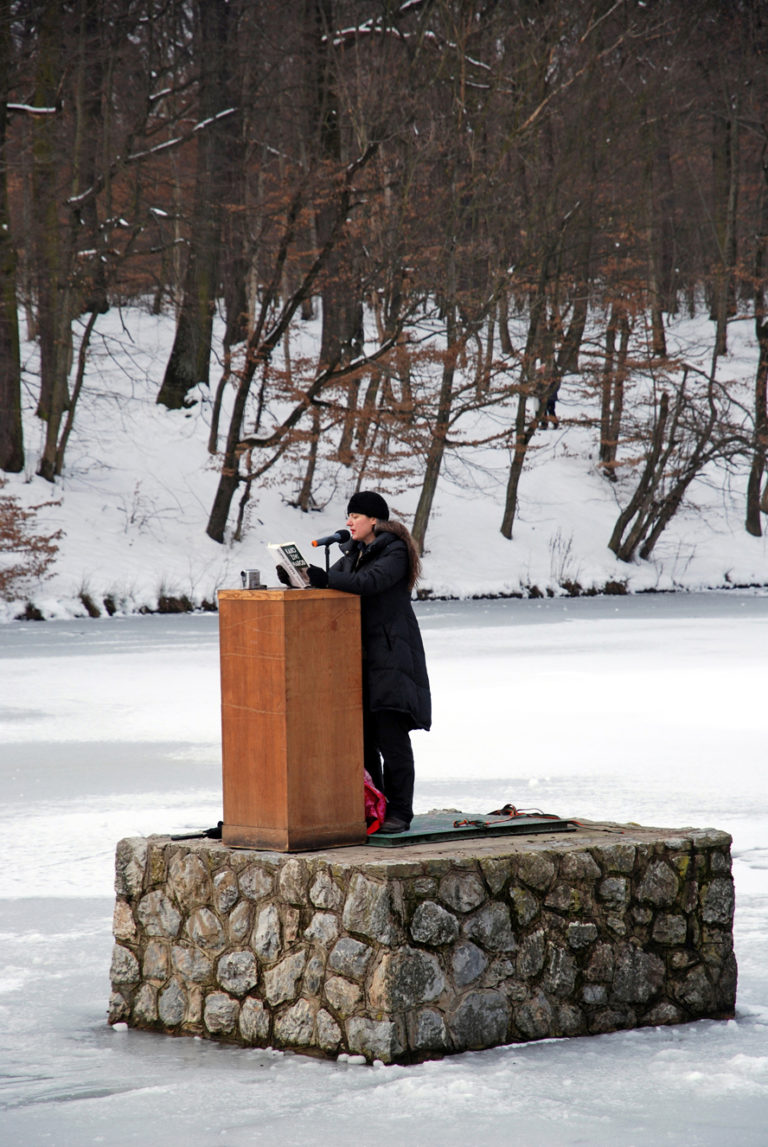
Van Hove's talk is part of a larger series of what the artist labeled “storytelling objects” rather than lectures. Each of these uses a number of earlier works and interventions -some unfinished or never even shown- as the base for a display of ideas and ruminations believed to be more meaningfully conveyed through stories. The ‘traveling artist’ is here in some way similar to the Kamishibai of Japan who, between the two World Wars, was telling from the back of his bike different stories based on a number of picture cards. In his talk Eric Van Hove will introduce several recent works and site specific installations in Senegal, Costa-Rica, Japan, Iran, Madagascar and Egypt.
One can also think of the bakhshi or Ashug of central Asia or the itinerant storytellers of Africa (mikilist of the Congos, Griots of Mali, bards, ashiks, jyrau who go from one village to the next, unfolding a story. Van Hove will also show a video piece (Abreaction series) made during the Shanghai Biennial in 2004, as well as introduce a recent work – ‘Off the record’ for which the artists created a short-lasting tactical art platform by hijacking a recently installed cell phone-run locker system in Tokyo. Van Hove’s is organized in collaboration with Croatian Photo Association at HFS project space, Vinogradska 14.
Born in Algeria the same year Bas Jan Ader was lost at sea, Van Hove spent most of his youth in YaoundeÅL (Cameroon). He graduated from E.R.G. in Brussels, studied Traditional Japanese Calligraphy (MfA, Tokyo) and is Doctor of Arts (D.A.) from the Tokyo Geidai University of Fine Arts and Music. His work often ponder and cross-refers to sociological, political and ecological issues, while simultaneously addressing local and global concerns. He is based Brussels and Tokyo.

24/05/2010.
Join us at the opening of the exhibition 'Izgubljena Fox' on Tuesday, May 25, 2010 at 8 pm. The exhibition has been developed within the frame of an annual joint project that involves linking students from the BA Animation and New Media Department at the Zagreb Academy of Art in Croatia, with the Fine Art BA students based at London Metropolitan University. The project begins with a series of meetings, readings and workshops which aim to set out some of the objectives of the project. Although the underlying themes change from year to year, they often tend to circle issues related to foreignness, the exotic, tourism, displacement/dislocation, and estrangement.
There are two key stages of the project – five students from Zagreb going to London, and five students from London going to Zagreb. The students develop a group exhibition in each city. In London this takes place at Unit 2 Gallery, and in Zagreb at the Gallery Miroslav Kraljević. During their time in each of these cities the students from each university take part in group seminars and presentations, as well as attending exhibitions, museums, talks, bars, pubs etc. The work is often developed in and for the city and gallery where the work is presented.
The nature of the project means that the work often has to be developed in a climate of fluidity and spontaneity. The experience often involves the students’ preconceptions and positions being constantly challenged. Therefore works are not always completed, but rather might form the beginnings of work to be made at a later stage. This joint project and the exhibition ’Izgubljena fox’ is a continuation of a collaboration started in 2005 with the aim of developing a long-term exchange between the two art schools.
Participants: Nikolina Butorac, Marija Golub, Phil Howe, Jari Kennedy, Tihana Mandušić, Henry Mulhall, Luka Smetiško, Eva Vikstrom, Eva Wilkinson, Josip Horvat
Mentors and project coordinators: Ben Cain and Nicole Hewitt
Supported by: London Metropolitan University,Akademy of Visual Arts, Zagreb, City of Zagreb, Ministry of Culture RH, Student Assembly, Zagreb


02/05/2010.
G-MK is taking part at Vienna Fair 2010. Its participation as an independant and non- profit gallery is generously supported by the Erste Foundation, Vienna. For this occasion G-MK will present works by Ben Cain, Tina Gverović, Marko Tadić and Lala Raščić. The fair is open May 6- 9, 2010. Please join us at stand A1704, Halle A, Messeplatz, Vienna.

09/03/2010.
For the Venice Architecture Biennale in 2008 STEALTH.unlimited co-curated the Dutch Pavilion with the project 'ARCHIPHOENIX - Faculties of Architecture'. Their response to the overall topic 'Out There: Architecture Beyond Building' was triggered by the recent burn-down of the Faculty of Architecture in Delft. Instead of thinking in terms of an exhibition, the Dutch Pavilion was turned into a stage for research and exploration and a debate platform focusing on faculties for architecture – in the sense of its multiple capacities, powers, capabilities. For a week, the project took the opportunity to engage a vast network of architects and other professionals in a direct exchange either as speakers, interviewers, or moderators. The spatial set-up for the pavilion changed on a daily basis to accommodate the line of activities and an on-site instantly edited video and book production unit. While the pavilion has been acting as a temporary 'school', the produced content aimed to become an imaginary curriculum for architecture beyond division on education and practice...
A year later, in autumn 2009, STEALTH curated one of the three episodes of the Tirana International Contemporary Art Biannual (T.I.C.A.B). In an attempt to critically respond to the current development of Tirana - through ‘wild’ urbanization, fast capital investment and set within the horizon of a neoliberal context, this 4th Biannual edition expanded beyond the field of visual arts, into the domain of architecture and processes of urbanization. By involving architects, artists, cultural workers, activists and journalists from the Western Balkans region and the wider global context, the Biannual's Episode 2 examined the deficiencies resulting from the highly individual and profit driven development of contemporary cities - and pointed at alternatives that emerge from these cracks, opening the horizon to different contributions and involvement of citizen’s to what the future of our cities could be.Ana Džokić and Marc Neelen collaborate since 2000 in STEALTH.unlimited, a practice based between Rotterdam and Belgrade. STEALTH shape opportunities where various fields of investigation meet and where thinking about possible future(s) of the city are mobilised. In their work shifts of perspectives – from visual culture, urban research, spatial intervention, to cultural activism - are a key element. By creating devices that can take the form of a specific intervention in physical space, an occasion for exchange of knowledge, but also a piece of software, they produce test conditions to probe the shared authoring of urban space and culture.
23/02/2010.
"What is robbing a bank compared to founding a bank?"
“Robbing a bank is an act of an amateur. True professionals found a bank.”
(Bertolt Brecht, The Threepenny Opera)
“They say he is dishonest, that he does not pay his debt. But what should we think of the one who took our interests, left his prices, and approved our prices?”
“Whoever set foot inside a bank never left it.”
(Rudolf Bićanić, How the People Live)
The phenomenon of money is as old as civilization itself and studying its nature and history drifts between two extremes: the liberal theory of economy which perceives money as a neutral means and sees its development from commodity to currency as a spontaneous process, as opposed to the conception of money as a complex system of social and political relations. At the beginning of the 20th century, Georg Simmel saw how money changes its social function and how, from being a means to accomplish a goal, it becomes the sole means, which is independent from the goal it tries to accomplish. Today’s electronic technologies question the term of money itself. According to some estimations, out of the total amount of US dollars in world circulation, 97% is virtual, while only 3% are paper bills.
Money is not a closed system and its meaning does not stem from money itself; its institutional position depends on society. Outside the community’s participation, money is meaningless, as Robinson Crusoe realized when he found coins on the shipwreck. If using money plays an important role in the structuring of different societies in very different cultural contexts and historical conditions, we can state that money is a universality whose nature we should seek outside of the physical characteristics of the means itself, somewhere else. In their book “Money as Sovereignty”, Michel Aglietta and Andre Orlean claim that “money does not exclusively belong to, not even primarily, to economic sciences,” because “its acceptance does not come down to a rational calculation of expenses and profit.” They suggest that the phenomenon of money and its usage should be observed as logically establishing a community and conserving its continuity, and of course money then “mobilizes beliefs and values via which one’s belonging to a community is confirmed.”
Elias Canetti analyzed the psychological effects of the German inflation after the First World War and concluded that, parallel with the weakening of the Deutche Mark, the belittling of citizens was developing. In the loss of value, personal and monetary units were intertwining. Let us briefly return to the quotes from the beginning. Brecht wrote his “Threepenny Opera” in 1928, a year before the Great Depression. Bićanić travelled the passive parts of Croatia in the direct aftermath of the crisis. Similarly, the question of understanding the complex field of finances and the functioning of the capitalistic system gains new momentum in the light of the current recession, spreading knowledge and spreading interests are now mandatory for those who are not familiar with the secrets of the financial sciences