


25/09/2018.
Transient Hole (Variations) VIII 6.-13.10.2018 Galerija Miroslav Kraljevic (G-MK) Šubićeva 29 - 10000 Zagreb contributions by: Atzgerei Productions, Arnold Berger, Vitar Drinkovic, Sophie Dvořák, Alexander Felch/Aisek Ifraimov, Hrvoje Hiršl, Christoph Hoeschele, Harald Hund, Ana Muscet, Vladimir Novak, Anja Nowak, Jaysha Obispo, Predrag Pavic, Jeroen van Amelsvoort, Anna Vasof, Stefan Voglsinger, Jan Vormann, David Wauters, Hui Ye et al. opening: 6.10.18, 7pm Introduction: Transient Hole Research - Instationarity as an artistic concept / a scientific particularity LIVE Performances by: T_A-Z (A) Paul Gründorfer is using process-related setups to explore sonic worlds and to realise site specific interventions. He is developing real time audio systems, that act autonomous or in reference to the spatial constellation. While considering the encounters between analog and digital, structured or improvised elements, his works focus on the abstract occurrence of sound and its physical impact. His artistic activities examine variable connections between transmitter-receiver networks, which function as a conceptual framework for experimentation with sound and transmission of information. http://tricx.net/ Tin Dožić (HR) - In/Through Empty Spaces A noise performance for sounds that don't vibrate through the air and for those affected by the shape of empty space around them. Electromagnetic emmisions, no input mixing, preamp hiss and
27/08/2018.
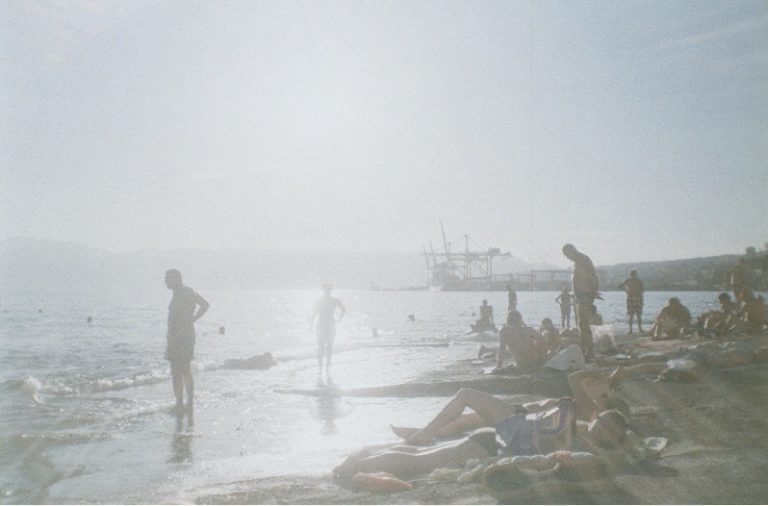
During the sweltering summer of 2015, Ivan Hrkaš was staying in Rijeka, as a participant in the Kamov Residency Programme. Nearly every day he visited the city beach in the residential quarter Pećine, which the locals had named Number Three. Spending his late afternoons as one of the bathers, he was doing what everybody else was doing, relaxing and keeping out of the sun, swimming, lying and rolling on his towel, looking around. From time to time, he would select a frame and stealthily take a shot. Without hesitation, he followed an inner voice that said “now!” Wishing to preserve the peace and quiet of his surroundings and remain anonymous, he kept his dedication to himself and he used up six rolls of film with a foolproof camera. Therefore, we may expect to see a reporter's chronicle, a series of snapshots, but this exhibition reveals a different selection that may be classified as landscape photography or, more precisely, as a sequence of explicitly recognizable landscapes and non-landscapes.
Hrkaš's interest in a city beach was awakened by his idea that spaces of collective rituals are deprived of privacy; we divest these spaces of intimate appropriations. Of course, we work on the

26/06/2018.
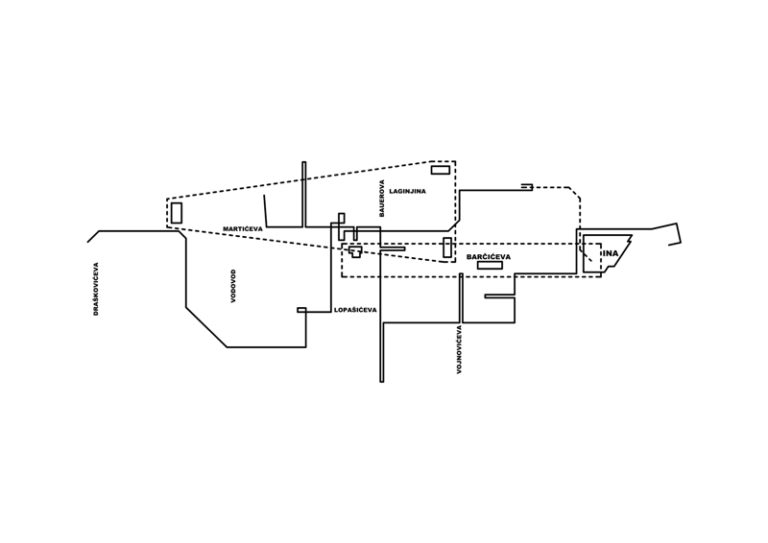
Art and research project What are we supposed to do with an art collection? was started in 2016 by Katerina Duda within the framework of Open Studio in the Gallery Miroslav Kraljević. The artist focused on the Gallery's history and themoving out of INA’s employees from their building in Subiceva 29which happened at that time. Narrations about the building inevitably uncovered the stories around the history of Arts and Culture Society INA established in 1977.Although in the beginning it was envisioned only as an exhibition space for amateur visual artists the change in the conception of the program occurred in 1990s and the gallery was focused on exhibiting contemporary artistic practices. The practice of exhibiting both works of amateur and professional artists' works contributed in creating a hybrid gallery collection that circulated in between storage spaces in the gallery, offices in INA building and private homes of former INA employees.Together with curators in Gallery Miroslav Kraljevic the artist enters the Gallery archive, talks with the former members and directors or ACSand former curators in the Gallery in order to clarify what role INA had in collecting of the artworks and towards the artistswho exhibited in the gallery. What werethe conditions

05/06/2018.
Exhibition „Neighbourhood: Docufictional Storyboard“ is continuation of workshop held as part of DDZ 2017. festival, which produced four docufictional narratives in diverse audiovisual formats. Works exhibited confront simplistic logic of „branding“, while DDZ area (part of Zagreb framed by Draškovićeva, Vlaška, Držićeva and Zvonimirova street) is presented as field of diverse and often irreconcilable paradigms, where faction and fiction blend together.
Authors: Inesa Antić, Dafne Berc, Nikolina Fužul, Nina Gojić, Lana Harjaček, Ana Jelušić, Ena Jurov, Ana Labudović, Nikolina Rafaj, Dino Belamarić, Lovro Japundžić
Project initiators: Antigentrification redaction (Dafne Berc, Dino Belamarić, Bojan Mucko)
Workshop organization: Antigentrification redaction & Nina Gojić
On gentrification and antigentrification
In general, processes of urbanistic revitalization of a specific part of town should have positive ramifications for public space and its inhabitants, but if those processes aren’t adequately thought out, supervised and directed, their effect can turn out to be destructive as well. Negative effects are analogously reflected on cultural production and creative sector since those agencies are often used as speculative ways to increase prices of real estate, as well as rent.
Parts of population with lower average incomes are the first ones to experience the effects of such price growth, which in turn
09/05/2018.
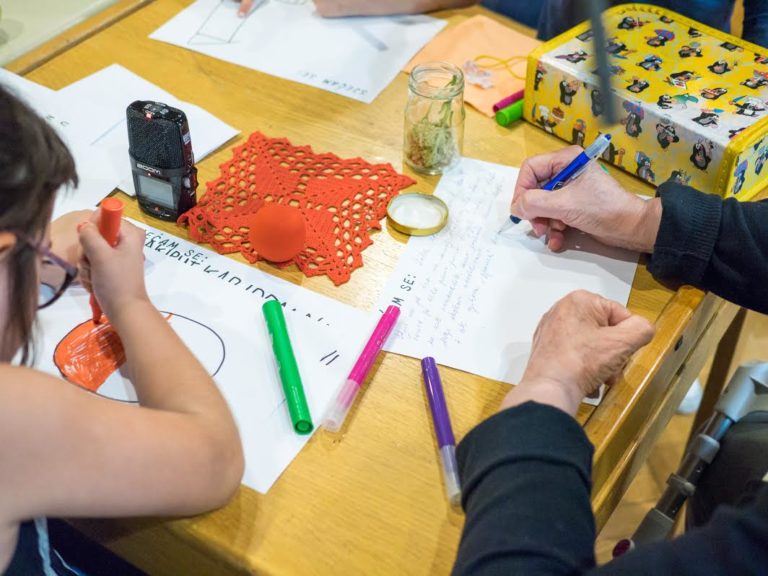
Three workshops were held at the Medveščak Home for the Elderly and Infirm, in which children from the first and second grades of elementary school also participated in the home, and the topic of the workshop was memory.
Inspired by the artist Wilfrid Gordon McDonald Partridge, inspired by artist Mem Fox and illustrator Julie Vivas, and assisted by educator Hanan el Sayed and the GMK team, three workshops were held in which elementary and high school students exchanged their own definitions of memory, revealing to each other, which are memories for them. They then presented the objects to which they relate the deepest and most intimate memories, and finally shared those memories with one another.
Upon completion, it was also clear by the way the participants greeted each other, that years and generations were a small gap that bridged goodwill and openness as a joke. That's why the laughter wasn't missing at the workshops.
Main sponsor of the program: INA.
The exhibition is co-financed by the Ministry of Culture of the Republic of Croatia.
GMK's work is supported by the Culture Nova Foundation.
