

24/01/2019.
Žižić/Kožul Open Studio 15.01. – 28.02.2019. First open door: 28.01. event starts at 20h
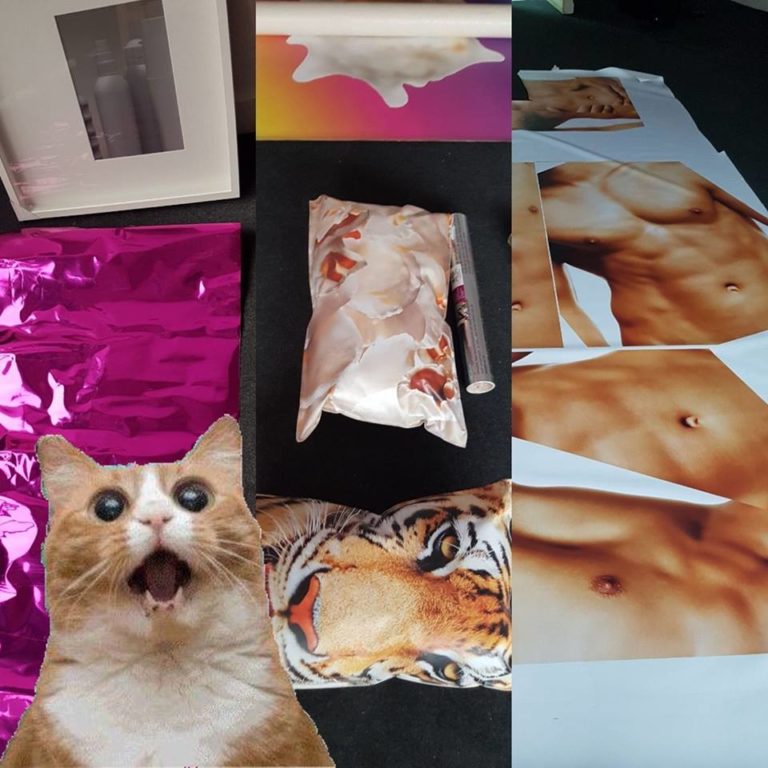
In the works of artist duo Žižić/Kožul discrepancy between socio-economic reality and its highly aestheticised representation is the main topic, and one they continuously approach. Using various strategies of appropriation, they are focused on manipulating both the product and its image as conceived and prepared for market by advertising industry. In their works they question the mechanisms and the possibility of constructing an authentic experience, as well as the role of an artist in creation of generic, seductive and desirable product.
Tourism is one of the main subjects of GMK’s programme for past and current year. Namely, although tourism and associated services generate almost one third of Croatia’s annual GDP (and is therefore a source of income for a big part of population), political and juridical framework for social as well as environmental reproduction is mostly based on ad hoc decisions directed at solving problems of individuals, often followed by suspicious business and political deals made at the expense of local communities. Comodification with sole aim of touristic consumption is becoming a more obvious process amid growing influx of foreign capital towards this branch of economy,
18/12/2018.
Anni Puolakka (born in Oulu, Finland) is based in Helsinki and Rotterdam and makes performances, videos, installations, drawings and texts in which situation-specific or documentary materials are incorporated into fictional worlds. Puolakka's works have recently been shown at Bunkier Sztuki (Krakow), BOZAR (Brussels), PLATO Ostrava, Kiasma Museum of Modern Art (Helsinki) and Performance Space (Sydney).
www.annipuolakka.comJaakko Pallasvuo (b. 1333) is an artist. Pallasvuo makes videos, texts, performances and installations that explore the anxieties of being alive now, and the prospect of living in some possible future. In recent years this work has been presented at The New York Film Festival, Museum of Modern Art in Warsaw, Kunsthalle St. Gallen and Jupiter Woods, among other places.www.jaakkopallasvuo.comTarwuk (Bruno Pogačnik Tremow and Ivana Vukšić) is an artist duo based between Zagreb and New York. Tarwuk collaborate with a diverse group of people, including their family members, to produce haunted installations, objects and films. Their recent exhibitions include 'Ti živiš već hiljadu godina' at team gallery, 'Beside Myself' at JTT, 'Tužni Rudar' at 15 Orient, '21070621-141332(2)' at The Museum of Fine Arts in Osijek, Croatia and 'Tout est pret. Au premier signal que vous nous enverrez de Tireste, tous se leveront en masse pour
07/12/2018.
Matija Debeljuh produced his work “Y” as a winner of this year’s “Tvornica” application which awards the proposition for best new artistic piece, and which was focused on the subject of tourism, as one of the principal themes of gallery’s this and next year’s programme. Although services related to tourism generate almost one third of Croatia’s GDP (and are substantial resource for big part of population), political and juridical framework for spatial and social production is based on ad hoc decisions oriented towards solving individual problems, and often followed by suspicious business and political arrangements made at the expense of local community. Comodification which sole purpose is touristic consumption is becoming more visible amid increasing presence of foreign capital, while growth and consequential dependence of local population on tourism affects their everyday lives.
Within the range of key problems concerning the tourism and touristification, we were intrigued by Matija Debeljuh’s proposition to address the subject of sex/swing tourism in Istria, region that is popular among European nudists and swingers. This branch of tourism that flourished during the former Yugoslavia is now reduced to several nightclubs and beaches that state takes no care of and are owned by private owners. Sex tourism is perceived as

20/11/2018.
Garden Road (Vrtni put) is unofficial name of Roma settlement located in south-east of Zagreb (Peščenica-Žitnjak municipal district, local council Savica-Šanci). Settlement is placed on the edge of industrial zone, its boundaries defined with fences that protect private and business properties on one side and above surface heating plant pipe line on the other side.
Around fifteen households are registered on three different addresses. Organic center of the settlement is comprised of educational and sanitary buildings, containers put there during pre-electoral campaign in 2012. Although it was initially announced that they are going to be used for educational work with children from the settlement, that plan was never realized. Therefore, due to practical reasons, container building planned for educational purposes has for the past few years been used as a place to live for a family of ten.
At the same time, aforementioned container building is also the only source of electricity for thirteen shacks in the settlement. Frequent overloads of electrical network cause arrester to break up the circuit, causing blackouts more than ten times a day. Sanitary container building is currently out of function. It is not known who is paying for the electricity, as well

08/11/2018.
Work of the panic is three-year-long processes of choreography, research, and production formed by Croatian performance collective BADco which starts with the sneak peek in the constellation of the prevention of an emergency from the perspective of the work which is in the paradoxical correlation with production – it products destruction. Title Work of Panick corresponds with the Croatian translation of the title of the book City of panic by Paule Virili in which the writer connects the logic of creation without creation in the society and art. While terrorism, on the one hand, produces situations like accidents, as annulation of the continuity, work of the safety, on the other hand, produces dobule annulation, double negation, almost esthetical operation at the surface of the transparent city, the city that is overlighted and overviewed. But also the city that produces panicked with control of the public space and with differentiations between social groups, by enclosing towards migrants and retributes bodies in the space. At the same time with the increasing of the work in the sphere of safety, rises general social insecurity – instability of employment, imagining of threats, catastrophic scenarios. The city has become today one unusual combination of museums
29/10/2018.
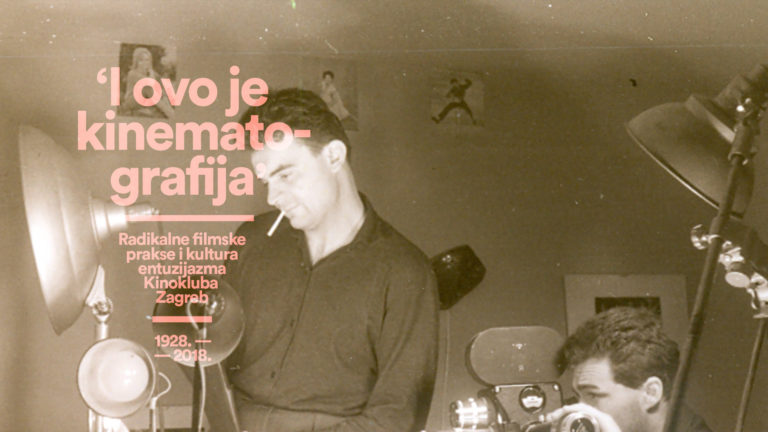
The very classification "amateur" has an apologetic ring. But that very word–from the Latin "amateur"–"lover" means one who does something for the love of the thing rather than for economic reasons or necessity. And this is the meaning from which the amateur filmmaker should take his clue. — Maya Deren, 1959. Question of amateurism and enthusiasm in the contest of Cinema club (Kinoklub) Zagreb is followed by a rich and complicated history of interpersonal relationships, technological changes but also radical approaches to the art of filmmaking. It has survived in its nine decades several different economical and political regimes. From their beginnings in Fotoclub Zagreb formed during the Austrian Hungarian Monarchy, through the Kingdom of SHS and Yugoslavia till NDH, FNRJ, and SFRJ, Kinoklub Zagreb has its 90th anniversary welcomed as serious, organized and well established non-govermental organization. History of the Kinoklub is more or less history of his members, and their gestures had placed today's participants in one specific position considering their material history. In other words, except for a few members, most of them aren't aware of their material history, their heritage, and work. Continuing the tradition of celebration of the anniversary, this exhibition represents one amateur reconstruction
