25/09/2018.
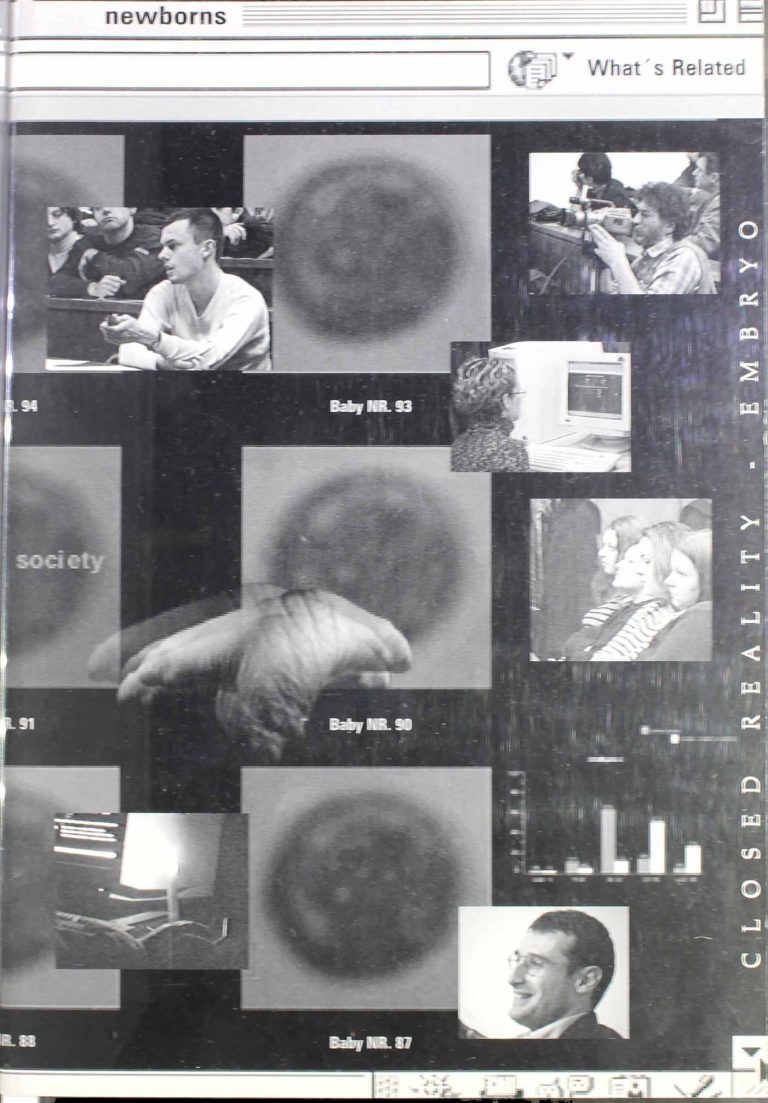
Transient Hole (Variations) VIII 6.-13.10.2018 Galerija Miroslav Kraljevic (G-MK) Šubićeva 29 - 10000 Zagreb contributions by: Atzgerei Productions, Arnold Berger, Vitar Drinkovic, Sophie Dvořák, Alexander Felch/Aisek Ifraimov, Hrvoje Hiršl, Christoph Hoeschele, Harald Hund, Ana Muscet, Vladimir Novak, Anja Nowak, Jaysha Obispo, Predrag Pavic, Jeroen van Amelsvoort, Anna Vasof, Stefan Voglsinger, Jan Vormann, David Wauters, Hui Ye et al. opening: 6.10.18, 7pm Introduction: Transient Hole Research - Instationarity as an artistic concept / a scientific particularity LIVE Performances by: T_A-Z (A) Paul Gründorfer is using process-related setups to explore sonic worlds and to realise site specific interventions. He is developing real time audio systems, that act autonomous or in reference to the spatial constellation. While considering the encounters between analog and digital, structured or improvised elements, his works focus on the abstract occurrence of sound and its physical impact. His artistic activities examine variable connections between transmitter-receiver networks, which function as a conceptual framework for experimentation with sound and transmission of information. http://tricx.net/ Tin Dožić (HR) - In/Through Empty Spaces A noise performance for sounds that don't vibrate through the air and for those affected by the shape of empty space around them. Electromagnetic emmisions, no input mixing, preamp hiss and physical filtering create textures and noises that vibrate through the room. Tin Dožić (1989) completed his studies in psychology at the Croatian Studies of the University of Zagreb and new media at the Academy of Fine Arts in Zagreb. In his artistic practice, he takes the sound medium as a starting point and his fields of activity include multimedia, field recordings, radio, experimental music, works in public space and installations. His work is based on the media research through the practice of developing his own electronic instruments, appropriation of outdated technologies and recycling. Current topics of interest are media archaeology, the anthropocene, DIY culture and development of temporary sleep communities. DJ: Soziale Plastik Beuys (A) curated by Alexander Felch + Hrvoje Hiršl ++++ About the project: Transient Hole Research (THR) is a hybrid curatorial/artistic project and a symposium started in summer of 2017 by viennese artist and curator Alexander Felch. The project`s title refers to a concept for a media artwork, that cannot, properly speaking, be materialized for it deals with a moving void – a transient hole. Across the floor of a white, three-dimensional room a little black hole constantly and randomely moving. The hole is simultaneously there and not there. It is a portal to nowhere. But is it really? Might it not lead to transcendence, to another reality, or perhaps our reality can only be understood through this liminal presence of nothingness? Although this concept is easy to understand, it is nevertheless impossible to represent it in reality. There is no way to depict an actual hole moving through space and time, apart from virtual digital simulations. https://www.youtube.com/watch?v=bbFzbsy3pxE Therefore the participants of Transient Hole (Variations) are invited to provide their own interpretation of this problem and develop means to represent it, whether through art or science, to
27/08/2018.
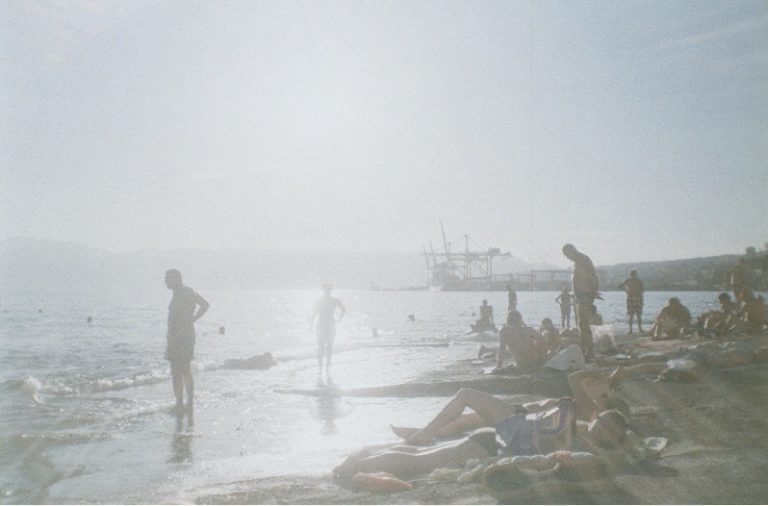
During the sweltering summer of 2015, Ivan Hrkaš was staying in Rijeka, as a participant in the Kamov Residency Programme. Nearly every day he visited the city beach in the residential quarter Pećine, which the locals had named Number Three. Spending his late afternoons as one of the bathers, he was doing what everybody else was doing, relaxing and keeping out of the sun, swimming, lying and rolling on his towel, looking around. From time to time, he would select a frame and stealthily take a shot. Without hesitation, he followed an inner voice that said “now!” Wishing to preserve the peace and quiet of his surroundings and remain anonymous, he kept his dedication to himself and he used up six rolls of film with a foolproof camera. Therefore, we may expect to see a reporter's chronicle, a series of snapshots, but this exhibition reveals a different selection that may be classified as landscape photography or, more precisely, as a sequence of explicitly recognizable landscapes and non-landscapes.
Hrkaš's interest in a city beach was awakened by his idea that spaces of collective rituals are deprived of privacy; we divest these spaces of intimate appropriations. Of course, we work on the general assumption that public is public and private is private. The author was driven by a desire to demonstrate that metaphysical appropriation can be made physically visible and can thereby be represented. In spite of uncertainty as to how to achieve this, he decided to try.
The artist arranged around sixty photographs (the exhibition includes forty-eight) in a conglomerate of recognizable seaside scenes and fragments from private treasuries of the occupants of this particular beach, emphasizing the reciprocity of two contradictory aspects; private and public. Frontal, symmetrical, and somewhat monumental panoramas are enriched with close-ups and seemingly irrelevant details. Diagonal shots, asymmetrical and non-hierarchically organized compositions reveal that the author is interested in a situation, not individuals. Similarly, we may note an absence of the iconic – Hrkaš never uses portraiture, he never aims at a particular person in relation to whom he has to take a frontal and symmetrical stance, nor does he define himself in hierarchical terms. He moves beyond these individuals, who are always there, but they elude the eye. Among the faces every single one is equally important. Hrkaš searches for something that flows between them; he studies their body language, he captures their gestures and states. He is interested in the place.
The extent to which these photographs represent lies in their capacity to embody that which is usually not represented. They convey the invisible substance which can be felt, but which cannot be observed nor can it be named (in contrast to the logic of language, where the unportrayable can be expressed by words). The author's focus often captures an empty spot, or it is unclear where the focus actually lies... When we observe these photos, our attention is not satisfied immediately, nor do our eyes sweep the photos' content instantly. On

26/06/2018.
Art and research project What are we supposed to do with an art collection? was started in 2016 by Katerina Duda within the framework of Open Studio in the Gallery Miroslav Kraljević. The artist focused on the Gallery's history and themoving out of INA’s employees from their building in Subiceva 29which happened at that time. Narrations about the building inevitably uncovered the stories around the history of Arts and Culture Society INA established in 1977.Although in the beginning it was envisioned only as an exhibition space for amateur visual artists the change in the conception of the program occurred in 1990s and the gallery was focused on exhibiting contemporary artistic practices. The practice of exhibiting both works of amateur and professional artists' works contributed in creating a hybrid gallery collection that circulated in between storage spaces in the gallery, offices in INA building and private homes of former INA employees.Together with curators in Gallery Miroslav Kraljevic the artist enters the Gallery archive, talks with the former members and directors or ACSand former curators in the Gallery in order to clarify what role INA had in collecting of the artworks and towards the artistswho exhibited in the gallery. What werethe conditions the artists workedand exhibitedin? How is their market and collection value formed and who has the right to the collection established within the self-governing economic system and the paradigm culture to the workers?Exhibition and publication supported by: Ministry of culture of Republic of Croatia.Katerina Duda graduated in New Media at the Academy of Fine Arts, and Sociology at the Faculty of Humanities and Social Sciences in Zagreb. The starting point in her work is the city and public space, her approach is usually site-specific and combines the media of video, intervention and action in public space and social practice. She exhibited in solo and group shows in Croatia and abroad. Lives and works in Zagreb.


21/06/2018.
link
Shakespeare među nama
14. 11. – 9. 12. 2017.
Curator: Branka Stipančić
Text: Branka Stipančić
Artists: Mangelos, Tomislav Gotovac, Mladen Stilinović, Sanja Iveković, Dalibor Martinis, Sven Stilinović, Vlado Martek, Igor Grubić, Goran Trbuljak
Design: Ivan Klis
Translation: Tihana Bertek
Proofreading: Dušanka Profeta