


05/06/2018.
Exhibition „Neighbourhood: Docufictional Storyboard“ is continuation of workshop held as part of DDZ 2017. festival, which produced four docufictional narratives in diverse audiovisual formats. Works exhibited confront simplistic logic of „branding“, while DDZ area (part of Zagreb framed by Draškovićeva, Vlaška, Držićeva and Zvonimirova street) is presented as field of diverse and often irreconcilable paradigms, where faction and fiction blend together.
Authors: Inesa Antić, Dafne Berc, Nikolina Fužul, Nina Gojić, Lana Harjaček, Ana Jelušić, Ena Jurov, Ana Labudović, Nikolina Rafaj, Dino Belamarić, Lovro Japundžić
Project initiators: Antigentrification redaction (Dafne Berc, Dino Belamarić, Bojan Mucko)
Workshop organization: Antigentrification redaction & Nina Gojić
On gentrification and antigentrification
In general, processes of urbanistic revitalization of a specific part of town should have positive ramifications for public space and its inhabitants, but if those processes aren’t adequately thought out, supervised and directed, their effect can turn out to be destructive as well. Negative effects are analogously reflected on cultural production and creative sector since those agencies are often used as speculative ways to increase prices of real estate, as well as rent.
Parts of population with lower average incomes are the first ones to experience the effects of such price growth, which in turn causes social marginalization and general decrease in life quality among them. Even though employees in local cultural and creative industries are participants in processes, at the same time they are equally affected by those changes as other residents of certain urban area in question. Barren cultural and social landscape, as well as gradual disappearance of all non-commercial activities are some of the direct consequences of those processes.
Beside festival itself, the title “Design District Zagreb” also refers to a part of town which is very active and frequented by local people – its residents, strategic institutions as well as civil society and non-government organization employees - even outside of the festival period.
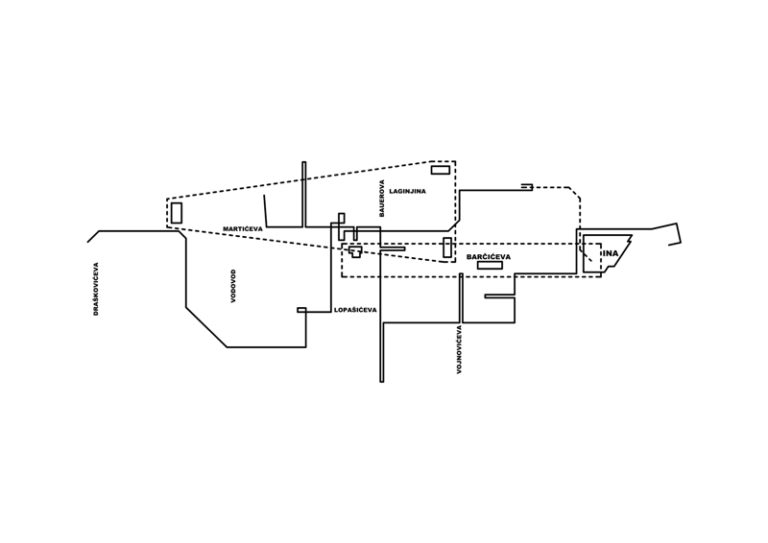
During the preparatory phase for workshop that was held in June 2017., mental map of neighbourhood was made for which was intended to offer a layered depiction of its subject area combining multiple perspectives. This hybrid and synthetic map was used during this year’s workshop as groundwork for interdisciplinary narrative experiment in which twelve students and professionals from the fields of architecture, design, dramaturgy, cultural anthropology, new media and sociology took part.
Exhibited narratives, articulated in diverse media, share critical stance based on selective, parallel interpretations of historical layers present today in this area, as well as recent, revitalizing effects of neighbourhood’s festivalization. Although four narratives constructed for this occasion at first glance appear futuristic and their atmosphere resembles noir, at the same time they articulate guidelines for discussion. Content of discussion becomes contemplation on possible ways to confront repercussions of existing gentrification processes, both in this neighbourhood and in other areas where this processes are active.
Dafne Berc, Dino Belamarić, Bojan Mucko
09/05/2018.
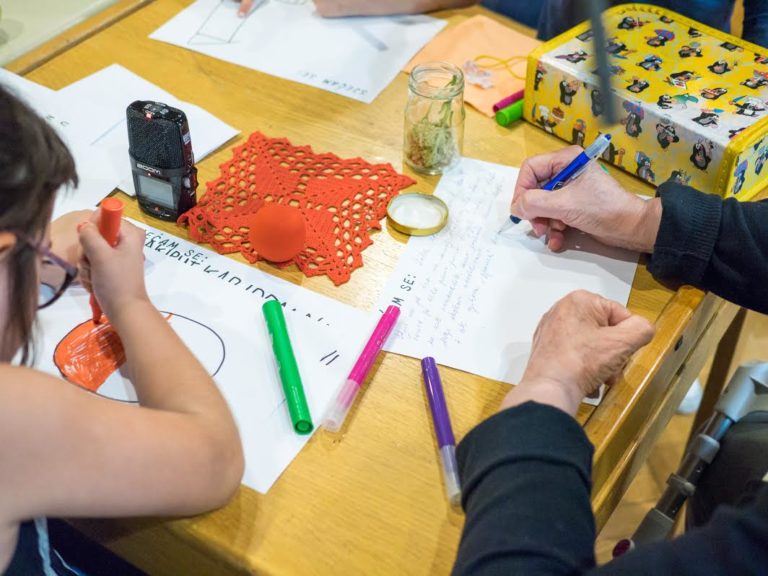
Three workshops were held at the Medveščak Home for the Elderly and Infirm, in which children from the first and second grades of elementary school also participated in the home, and the topic of the workshop was memory.
Inspired by the artist Wilfrid Gordon McDonald Partridge, inspired by artist Mem Fox and illustrator Julie Vivas, and assisted by educator Hanan el Sayed and the GMK team, three workshops were held in which elementary and high school students exchanged their own definitions of memory, revealing to each other, which are memories for them. They then presented the objects to which they relate the deepest and most intimate memories, and finally shared those memories with one another.
Upon completion, it was also clear by the way the participants greeted each other, that years and generations were a small gap that bridged goodwill and openness as a joke. That's why the laughter wasn't missing at the workshops.
Main sponsor of the program: INA.
The exhibition is co-financed by the Ministry of Culture of the Republic of Croatia.
GMK's work is supported by the Culture Nova Foundation.

03/05/2018.
For the past four years artist ŽarkoAleksić has focused his interest on the field of cognitive neuro-science and his potential for articulating new artistic ideas and concepts. Over the years he developed multiple projects, one of which was „States of Mind“, where he explored the importance of experience in construction of ones identity, through researching neuroplasticity, episodic, semantic and procedural memory, using video journal methodology developed by Jonas Mekas, as well as James Joyce's stream of consciousness. Furthermore, „Brain Pictures“ is another multidisciplinary project realized as the result of a research done over the several years, in the context of which scientific methodology and artistic practice have been intertwined, displacing artistic activity in general, production of artistic pieces, as well as contemplation of art in new ideological frame, based on researches in cognitive sciences.
After the successfulcollaboration with EvaLab on the project titled „Brain pictures“ , at the department for the cognitive psychology at Vienna University, they once again join their forces as a part of the project under the name „Swimming against the stream of consciousness“, focused on researching the brain-machine interface through non-invasive brain stimulation, done by machines TMS and tDCS. References on Dadaistic movement and their fascination with mechanization and new mechanical devices is reflected in mechanicistic understanding of the brain as biological machine. Apprehension like this clearly poses the question – who directs and controls our space of thought and action.
Advances in cognitive sciences and associated technologies in the past years open numerous questions among which those regarding consciousness, privacy, thought decoding and power relations are in focus of Žarko's new work. Brainwashing, conducted on war prisoners and prisoners in concentration camps, was presented as regular practice through media, who themselves use similar patterns for manipulating consciousness. Nowadays, brain manipulation has become more direct, and technology became more accessible than ever. Collaboration of people and the machines is looking increasingly inevitable, but the question of authority in that alliance remains open.
Besides exhibition itselfand performance on the opening night, programme includes lecture and presentation of segments of artists multidisciplinary project „Brain Pictures“, developed over the course of several years.
ŽarkoAleksić was born in Knjaževac in 1985. He studied philosophy at Beograd Unversity, and has later enrolled at Academy of Fine Arts in Vienna, where he works as student assistant. His primary interest are questions stemming from cognitive neuro-sciences, such as relation of perception and imagination, problems of relation between material and immaterial, body and soul; mental representation, constructing reality, stream of consciousness, question of empathy and neuroplasticity.
He is engaged as an exhibiting artist, while his most prominent individual shows are Brain Pictures, States of Mind, Education and Formation, Dreams of Reality. He is founder of informal group called UMETNIK* (ARTIST*) which is focused on theoretical and practical explorations of term „artist“, both in ontological as well as social-economic sense.
Exhibition is financed by Ministry of Culture.
GMK work is supported by Kultura Nova foundation.

13/04/2018.
Talkthrough [April 20th and April 27th at 8 PM]Presenters: Penny Rafferty, Miloš Trakilović, Marko Gutić Mižimakov, SwS (Tea Stražičić i Marta Stražičić), Srđan Laterza, Darko Masnec, net.cubeOrganizers: Lovro Japundžić i Mario Mu
Talkthrough is a series of lectures/performances inspired by the main motives behind the work Walkthrough. A variety of talks seek to foster an international exchange within extensive field of gaming. Appropriation of the video game mechanisms enabled game to extend beyond leisure time into corporate and artistic domain. Invited authors, who come from the academic as well as from the pop-cultural sphere, will present possibilities of different directions in interpreting this ubiquitous phenomenon, taking into account its positive and negative effects. Some of the topics discussed: corporative logic in the video game industry, impact of gaming experience on player’s identity, relationships in temporary online communities, dramaturgy in video games, gamification of the art world.
TALKTHROUGH I [April 20th at 8 PM]Penny Rafferty: Politics as Play: The Active ViewerMiloš Trakilović: A Shot in the ArmMarko Gutić Mižimakov: A performing site for affective clones and whatever they wantSwS (Tea Stražičić i Marta Stražičić): NON Playable
TALKTHROUGH II [April 27th at 8 PM]Srđan Laterza: Mechanics of Intimacy: Video Game as an AutobiographyDarko Masnec: Anemoia of the video game spacenet.cube: Feminist representation of video games
Talkthrough is supported by the Ministry of culture of Republic of Croatia and City of Zagreb. General sponsor is INA - Industrija nafte d.d. Work of Miroslav Kraljević Gallery is supported by Kultura nova Foundation.
13/04/2018.
Mario Mu: Walkthrough [18.04. – 04.05.2018.]Opening: April 18th at 8 PMCurator: Lovro Japundžić
The innocent gaming experience is now part of the past. Video games have become a set of rules, carefully structured to produce an affective impact on the player who soon becomes emotionally invested, unconsciously catering to game developers. The player takes over the role of a performer within the system that goes far beyond the gaming world. Critic and media theorist McKenzie Wark in his book GAM3R 7H30RY uses the term “gamespace” to describe our modern social condition, comparing algorithmic codification and unequal power relations in video games to the exploitative logic of capitalist production. In his view, the standardization, optimization and analytic potential of gaming interface serve as mechanisms that primarily compensate the agents of power. Thus, it is no wonder that capitalism has appropriated and commodified play within leisure time and personal life, a phenomenon that Julian Kucklich named “play-bor”.
A sense of community in an offline and online world can be achieved through habits. What is suitable we learn from others forming unified collective body. “Walkthrough” is a project by the artist Mario Mu who exposes hack values and the emancipatory potential of habits in the form of a role-playing game. It centers on the game with the focus on a specific set of habits by a group of eight participants who inhabited the same space. By taking turns and following the previously given instructions about the confines of the game space, the players successively repeat their specific movement pattern in order to achieve the sense of an automated habit. Actually, while the players are doing their best to follow the game rules, another process is happening – the game character’s avatar is in a constant state of becoming, exposing the possibility for an autonomous movement beyond any common ideology. By performing oneself each character creates the need for a new update within the game space. Instead of waiting for the new code to be mastered, they translate the community-owned and tailored game character to an extended video game environment. The role-playing game gives players the opportunity to switch between different personas in a game that is exempt from the digital cleanse.
Mario Mu (1987) works with the extended gaming platforms constructed as research projects. His practice incorporates 3D animation and performance often combined with sound design and painting processes. Most recently he has been working on a series of LARP events as a game designer and performer in UdK Berlin and Silent Green, PLAY CO. in London and Pakhuis de Zwijger in Amsterdam. He received his MFA in Berlin from the University of the Arts (UdK) Berlin, Class of Hito Steyerl in 2017, and in Zagreb from the from the Academy of Fine Arts BA in 2015 and the Faculty of Graphic Arts MA in 2011. In the period 2010-2017 he has been mainly using the name Mario Udženija exhibiting his projects in Cologne, Berlin, London, Split, Strassbourg and Zagreb and has been awarded
