

10/09/2014.
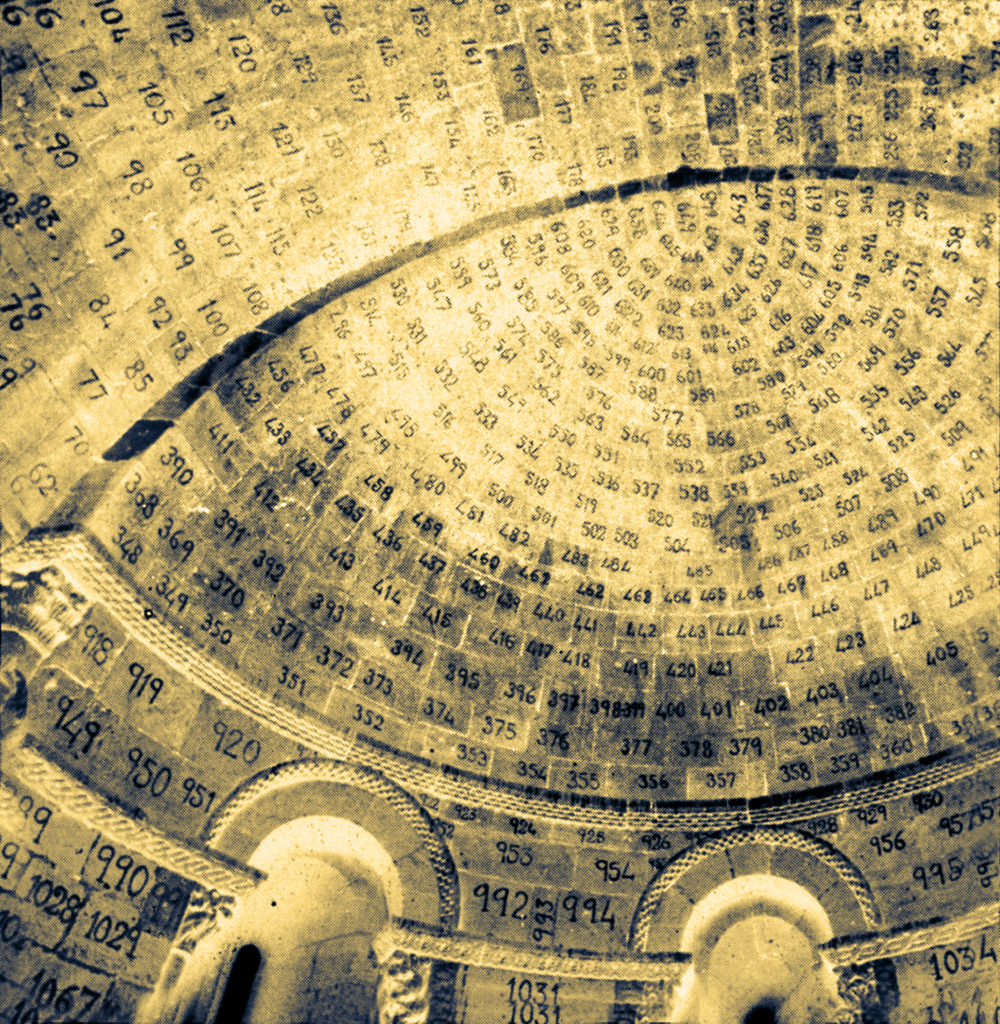
When not precious or semi-precious, how valuable is a stone? Can it have any value in itself, or is the value (for example, historical value) bestowed by the context in which the stone finds itself? Because it is not irrelevant whether a stone is used for skipping or is part of the structure of a medieval church. The skipping stone remains insignificant enough so that, as soon as it sinks, we can replace it with another one without feeling any loss, but what about losing a stone that is part of a church? Historians and archaeologists are certainly not indifferent about material remains because one stone, even a damaged one, can help build a narrative of the entire history. rn rnStarting from an interest in the value that is produced by the creation of narratives, Emilio Moreno is particularly intrigued by material remains, that is, cultural heritage that gets dislocated from its own temporality through relocation or the process of anastylosis. He is interested in what happens to the value of cultural heritage during such a procedure. Does the new building remain the "old one"? His first film Stone Acrobatics (2014) seeks to consider these issues, and the film narrative is built around the anastylosis of a medieval Spanish church which was declared national heritage. At the request of John D. Rockefeller Jr., who had just built a museum of medieval monasteries from all over the world in Manhattan, the said Spanish church was disassembled piece by piece and transferred to New York, where it was reassembled. As a resident of Triangle Arts NY, Emilio Moreno planned to investigate the political background of such an event, but during the residency his research interests had expanded. That is why in the film the consideration of the phenomena of anastylosis is interwoven with his very personal associations and stories about his father, but also his thoughts about contemporary usage of personal photographs and what they represent. Moreno captures the shots of his own travels and thereby associatively complements the narrative with images. From very personal shots to aesthetic ones, he narrates the story by deconstructing the idea of value and the way objects, actions and language are assigned value statuses. rn rnIrena Borićrn rnEmilio Moreno (1980) is a Spanish artist whose work investigates different notions of value, as well as the realms of experience from which value emerges. History, language, currency and space are some of the realms in which he focused recently. Formed as a philologist, a photographer and as an artist, his practice varies formally depending on every specific project. His work has been recently made public in solo shows at Instituto Cervantes, New York, South African National Gallery, Cape Town, as well as in group shows at De Appel Center for the Arts, Amsterdam, Centro de Arte 2 de Mayo, Móstoles, Madrid, CASCO, Utrecht, Vanabbe Museum-Onomatopee, Eindhoven. He collaborated with If I Cant Dance I Dont Want to be Part of Your Revolution and with Bulegoa z/b in the project \'18 Images and 18
02/09/2014.
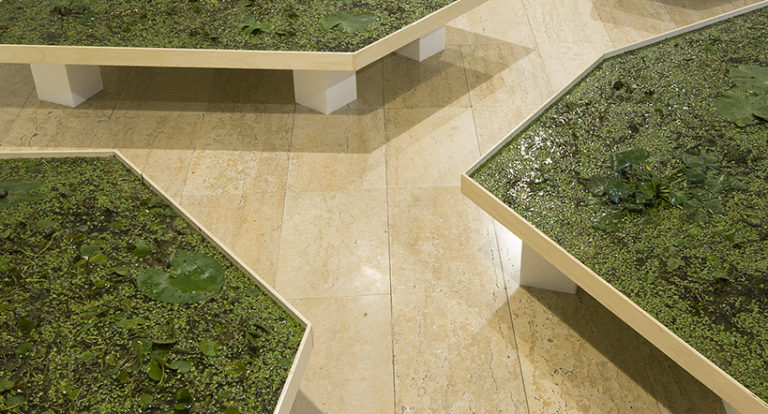
[stag-ney-shun n] the state or condition of stagnation, or having stopped, as by ceasing to run or flow:rna foulness or staleness, as one emanating from a standing pool of water.rna failure to develop, progress, or advancern rn rnWhen a river develops one or more alternative channels, one channel is considered primary and is used as a navigational route, while other channels are called backwaters and are often shallow and in stagnation. In this case, the term backwater can be applied to the physical and social areas that have been isolated—systematically neglected in their cultural and economical development—in the process of shifting from the periphery to the margin. Although these places are stagnant, they posses a far greater richness and diversity of life than the main stream.rn rnThrough displacement of these natural forms inside the gallery space, Stagnation allegorically interprets states of neglect and diversity, as well as the disconnect between individual formations. The disconnect of the margins and their gravitation towards the center, as well as the relation of the center towards the margins, disables them to achieve any true change, regardless of the individual potential they posses.rn rnAlthough the work reflects upon the dynamics of margin-center, and can be interchangeably applied to all levels of the hierarchy, the main focus of the work lies in the symbolic transposition of dominant versus independent culture.rn rnThe work Sagnation, by Iva Cepanec Masters, has been realized through Call for production of new work and participation in the Miroslav Kraljević Gallery, 2013. The goal of the project is to enable artistic research and provide support for young and emerging artists. rn rn rnIva Cepanec Masters is a sculptress and multimedia artist, born in 1984 in Bjelovar, Croatia. In 2009, she received her BFA in Sculpture and Extended Media, College of Visual and Performing Arts, University of South Florida, under the mentorship of Gregory Green and Rozalinda Borcila. In addition to receiving high honors (Magna Cum Laude and Dean Recognition), she was nominated for admission to the Yale School of Art. Upon returning to Zagreb, she designed and implemented the Interdisciplinary project Antibiotik, in collaboration with Nives Sertić, and an artist-in-residence program Transfusion in collaboration with Alexander Masters.rn rnFrom 2009-2012 she was the head coordinator of Gallery Jogurt, an artist-run space, located in the abandoned medical factory Medika in Zagreb, used by numerous art collectives and individuals. She has exhibited domestically; Drava Art Biennale, Koprivnica, 2013; Gallery Jogurt, Zagreb, 2009-2012; Gallery SC, Zagreb, 2011; 7th Culture Fair Zagreb, 2011; Vizura Aperta, International Festival of Audio-visual Arts, Momiano, 2010; 50th Poreč Annale, Poreč, 2010, as well as internationally; Popps Packing, a three-month residency, Detroit, 2012; Cigar Factory, 2012, Tampa; Roosevelt gallery, State of the Arts Vol.2, Tampa, 2009; Nancy and Oliver Gallery, Tampa, 2009. Since 2009, she has also curated over 30 exhibits in Gallery Jogurt and has worked in collaboration with numerous cultural NGO’s and individuals. She works within the medium of installation, performance and socially engaged art. She lives and works in Zagreb.rn rnExhibition is open until 12th of September 2014.

31/05/2014.
Wave Drawings (orange and green)rnField Drawing (Brisbane, a film)rnLandscape Paintings (Lake Bolac and Zagreb) rn rn"These works are concerned with ‘difference’, an aspect of connectivity between things in the world that is often disconnected by notions such as ‘natural’ and ‘manufactured’. Everything in this world, both natural and manufactured, is a part of nature and interrelated. Each thing in the world is innately unique and constantly in a state of flux. The nature of nature is such that a small shift within very tight parameters can produce quite different outcomes. The less that change is allowed to occur (is repressed) the more radically change may happen when it does occur, because it will occur. The physics of such processes of change helps to explain what is going on in the world around us."rn rnWave Drawings (orange and green)rn"The process of making these wave drawings is about understanding the processes of waves, and the relationship of wave dynamics to objects and ideas by ‘drawing’ relationships between waves and patterns. Waves can be used as a metaphor to describe the phases and layers of geomorphology, histories, cultures, stories, politics, art, friends and ideas; how things shift and change, merge, blend and disperse."rn rnField Drawing (Brisbane, a film)rn"Since 1991, I have been making instruction-based artworks that enable other people to produce large geometric drawings on wall and floor surfaces. The instruction books are designed to ‘mass produce’ unique objects. Asymmetry and difference is intentionally generated through the process of production. The people who make the drawings influence the visual outcome of each particular drawing through their participation. Each drawing will be visually quite obviously unique.rn rnField Drawing #1 can be made and maintained by gardeners or park caretakers or anyone else who is interested. The lines of the drawing are made with a sports-field line-marking machine. The drawing either washes away with rain or grows out, it can be mown away or left to grow or it can be maintained like a sports-field."rn rnLandscape Painting (Lake Bolac and Zagreb)rn"In the middle of the Victorian Volcanic Plains (South Eastern Australia) there is a vast body of water called Lake Bolac. Lake Bolac was formed around 20,000 years ago, within the tribal memory of the local Aboriginal people, through volcanic eruptions and is a place of special significance.rn rnFour non-objective monochrome paintings were made on the shores of Lake Bolac, ‘en plein-air’ style. These paintings are ‘landscape paintings’, designed to collaborate with the landscape. I\'ve followed trails and paths alone and with friends through Zagreb finding places that hold some affinity with these paintings. The paintings have been placed in these landscapes and photographed, made into postcards ready to be sent elsewhere. Small ripples from Lake Bolac."rn rn- Kerrie Poliness, May 2014, Zagrebrn rn rnKERRIE POLINESS was born in Melbourne in 1962 and lives in Melbourne. Her work has been commissioned for numerous projects including The Geometry of Waves, Highpoint City, Vic. (2013) and The Pipestacks, Pipemakers Park, Maribyrnong, Vic. (1999). Poliness has held numerous solo exhibitions including; The Dowse Art Museum, Wellington, NZ (2013);


25/04/2014.
Over the last quarter of century the countries of former Yugoslavia have seen the wholesale transfer of social ownership of the collective means of production and subsistence into the hands of the free market and private capital. Companies, banks, housing stock, higher education, health, natural resources, public space and infrastructure have been submitted to the repeated rounds of marketization, commodification and privatization. The re-alignment to full-blown liberal capitalism, which started in the late 80s with the structural adjustment programs that were supposed to end the enduring crisis of the Yugoslav social and economic model, and then further spurred by the vitriol of ethnic conflict and war in the 90s, had been legitimated by a promise of progress that the integration into the capitalist world-system would bring to everyone. It was a promise of normalized trickle-down capitalist progress that would paradoxically ensue after the end of history. But now that the crisis of 2008 has shown that the emperor is naked, that the capital cannot expand and reproduce without deepening social divisions across the global capitalist territory and that under this regime of supposed equal opportunities some face lasting prospects of poverty and destitution, the continuous accumulation by privatization is showing its corrosive impact.rn rnThe competition between society and capital over the resources is unfolding both there where the potentials of sociality are intense - in public spaces, in mass education, in public services - and there where the potentials of sociality has been eviscerated - evicted buildings, closed factories and street-side shops. Accumulation by privatization parasites the potentials of sociality, but its working are frequently arcane and impersonal. The exhibition "Liquidation" interrogates how privatization, although not always visible, can nevertheless be made intelligible through artistic, social and political practices. The conference will bring together participating artists, prominent scholars and intellectuals, and activist from the region who have been opposing privatizations to reflect on these processes and the prospects of contestations of previous years that have spawned throughout the region.rn rnCONFERENCE PROGRAMrn rnThe conference is taking place in INA building (first door on the left) in Subiceva 29, Zagreb.rn*The conference will be held in English.rn rnrnSaturday, 3/5/2014rn rn10:00 – 10:45 Boris Buden (European Institute for Progressive Cultural Policies): Those who make revolution half way ...rn rnDiscussion: 10:45 – 11:45rn rn12:00 – 14:00 The Primitive Accumulation and Industrial Action in the Ex-Yugoslav Countriesrn rnDomagoj Mihaljevic (Baza za radnicku inicijativu i demokratizaciju)rnMilenko Sreckovic (Pokret za slobodu)rnEmin Eminagic (Front Slobode)rn rn rn16:00 – 16:45 Neil Brenner (Graduate School of Design, Harvard University): Urban Ideologies and the Critique of Neoliberal Urbanizationrn rnDiscussion: 16:45 – 17:45rn rn18:00 – 20:00 The Enclosures of Space, the Resistances of the Publicrn rnTeodor Celakoski (Pravo na grad)rnJohn HawkernVolker Eick (Freie Universität Berlin)rn rn rnSunday, 4/5/2014rn rn11:30/ Technical MuseumrnExhibition Art and LabourrnGuided tour through the exhibition (in English)rn rn15:00 – 18:00 The Afterlives of Laborrn rnBojan MuckornMilijana BabicrnMario KikašrnOUR (Alemka Ðivoje, Dalibor Prancevic, Robertina Tomic)rn rn rn rn rn rn rn rn rn
19/03/2014.
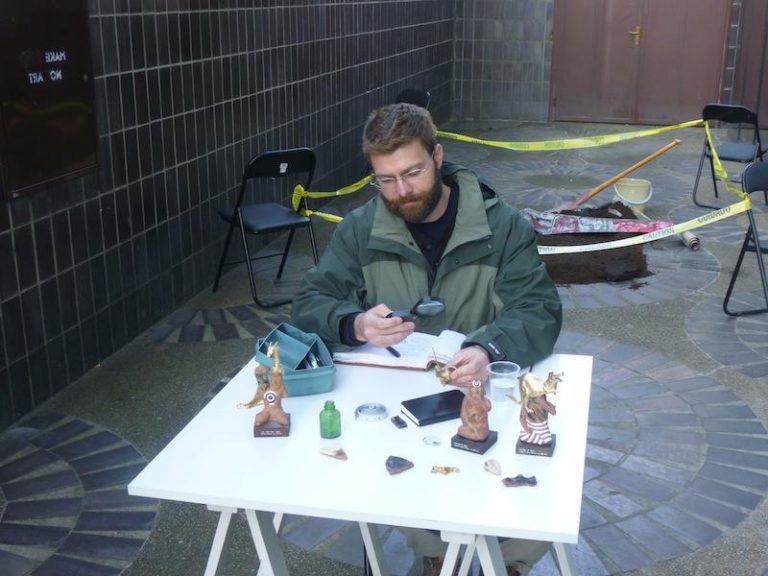
In the exhibition, The Lost City, American artist Joshua Goode will showcase the remnants of an underground city, a part of an imaginary ancient civilization. These ruins were found during an archeological research of multiple locations near the Miroslav Kraljević Gallery from March 11th to 14th. Posing as an archaeologist, Goode has publicly carried out an archaeological dig and discovered amazing lost treasures.
During the excavation, the passersby have witnessed the discovery of objects of the lost city and contemplated the boundaries between reality and fiction.
Joshua Goode will exhibit these found objects within the gallery space, temporarily transforming G-MK into a small archeological museum where reality and fiction become one.
Joshua Goode was born in 1981 in Fort Worth, Texas. He received his BFA from SMU in Dallas, Texas and his MFA from Boston University in Boston, Massachusetts. He has had solo exhibitions in international venues such as the Zendai Museum of Modern Art, Shanghai, China; Darb 1718 in Cairo, Egypt; LaSala Gallery in Zaragoza, Spain, and Shanghai University in Shanghai, China; in addition to group exhibitions at the Museum of the National Library in Madrid. Spain; National Library of Argentina, Buenos Aires, Argentina; Zentral Bibliothek, Zurich, Switzerland; University of Ulster, Belfast, Ireland; Westminster Library, Westminster, United Kingdom; MX Espai, Barcelona, Spain; and at Loyola University, Rome, Italy. Joshua has been a Visiting Artist or Guest Critic at Shanghai University, University of Massachusetts-Boston, Dartmouth College, Marist College, Rhode Island School of Design and Savannah College of Art and Design and was a researcher on an archaeological dig for the University of Tubingen at Vogelherd Cave in Germany. He was awarded the Dozier Travel Grant from the Dallas Museum of Art and is currently the Chair of the Fine Arts Department at Tarrant County College in Fort Worth, Texas.

10/01/2014.
Exhibition will open on 10th of January 2014 at 8 pm.rn rnThrough his films and installations, Duncan Campbell investigates how meaning and history are constructed and mediated. The artist’s work examines historical events and their interpretation, and tests the boundaries between the factual and fictive. The captivating power of Campbell’s films is derived from their specific collage structures and fragmentary narratives, unusual sound editing, montage of black and white and color footage, dazzling animated excerpts and quotes from the history of experimental film. The films re-contextualize the authentic archival film material by combining it with the newly shot scenes—re-enacted episodes filmed in 16mm by Campbell himself—and challenge the viewer to navigate through their open-ended fables.rnrnIn Zagreb, the artist will present his acclaimed film Bernadette (2008, 37’). While giving a portrayal of Bernadette Devlin, the controversial Irish republican member of parliament and civil rights activist from the late 1960s, the film also captures wider political, social and cultural struggles, civil unrest and political leaders during Northern Ireland’s The Troubles era. However, rather than giving a simplified overview of the struggle between Republicans/the IRA and the British government and loyalists, or the common heroic presentation of Bernadette Devlin’s fiery character, Campbell focuses on how her charismatic persona was constructed through television news footage. Bernadette questions the notion of truth and objectivity usually claimed by the documentary form, by subverting its usual norms and structure. The artist appropriates and re-edits the television archival material while adding the self-shot fragments. The original audio is accompanied by narration of contemplative kind - a script that combines parts from Devlin’s autobiography and the artist’s own writings, in which the first and third person interchange. rn®eljka Himbelern rnDuncan Campbell was born in Dublin, Ireland, in 1972. He earned his BA at the University of Ulster, Belfast, and his MFA at Glasgow School of Art in Glasgow, Scotland. His work was presented internationally in solo exhibitions at Carnegie Museum of Art, Pittsburgh, 2012; Hotel, London, 2011; Artists Space, New York, 2010; Tramway, Glasgow, 2010; Kunstverein Munich, 2009; and BALTIC Centre for Contemporary Art, Gateshead, 2008. Campbell’s work had been included in a number of group exhibitions, among them: Manifesta 9, Genk, Belgium, 2012; British Art Show 7, Nottingham Contemporary, Nottingham and Hayward Gallery, London 2011; Asking Not Telling, Institute of Contemporary Art, Philadelphia, 2009/2010; Fight The Power, Museo Nacional Centro de Arte Reina Sofia, Madrid, 2009; You Have Not Been Honest, Museo D’Arte Donnaregina, Naples, 2007; Art Now, Tate Britain, London, 2006. The artist currently lives and works in Glasgow.rn rnExhibition is supported by: the City of Zagreb and Ministry of Culture of Republic of CroatiarnExhibition is open until 1st of February 2014.rn rnDuration of the film; 37 minutesrnrn rn

14/11/2013.
Monday, Nov 18, 2013rn19:00 exhibition openingrn19:30 discussion as part of the program Micropolitics rnparticipants: Rena Rädle and Vladan Jeremić, artists, Iva Marčetić, architect and member of the Young Anti-Fascists of Zagreb, Nikola Vukobratović, member of the editorial board of the Croatian edition of Le Monde Diplomatique and [BLOK]rn rn“A girl asks a monkey at the ZOO: Why do you live here? Isn’t it nicer where you come from?” This text opens Dušan Makavejev’s “Montenegro,” a film in which he shows the encounter of a wealthy American housewife, brought to Sweden by her businessman husband, with Yugoslav immigrants, who come to Sweden to look for work. The separation of the worlds, which leads the protagonist Montenegro (who gets a job at the ZOO) to his tragic end, is primarily class-based, but is also the product of a specific production of otherness, and his suicide is the final consequence of the clash between the imagined idea of the constructed “other” (the wild Balcan, attractive and intimidating at the same time) and his actual appearance – the man whose position is clearly determined by concrete economic and political processes, whose origins reveal nothing exotic, and whose workers’ nomadism contains nothing romantic.rnThe exhibition Between Worlds II approaches the issue of migration in the contemporary economic and political moment from the position of the criticism of the production and use of images. In the video Postcards and the photo series Impressions: Landscapes/Paradise of Slovenia, the artist Nika Autor uses archival footage from Radio-Television Slovenia (RTV) in order to show “that the image by itself, determined by the mode of production (montage), implies the criminalization and victimization of asylum seekers, fugitives and migrants. (…) The mode of production establishes the optics of RTV’s gaze which reduces segregates, discriminates, excludes and constructs ‘the other’.”1 In the installation The Housing, the artists Rena Rädle and Vladan Jeremić present two specific cases of Roma deprivation, the Belgrade one and the Roman one, in order to put the so-called “Roma issue” in its right place, into class relations in the production of space. Through three videos they expose the image of Roma-nomads as a construct which conceals the fascistoid politics of cleansing the city of Roma, but they also relate such politics to the general tendency of “the market-oriented state to deny the lower class the right to the city,”2 offering different approaches to addressing the problem of migrant workers’ housing.rnBetween Worlds II aims to draw attention to the issue of alleged mobility in the art field. Makavejev himself is in the position of the immigrant when he films “Montenegro” in Sweden, and the survey “How to suture a finger with a credit card and other stories” we include in the exhibition focuses on contemporary migrations of artists and cultural workers. Beyond the romanticized image of travelling artists and the supposed democratization of the art field, it represents a counter-image of the creative class as a reserve army of artists who, under the guise of the promise of the so-called global art,
