


29/09/2015.
The exhibition takes on the concept of shame through the works of Nicole Hewitt, Louie+Jesse, Ivana Pipal, Oliver Ressler and Chloé Turpin. The title of the exhibition is taken from a drawing by Ivana Pipal depicting a multitude of eyes, alluding to the constant exposure to the gaze of others as well as to the avoidance to look back. The Hungarian mythologist Károly Kerényi associates shame with observation since it presupposes both passivity and activity, being looked at and looking. The exhibition considers the way shame is condition by the gaze, focusing in particular on the public aspect of shame which is a consequence of dominant social patterns.rn rnThe body on display is the topic of whimsical drawings taken from Ivana Pipal\'s third book: Instructions for use (human body). Drawing from everyday social and personal situations, Pipal uses drawing and text to build a proposal for a system of habitation in the human body. The presented segments of her work are related to the concept of shame; for example, the drawing of a figure that is being observed through long pipes by neighbors\' curious eyes. In a way, it is the body that is ashamed, that is, it is the cause of our shame. To quote Giorgio Agamben: "Nudity is shameful when it is the obviousness of our Being, of its final intimacy. And the nudity of our body is not the nudity of a material thing that is antithetical to the spirit but the nudity of our entire Being, in all its plentitude and solidity, in its most brutal expression, of which one cannot not be aware." In that sense the body is seen as a metaphor, as the spirit\'s means of transport.rn rnChloé Turpin also reflects on shame through the corporal, with an emphasis on gender. Her piece Mora alludes to a specific gender politics and fascination with the rejected. The artist associates the term mora from the Slavic tradition with "monstrous femininity" which she encounters in the drama Adventurer at the Door (1925) by Milan Begović. Turpin interprets Freud\'s psychoanalytic theories and stages of hysteria through the character of the "Girl" whose mirror image "Agnes" is based on the widespread femme fatale stereotype. The dancer and performer Nikolina Komljenović embodies the "Girl" in the performance in three acts. At the beginning the performer embodies the conceptual archetype of the mora through improvisation, only to deconstruct the first act. At the end she assumes a physically demanding pose which stresses the impossibility of escaping from the camera which is located in the other room. Exposed to the gaze of the unknown other, she wears the mask of shame. rn rnWhile in Turpin\'s work there is an emphasis on corporeality and performance, Oliver Ressler\'s film The Visible and the Invisible focuses on power structures that escape the naked eye. The title was taken from the French philosopher Maurice Merleau-Ponty, and the film juxtaposes the exploitation in the form of heavy industrial pollution and inhuman working conditions in the global South and the gigantic

23/08/2015.
The photographs show a disposal site of phosphogypsum, an industrial by-product of the production of mineral fertilizers. From 1983 until today over six million tons of this material have been dumped at this site.rnThese photographs represent a segment of photographic work, which uses the example of various types of landscape (abstract, natural, urban) of the City of Kutina to examine how social relations are conditioned by various kinds of industrial production. The goal is to create photographs which document the times and bear witness to relevant social themes, and which, at the same time, attract viewers with their wondrous beauty.rnExhibition opening is on 4th of Sept at 8 pm.rnExhibition is open till 25th of Sept.rnrnThe exhibition is a result of coproduction between Miroslav Kraljević Gallery from Zagreb and Center Sodobnih Umetnosti Celje from Celje. It is shown as a part of 7th International Photography Festival Organ VIda, held in Zagreb from 3rd till the 18th of September in Zagreb.rnrnSupported by: Ministary of culture and City of Zagreb.rnGallery Miroslav Kraljević is supported by Zaklada Kultura Nova.

15/07/2015.
Tyler CoburnI'm that angelIn collaboration with Altus IT Data CenterLimited seating. To reserve a spot, e-mail: info@g-mk.hr (until 14th of July)Tyler Coburn’s publication, I’m that angel, explores the conditions of how we work on and against the computer, narrated from the perspective of a “content farmer”: an online journalist contracted to generate articles based on words peaking in Google Trends. Periodically, Coburn holds readings at data centers worldwide, including Google New York, Google Zurich and the infamous “Wikileaks Bunker” of Bahnhof Stockholm. These events give audiences access to the sites where “the cloud” is kept.
Rather than concede to the seeming intractability of cognitive capitalism, these readings seek to potentiate new critical operations through shared access, listening and discussion. Across its parts, I’m that angel argues for a renewed consideration of the immanent horizons of subjectivity, sociability and creativity.Tyler Coburn is an artist and writer based in New York. Coburn's writing has appeared in frieze, e-flux journal, Dis, Mousse, Art-Agenda and Rhizome, among others. His performances, sound works and installations have been presented at the Whitney Museum of American Art, New York; South London Gallery; Kunstverein Munich; CCA Glasgow; Objectif Exhibitions, Antwerp; LAXART, Los Angeles; and SculptureCenter, New York.Altus IT Data Centre provides services such as IT and communications equipment leasing, comprehensive maintenance, data backup on a medium or on a backup server, system monitoring and Internet and/or VPN connection, equipment collocation, basic maintenance, backup, remote access on the monitoring system, leasing a patch position, connections to the Internet or a communications channel.

02/06/2015.
The video In Diverse Estimations Little Moscow deals with the participatory democracy experiment that was carried out in the town of Fatsa in Turkey during 8.5 months and was forcefully brought to an end with a military intervention in July 1980. Afterwards, the mere mention of the event was forbidden and the memory of participatory democracy was almost forgotten. Her work A Small Mix-up shows how easy it is to manipulate the memory and relationship with the past through their modification. On the other hand, the work The Destruction of the Russian Monument at Ayestefanos speaks about the ingrained narrative lacking proof – it is widely believed that on the occasion of monuments demolition, the first Turkish film was made; however, the recording has never been found. The act of demolition is documented only in the two preserved photographs (before and after the demolition), and Çavuşoğlu construes that process in her work, filling the archival gaps of her own accord. The work 191/205, similarly to In Diverse Estimations Little Moscow, speaks about an attempt at forced amnesia – the General Directorate of Turkish Radio and Television Corporation's decision to ban certain words under the excuse that they do not comply with the nature of the Turkish language, and that they are substandard. Among 205 forbidden words, we find: memory, remembrance, nature, movement, revolution, dream, theory, possibility, history, freedom, whole, life etc.
More about the artist: http://aslicavusoglu.info/
The exhibition is opened till the 4th of July 2015.
The exhibition is supported by: Ministry of Culture of the Republic of Croatia, City of Zagreb – City Office for Education, culture and sport.Gallery Miroslav Kraljević is supported by Zaklada Kultura nova.
23/04/2015.
Please join us to see the starting collaboration between the students of the Cass in London and the Academy of Fine Arts in Zagreb.rnWe are inviting you to celebrate the opening ideas for what will be an ongoing engagement.rn rnYours sincerely,rnLea Anić, Laura Barić, Tin Dožić, Vanda Kreutz Oslaković, Toni Mijač, Nera Miočić, Valerija Cerovec, Haydn Ronnie Albrow, Trude Elisabeth Bekk, Santa Sabule, Paulina Glimas, Katarina Sobolciakova, James Johnston and Mar Gonzalez Del Corralrn rnProject coordinators: Nicole Hewitt, Ana Hušman and Ben Cainrn rnSupported by: Grad Zagreb, Ministarstvo kulture Republike Hrvatske, Odsjek za animirani film i nove medije - Akademija likovnih umjetnosti u Zagrebu i London Metropolitan University.rn rn rnGallery Miroslav Kraljević is supported by Zaklada Kultura Nova.
18/11/2014.
The workshop will begin by looking at the work of philosophers such as Louis Althusser and Michel Foucault, departing from their groundbreaking thinking to follow more current work on idenficitcation from Judith Butler and Sara Ahmed. Ahmed’s idea about direction as queer phenomenology will provide a basis for examining shame, how the body’s sense perception changes according to context and expectation.
Olivia Dunbar (b. 1988, Vancouver) graduated with an MFA from the Piet Zwart Institute and is currently based in Amsterdam where she is a resident at the Rijksakademie van beeldende kunsten. Her interest in language and identity provides the basis for works that move through different media, appearing as texts, sculptures, videos, performances and installations in order to produce dispositions and affective realities. Recent presentations include picture that yr on a cliff (but it’s in a dream) at Buenos Tiempos International, and RijksOpen 2014 at the Rijksakademie.
Shame on you! is supported by: Kultura Nova, Ministry of culture and City of Zagreb
18/11/2014.
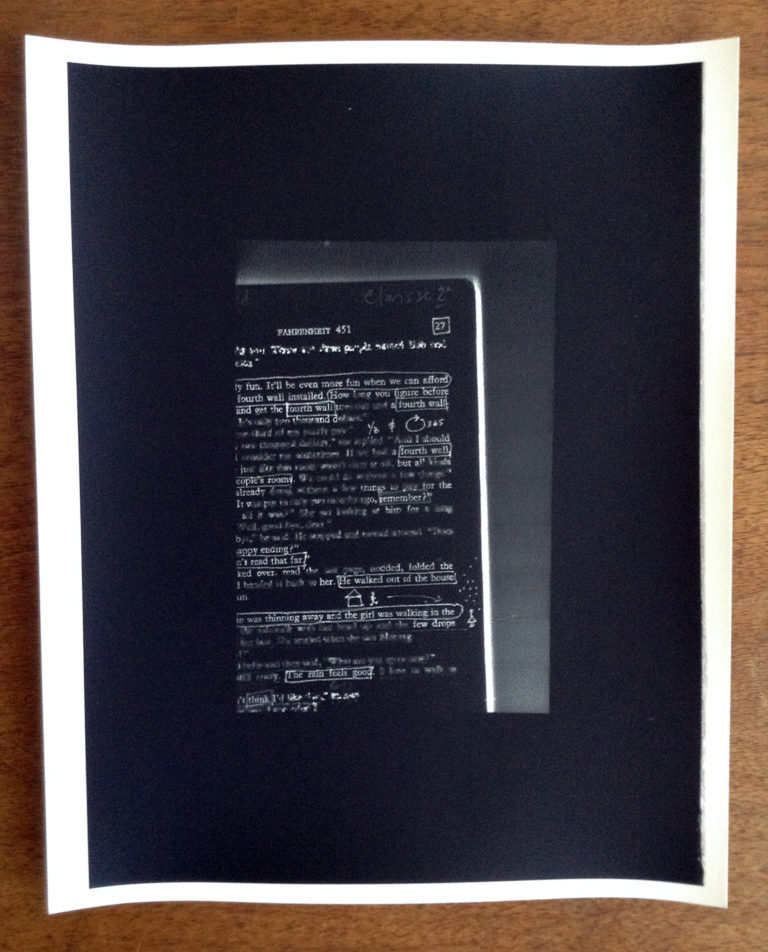
rnEKTBF451/EKTFF451: Notes and Confessionsrn rna solo exhibition by Ève K. Tremblayrn rncurated by Zeljka Himbelern rnExhibition will open on 5th of December 2014 at 8 pm.rn rn rnEve K. Tremblay’s multimedia project Becoming Fahrenheit 451 started in 2007. Similar to many of her other works, it was triggered by an accidental event from the artist’s former nomadic life and sharp observations of her close surroundings; in this particular case, the encounter with a video-rental store in Berlin, in the neighborhood Tremblay was living at the time. The store’s name, Filmgalerie 451, was indeed symbolic; it referred to the name of a famous Sci-Fi novel by Ray Bradbury (in the 1960s loosely adapted into film by François Truffaut) that describes not that distant future in which books and reading are treated as a threat to society’s peacefulness; as a disturbance that supposedly leads to uneasiness, doubt, criticality and consequently misfortune. Therefore, the books needed to be destroyed by specialized squads of firemen; only small groups of dissidents, the so- called “Book People,” had the mission to preserve the books from obsolescence in immaterial form- in their minds, through the specially developed photographic memorization method- in spite of being prosecuted.rn rnThe event of running across this store in Berlin generated remembrance of Bradbury’s book that Tremblay indeed read a long time ago. This became a starting point for several years of the artist’s immersion into contemplative, playful as much as persistent quest of memorizing Fahrenheit 451, in a metaphorical attempt of “becoming a book.” It engaged the artist’s interests in literature, theater, philosophy and visual arts as much as scientific texts, neuroscience, history of mnemonic systems and mechanisms of remembering and forgetting. Here, poetical approach and philosophical contemplation come into play with constant material experimentations; the still evolving project comprises of numerous media such as performance, video, drawing, collage, sculpture, installation, text, ceramics as well as Tremblay’s most common medium of photography.rn rnFor MK Gallery, Tremblay envisioned an all-encompassing presentation of her Becoming Fahrenheit 451, titled EKTBF451/EKTFF45 : Notes and Confessions. The exhibition starts with a letter, written and rewritten many times, to the writer Ray Bradbury himself. The letter is an invite for Bradbury to her exhibition, but also reveals, in almost diaristic form, the artist’s thoughts on the whole process of developing this project (as much as her reflections on art making in general) which she defines as “making and comprehending with grey matter” – both by her and by the public. The notes to Bradbury, as much as to herself, are also scattered throughout the exhibition in the form of post-it notes, creating peculiar and engaging juxtapositions of these short texts and imagery that surrounds them. These constellations feature Tremblay’s black and white and colored photographs and videos that had captured numerous days and months of memorizing the book (quite contrary to the fictional fast memorizing method of the “Book People” in Fahrenheit 451) and observing what was simultaneously happening in the artist’s mind, in private interiors of Tremblay’s ever changing apartment(s), but also in various

20/10/2014.
Residential lab by G-MK and Radiona titled ‘Alternating current’ will take place in lab’s usual working hours, Tuesdays, 20h and Saturdays, 18h onwards within the following groups: Robotics and hacking, advanced audio section, Processing (interaction design), BIOsection, 3D printing, wearable technology and eTextiles, Balkan rocketry and flying objects, microcontrollers and hands-on electronics, DIY print and design, FPGA, advanced programming, DIY prosthetic, and a variety of educational programs specifically designed for beginners, kids, youth and seniors.
The curatorial teams of G-MK and Radiona will also work on special programs which are connecting fields of contemporary art, intermedia and innovative technological practices.
Radiona.org is currently conducting a research phase of the project Amplitude of Image and Sound supported by Kultura nova Foundation, and will soon go in public with their first DIY kit – open source synthesizer / theremin powered by the ATmega microcontroller which is jointly designed by artists, designers and technologists, and as a part of the research the lab will organize a workshop for the wider audience. In addition, Radiona.org is also in the middle of the lab’s yearly educational program with domestic and international master class workshops, and is taking preparations for the exhibition Sound Hybrids – Creative Sonology.
After 4 years of work in the Student Center in Zagreb the lab continues its activities in collaboration with new partners, thus giving a new dimension to intersectoral collaboration between public and non-governmental institutions. In fact, a part of the program will also be made in cooperation with the Technical Museum and the Zagreb Centre for Independent Culture and Youth – Pogon, while the practical assistance is also provided by Domino, and Radiona.org would like to thank to all these institutions and individuals who have supported the organization, and to Culture of Change – the host of the lab from June 2011 to October 2014.
