


16/12/2019.
"While the story’s protagonist is in his hometown, he receives news of the death of his uncle E. A., who lives in a small town in a country on a different but nearby continent. Soon after, E. A.’s house is bought by a man named M. P. Contrary to the opinion of A. M., best friend of the late E.A. and the architect responsible for the original house plan, M. P. immediately removes all furniture and objects and initiates a series of changes to the house and its surroundings. Sudden and radical changes take place under unusual circumstances – at night, behind closed windows and doors. In addition, M. P. also cuts down all the trees on the estate. Surprised by the events, the protagonist decides to travel to the town where the deceased lived and investigate what’s going on. Shortly after, the protagonist discovers that almost all residents of the city have been avoiding the area where the house is located. One of the locals even tells him that one evening, when he only briefly glanced towards the house and garden, he “saw something”. We live on a quiet island of ignorance, in the midst of black seas of infinity, and we’re not meant to travel very far. Up to this point, science and culture, each heading its own direction, have both helped and harmed us. But one day, when that hidden, dissociated knowledge of society is revealed as well, more holistic views on our reality will open. Suddenly, as if it were turned off, the rain stops, and the protagonist decides to leave. But that very moment he hears the occupant of the house moving between him and the exit door. He begins to mirror all the strange objects, the space, the undefined amount of time he spent in the house and the arrival of the mysterious occupant through almost existential questions. What is the occupant of this house like? What is he looking for here on this planet that is just as scary to him as it is to us? From what secret areas of time, from which ancient and now undetectable twilight did he come to this small suburb on this very night? The protagonist realizes that if he wants to leave the room, he will have to meet the occupant. But this time his curiosity overcomes fear and unlike before, his eyes remain open." Opening is on 20th of December and exhibition is opened until 18th of January 2020. Technical support: Jan Kostanjevec, Sani Veljanovski, Aljaž Litrop, Denis Sadiković, Matej Pavšič, Dominik Mahnič Thanks to: Sanja Kuveljić Bandić, Goran Petrov, Tina Škoberne, Voranc Kumar, Neja Zorzut, Jonas Miklavčič, Tjaša PP, Zavod 404, Makplast, Wooding Special thanks to the Modern Gallery in Ljubljana for borrowing the installation. About the artist: www.andrejskufca.com

25/11/2019.
The installation deals with the route from the bus terminal behind the Importanne Center, through the underpass towards Tomislavac, Strossmayer's Square and Zrinjevac, all the way to Ban Jelačić Square; a route whose considerable segment is the most populated by the Advent program. However, the observed route as a whole is actually a city plexus important for the continued pursuit of vital urban activities. It is also a series of functional city gaps, essential for maintaining public communication flow crucial to Zagreb.Since during the Advent the route is laden with generic and mostly consumer content, designed as a temporary substitute for the shortcomings of the actual cultural and social offer of the city, the characteristic qualities of the plexus are shifted to the gallery space where the concept of urban emptiness is affirmed with a scenographic setting.Therefore, the gallery offers a break from Advent, a break from a vacation, an insight into Zagreb that "Christmas tourists" do not have a chance to see: the characteristic panorama of Zagreb within the tourist itinerary devoided of tourist content.
The duration of the Zorka Advent program in the gallery coincides with the duration of the Advent manifestation in Zagreb. The program ends in the gallery on December 28, 2019. while the Advent manifestation in Zagreb lasts until 07.01.2019. Working hours of the gallery during the exhibition are: Tue-Sun 16-20h--------------Contributing authorsCurators: Ana Kovačić and Lea VeneArchitecture: Dafne Berc and Dino BelamarićCamera, video, and editing: Karla Jurić and Ive TrojanovićSound and Music: Konrad MulvajGraphic Design and Illustration: Ena JurovSetting: Jasna ČagaljCommunication and promotion: Karla AndrićVisualizations: Ana KunstMobilizer: Mr. and Mrs. Asparagus
This program is financially supported by the City of Zagreb and the Ministry of Culture of the Republic of Croatia.
GMK's work is supported by the Foundation for Arts Initiatives, the Kultura Nova Foundation, and INA d.d
25/10/2019.
Wa are proud to anounce The Hub of tricks, cheats and love in disquise artists Vienne Chan, Obsessive Possessive Aggression, International Dance Terrorist Organization alongside the curator of the project Marko Gutić Mižimakov are selected for the 2020 PACT Zollverein residency program! Congradulations!

02/09/2019.
The exhibition deals with these topics through reclaiming visual and textual figures of Otherness. Specifically, these positions are thematized through the figures of the witch, the alien, the monster, and the cyborg. Monsters, along with freaks, villains, and perverts, describe just some of the violent insults society levels at LGBTIQ* people, and such associations are also alluded to via queer-coded visual and narrative tropes in film, television, and comics. The alien has been used in both queer theory and creative media, especially by LGBTIQ* people of color, as an allegory for feeling alienated and separated from a heteronormative and white supremacist society. The experience of being the Other, of being outside of or different from heterosexual norms of gender and sexuality, is an experience that unites otherwise disparate experiences within LGBTIQ* communities. For women, especially disabled women and women of colour, this marginalization is further complicated by their position of “Otherness”, in which their experience and contribution are excluded from participation or not considered worth recording. Reclaiming and reconfiguring the tired tropes by which society identifies these groups gives space for both self-identification and resistance to societal norms, while symbolic tropes offer rich ground for reclaimed self-understanding. It is through this that the exhibition finds new ways of resistance against hostile society. The witch, the monster, the alien, and the cyborg each walk a line between fiction and contextual reality, popular caricature and fear, oppression and powerful strength. They have the ability to shapeshift by choice, to terrify their tormentors, to find power in otherness and to administer justice in an unjust world. Since LGBTIQ* women have been relegated to these roles, why not root into their intrinsic cultural power, and create new narratives in this radical subjective Otherness?These topics are thematized by the artists: BYTE Zine, Lo-fi Cherry, Lotic + Matt Lambert, Sadie Lune, RurruMipanochia, Kiona Hagen Niehaus, Luiza Prado and Moran Sanderovich. In this way, the exhibition explores the ways of reclaiming the Other as a tool of resistance.This is the second iteration of EXTRA+TERRESTRIAL as it tours to the Galerija Miroslav Kraljević from the Schwules* Museum in Berlin, from where it premiered from November 2018 to February 2019.COVEN BERLIN acts in Berlin as sex-positive transdisciplinary “genderbender” collective, dealing with topics of feminism, love, gender, sexuality and art. It was established in 2013 in Berlin by Lo Pecado and Judy Mièl with a focus on feminist debate and critical thinking through provocative aesthetics, art, essay writing, and events. Today it consists of Harley Aussoleil, Frances Breden, Crab Content, Lorena Juan, Judy Landkammer, Kiona Hagen Niehaus, and Louise Trueheart. Their recent exhibitions include “PROBAND WERDEN” in the Profamiliacentre in Berlin,” Neodaddyism 100” in the Galerie AVU in Prague, “BEDTIME” in the GalerieMiejska Arsenal in Poznan , “LUCKY” in NeueGesellschaftfürbildendeKunst and first display of "EXTRA+TERRESTRIAL" in Schwules Museum in Berlin. Curators: Coven Berlin, Ana Kovačić i Iva PaskaThe exhibition and publication were funded by the Ministry of Culture of Republic of Croatia and the City of Zagreb. The Miroslav Kraljević

01/07/2019.
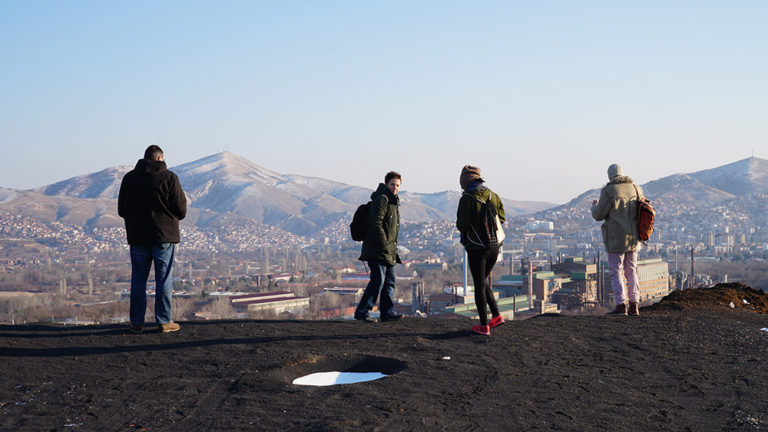
Miguel Soto has worked together with a student from the Art Academy of Zagreb Natan Sudec, to convert found rock cores into a design for a space heater. Living in Santiago de Chile, Soto first encountered these cores when his grandmother came back to Croatia after migrating to Chile during the Frist World War. On arriving, she realised she owned a property on the peninsula of Pelješac and drilled the cores to see if the property could be exploited for minerals. By shaping these cores into old designs of radiators, Soto creates a material narrative between the stone and the common objects they create which become part of the local visual vernacular.Ana Alenso has worked consistently with the theme of oil extraction and its link to “resource curse.” The curse is the common trend that minerally rich countries often fall victim to intense political corruption, mafias, and even warlords who vie for control of productive areas. Originally from Venezuela where a national crisis continues at the expense of the population, Alenso has investigated a scandal linked with a succession of events around 2014 in which fracking was intended for the Adriatic. Tracing the line of events from oil and gas companies such as INA and MOL, to specific politicians, and the activists who stopped the structures, the installation references the precarity and constant work that goes into preservation of the common good. Using recycled and found materials from Zagreb waste plants, the sculptural installation references the craze for extraction that often irreversibly damages resources of much greater value. In the black box room of GMK four films will be projected in loop that diversify the topic of society’s connection to material phenomena. From fire and invisible toxins to lithium and gold, the films follow material in relation to the body, the psyche, and human environments. Callum Hill, Crowtrap, 2018, 15’, intertwines the stories of two men whose tendencies to pyromania connect them in their material relation to the world. Filmed across the UK and Germany, the film connects current geopolitical tensions with parallel lives. One character presides over a coal yard separated from the outside by fragments of the Berlin Wall. His life and relation to fire is contrasted by a heather-burner in North Yorkshire. Their common experience of historical event is narrated by the artist and unfolds through references to art history and labour. Alina Manukyan, The Precious Metal Stays Noble, 2016, 10’12” draws attention to gold’s central role in the exchange of objects within society. This metal which has historically been coveted due to religious and cultural processes becomes a stable element to hoard and save. The metal adorns the human body both outside and becoming one with it. The film shows the metal receiving devotion, being implanted, but also melted down from objects to its pure liquid value. Speculating as to whether gold’s economic value can be destabilised, the film questions its inherent chemical makeup and pre-human existence.Alejandra Prieto, Lithium, 2019 is filmed in the salt plains
29/05/2019.
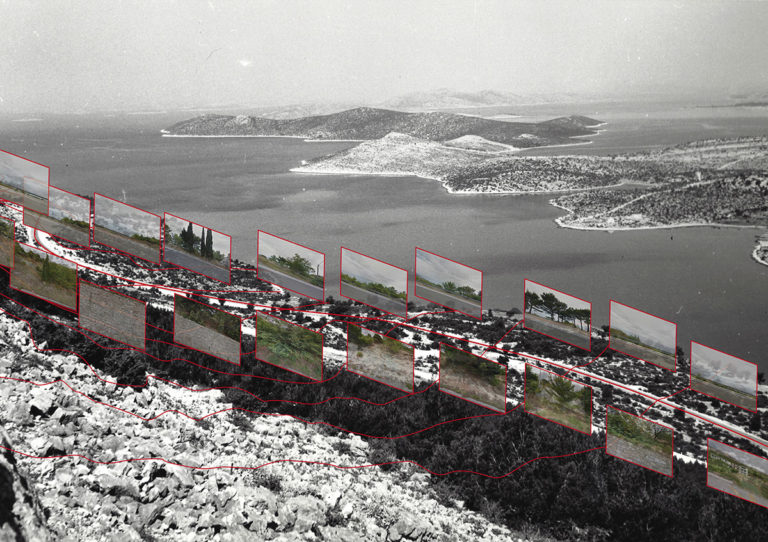
In the context of this project, Jadranska Magistrala has a double meaning. Most directly, it was only in 1965, the year when it has been opened, that the preconditions for the development of a continuously connected and wholly accessible coastal territory were met. This coastal territory had been fragmented due to unstable political, military or economical jurisdictions since the Roman times. On the other hand, Jadranska Magistrala was also a setting stone for the generations of rapid transformative processes. Magistrala has in less than half of a century of its existence irretrievably changed the image and the usage of historical urban nuclei situated previously mostly in intact nature. Surroundings of Magistrala subsequently changed into a continuous linear peri-urban line completely relegated to tourist exploitation.
By enabling present and intensive processes of privatization together with planned allocation of tourist, industrial and military complexes with the simultaneous growth of the individual, secondary construction, Magistrala is still the main artery of this area.
Unlike usual cartographic and statistics methods of spatial analysis, the starting point of this project is contemporary artistic researches. Several quantitative and artistic tools have been developed in this project for the understanding and representation of this extensive territory. From the beginning of this project in 2014 a research methodology has been gradually developed that has evolved into a hybrid analytical frame that connects the analysis of historical tabular itineraries with linear narrative norms. This frame is used to observe space as the series of arranged sequences of specific points or moments.
By layering of visual and textual sources, the project researches and develops the Linear mapping method as a proven alternative to the dominant paradigm of GIS: Geographical information system. Linear mapping method is based on the delineation of the linear territory along the route in clear segments. Those segments are then divided into specific spatial units according to their position along the route or the distance from it. This allows for the reduction of the space along the road into a fragmented spacial sequence defined via interchangeable framerates that becomes the main reference frame of the spatial data used in the project..
By optimizing the density of used data, elements of individual sections are recombined in new narratives and with new meanings. Spacial units formed in that way become a base of a robust classification and index system which enables the spatialization of different input data and facilitates the diagramatic representation of the totality of heterogeneous elements. Those elements offer a completely fresh way of representing this space.
Layers of specified subjects were joined to the index system and, as a whole, they constitute an extensive database from different sources as a spatial and time matrix which became the base for further research.
The main result of this process is a series of representations of clear, direct information sequences in which it is possible to recognize patterns, interruptions, and separations on the intuitive level. Through that, the base idea of space along the coast is built all over
27/05/2019.
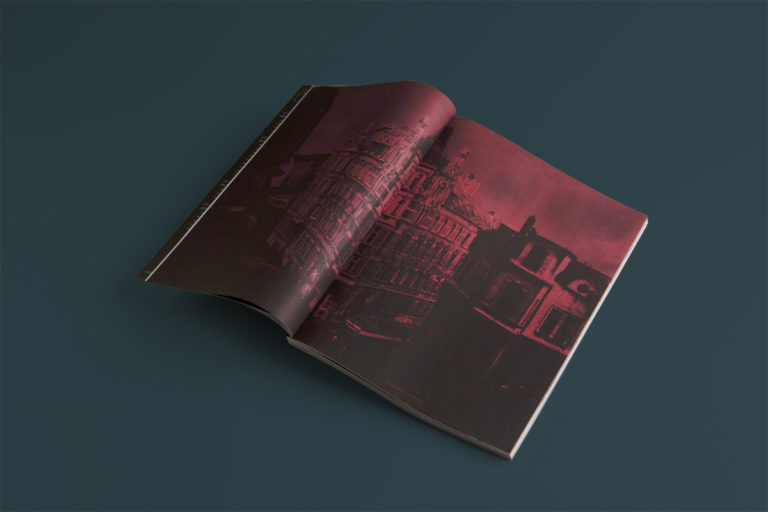
The editors of Flaneur Magazine are hosting a three-day workshop in collaboration with GMK. Employing psychogeographic and collaborative strategies, the workshop will provide a creative reading of the cityscape that reveals the hidden layers and mythologies of the place. GMK's space will be turned into a temporary editorial office where a one-off magazine will be made with the editors and 15 participants. The magazine will be made collaboratively and inter-disciplinarily.The participants will get an introduction to the cultural techniques of flaneuring and the narrative strategies of psychogeography. The magazine will be dedicated to exploring Martićeva street.
To join the workshop please write a brief description of yourself and why you want to participate (in English). You will receive further instructions once the selection of participants has been made. Deadline for submissions is 7th of June 2019.The workshop is primarily intended for photographers, illustrators, architects, urban designers, historians, writers, artists, performers and graphic designers as well as other interested audiences.About Flaneur Magazine:Flaneur is a nomadic, independent magazine focussing on one street per issue. The magazine embraces the street’s complexity, its layers and fragmented nature with a literary approach. The content of the magazine is produced with and for Flaneur by artists of all disciplines while the team spends two months on location. It is made using a collaborative, impulsive and unconventional approach. The magazine attempts to use a single microcosm to tell universal stories.More info: https://flaneur-magazine.comWhen: 14/6/2019-16/6/2019Where: GMK, Šubićeva 29, Zagreb, CroatiaThe workshop is free but participants are responsible for their own food.Please send applications to: grashina@flaneur-magazine.com & fabian@flaneur-magazine.com
Workshop is realized in collaboration with Design District Zagreb and Zagreb Tourist Board.
Project is supported by Goethe-Instutut Kroatien and the City of Zagreb. GMK is supported by Zaklada Kultura Nova and Foundation for Arts Initiatives.
30/04/2019.
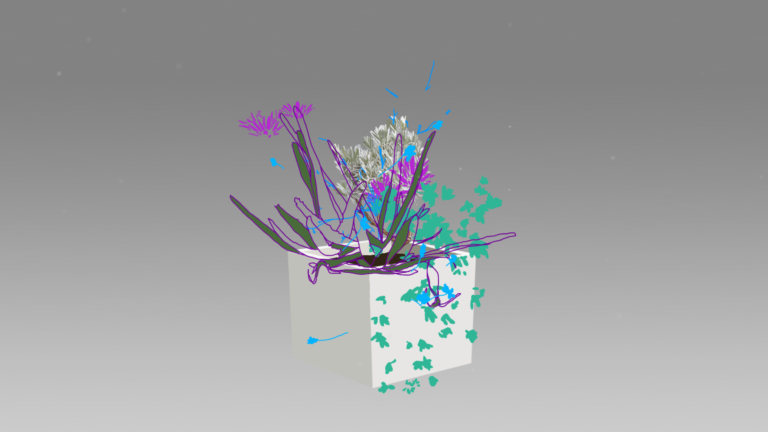
The elements we can manipulate with are in control of growth, appearance, and life of the plant. Light, color, transparency, sound, and combination of these four elements are a base to cultivate your digital plant. Each element can reach a value of a maximum of 100 points. The player is trying to find balance among all of the elements to achieve homeostasis: the optimal conditions needed to keep the plant alive. There are more than 8 billion different combinations of intertwined elements and at the same time, there are 8 billion possible visual representations of created plants. The videogame is envisioned as a set of possible digital translations of the herbal world and how the concept of flora can be redefined in a digital surrounding. A large number of plants digital visualization is directly inspired by nature, while others in their color, texture, and placing suggest work in progress, heterogeneous structure. Through leaves, stems, and roots, different digital plants are networked in the emerging hybrid organism. In the '90s, Tamagotchi, the digital pet, appeared. The main concept of Darko's game is close to this model. On a basic level, taking care of and upbringing healthy pet replicates models of real life. Lack of care results in death, but simply, by pushing the button and restarting the Tamagotchi machine, we can revive the pet. In a similar way, Bly-ka puts a player in the position of power in which player can freely construct their plant. However, due to unpredictable relationships among given elements player is enabled to have complete control over personal floral creation. Byl-ka project is also focused on building a digital archive of all created plants. Player has an option to memorize and save a finished plant or the process of plant's creation. In that way, this artwork includes another dimension by transforming into a plant catalog, the digital herbarium. Lea Vene Darko Masnec (1985., Celje) has graduated in the University of Maribor, Faculty of Education, Department of Fine Arts in 2009. and three years later he defended his master thesis on the Academy of Fine Arts in Zagreb, Department of Animated film and New media. In 2017. he defended his Ph.D. thesis „Zagreb's school of animated film – artistic and economic practices in the context of videogames". He works as a docent on the Academy of Fine Arts in Zagreb. He is the author of multiple awarded animated movie called „I know what I hear", he worked as an animator on a large number of short movies, published several articles and lectures on subjects of animation and videogames. Considering exhibition practices, he is mostly occupied with conceptual art. Projekt is supported by the City of Zagreb. GMK is supported by Zaklada Kultura Nova and Foundation for Arts Initiatives. General sponsor: INA d.d.
